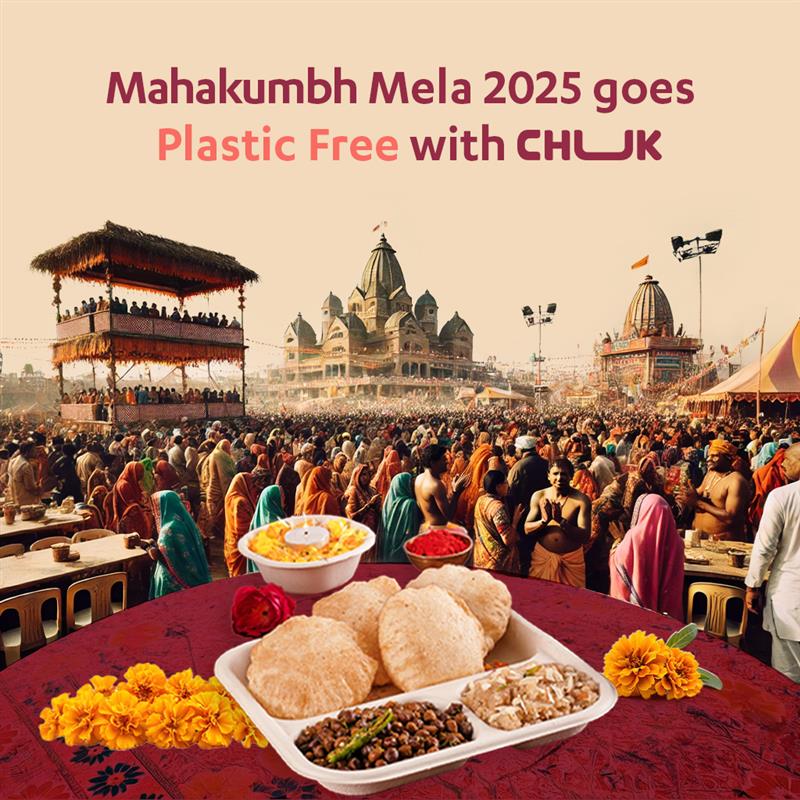
How Mahakumbh Mela 2025 went plastic-free: lessons for large events
Forty-five days. Over 450 million devotees. One of the holiest riverbanks on earth. And a complete ban on single-use plastic.
Mahakumbh Mela 2025 in Prayagraj pulled off something no gathering of this size has attempted before. The Uttar Pradesh government declared the entire Mela grounds a plastic-free zone. Every plastic plate, thermocol cup, and polythene bag was replaced with compostable or reusable alternatives.
A 45-day religious festival became the largest open-air test of whether India can actually feed hundreds of millions of people without single-use plastic.
Here is what they did, what the numbers looked like, and what any large event can take from it.
Key Takeaways
- Mahakumbh 2025 enforced a complete single-use plastic ban across the entire Mela grounds, serving 450 million devotees with compostable and reusable alternatives
- The Prayagraj Mela Authority deployed 15,000 sanitation workers, 20,000 waste segregation bins, and 160 waste collection vehicles to process an estimated 650 metric tonnes of garbage daily
- Traditional dona pattal (leaf plates), kulhads (clay cups), jute bags, and sugarcane bagasse tableware replaced plastic disposables across food stalls and langars
- Chuk, the compostable tableware brand by Pakka Limited, was selected as the official L1 sustainable tableware partner by the Kumbh Mela Authority
- The One Plate, One Bag campaign collected steel plates and cloth bags from across India to reduce dependence on single-use items at community langars
- Five Faecal Sludge Treatment Plants ensured zero untreated discharge into the Ganga, processing wastewater from over 1.5 lakh toilets daily
The scale of the problem: why plastic-free at Mahakumbh matters
To understand what the Mela Authority was up against, consider the numbers.
Mahakumbh Mela happens once every 12 years at the Triveni Sangam in Prayagraj, where the Ganga, Yamuna, and the mythical Saraswati converge. The 2025 edition ran from 13 January to 26 February, drawing an estimated 450 million visitors across 45 days. On a single day, Makar Sankranti (14 January), 35 million devotees took the holy dip.
Every one of those devotees needed to eat. Most needed tea, water, and snacks. Multiply that by 45 days of continuous operation, and the volume of single-use tableware becomes staggering.
At previous Kumbh Melas, plastic plates, thermocol cups, and polythene bags dominated. The result was visible. Non-degradable waste piled up along the riverbank. Plastic floated in the sacred rivers. Post-event cleanup stretched for weeks.
The UP government decided 2025 would be different. The single-use plastic ban was not advisory. It was enforced.
The waste management infrastructure: by the numbers
The Mela Authority and the National Clean Ganga Mission built what amounted to a temporary city’s waste management system from scratch. Here is what they deployed across the Mela grounds:
| Category | Infrastructure Deployed |
|---|---|
| Sanitation workers and Ganga Seva Doots | 15,000 |
| Eco-friendly toilets (FRP + prefabricated steel) | 28,000+ |
| Community urinals | 20,000 |
| Waste segregation dustbins | 20,000+ |
| Liner bags distributed | 37.75 lakh (3.77 million) |
| Waste collection vehicles | 160 |
| Compactor trucks | 40 |
| Daily waste processing capacity (Baswar plant) | 650 metric tonnes |
| Faecal Sludge Treatment Plants | 5 |
| Combined wastewater treatment capacity | 1,700 KLD |
| Total budget for waste and water management | Rs 1,600 crore |
These are not theoretical figures. This infrastructure served a floating population that, on peak bathing days, exceeded the population of entire countries.
Two additions worth noting: the garbage collection system was AI-monitored, and every toilet had a QR code for real time cleanliness feedback. ISRO and the Bhabha Atomic Research Centre were brought in for advanced waste monitoring. No Indian religious event has done that before.
How the plastic ban actually worked on the ground
Banning plastic at a 45-day event with 450 million visitors is one thing. Enforcing it is another. The Mela Authority attacked the problem from multiple sides.
Regulatory enforcement
- Single-use plastic items including bags, plates, cups, cutlery, and bottles were banned across the entire Mela precinct
- Dedicated stalls were set up selling sustainable alternatives: kulhads, dona pattal, jute bags, and cloth carry bags
- Vendors caught using plastic faced penalties and the UP government’s RACE (Reducing Plastic and Achieving Clean Environment) drive provided the enforcement framework
Traditional alternatives at scale
The ban pushed a return to what Indian festivals always used before plastic showed up three decades ago:
- Dona pattal (leaf plates and bowls stitched from sal, palash, or banyan leaves) for prasad and bhandara meals
- Kulhads (unglazed clay cups) for tea and beverages at every chai stall
- Jute and cloth bags distributed at six designated centres, roughly 70,000 cloth bags handed out to devotees
- Steel plates and glasses collected from across the country through the RSS-led “One Plate, One Bag” campaign, used for langar service
Compostable tableware for high-volume food service
Traditional dona pattal work well at smaller community kitchens. But when you are serving thousands of meals per hour across hundreds of food stalls, leaf plates hit their limits. You need tableware that handles hot, oily food without leaking, stacks for transport, and works at industrial volumes.
Compostable tableware made from sugarcane bagasse filled that gap.
Chuk, the compostable tableware brand of Pakka Limited (headquartered in Ayodhya), won the Kumbh Mela Authority tender as the L1 (most preferred) vendor. The initial contract was Rs 1.75 crore, expandable to Rs 2.5 crore depending on demand.
The bagasse tableware went exclusively to restaurants in government food programs across the Mela. Every batch cleared quality control: heat resistance with 100-degree oil and water, structural integrity checks, spill-free performance.
Chuk had done this before. The brand was the tableware partner at the Ayodhya Ram Mandir Pran Pratishtha in January 2024, supplying lakhs of compostable plates, bowls, and containers for prasad service.
Why compostable disposables worked where plastic failed
Ask any event organiser who has managed post-event cleanup: the problem with plastic at large gatherings is operational before it is environmental.
The disposal problem
Plastic waste at a riverside event cannot be composted, cannot be safely burned, and takes decades to degrade. At previous Kumbh Melas, post-event plastic cleanup was a weeks-long, crore-level operation. Compostable tableware made from bagasse breaks down within 90-180 days and can go directly into organic waste streams. That changes the entire post-event waste math.
The sacred food connection
This is where the cultural-spiritual dimension matters. Prasad, the food offered to deities and distributed to devotees, carries real spiritual weight. In Hindu tradition, what touches sacred food should be pure and natural. Leaf plates have served this function for centuries. Bagasse tableware follows the same principle: it is plant-based, free of chemical coatings, and goes back to the earth. Plastic does none of that. And devotees notice. Temple trusts across India are increasingly unwilling to serve prasad on something synthetic.
The heat and oil test
Indian festival food is not salad. It is hot dal, oily puri, steaming chai, gravy-heavy sabzi. Any alternative to plastic needs to survive that without buckling or leaking. Bagasse plates and bowls handle temperatures up to 100 degrees Celsius and resist oil. That is why they cleared the Mela Authority’s quality tests where other options fell short.
Five lessons every large event organiser can take from Mahakumbh
The Mahakumbh model is replicable. Here is the playbook.
1. Ban first, then build alternatives
The UP government did not ask vendors to voluntarily reduce plastic. They banned it. And they simultaneously made sure affordable alternatives were stocked at dedicated stalls across the Mela grounds.
If you are organising a large event, take note: a voluntary plastic reduction pledge will fail. A ban with easy access to compostable alternatives will work. Lock in your procurement contracts early.
2. Layer your alternatives
Mahakumbh did not rely on one substitute. They used different solutions for different situations:
- Reusable steel plates for community langars (high volume, repeat use)
- Traditional dona pattal and kulhads for smaller stalls and roadside vendors
- Compostable bagasse tableware for larger restaurant operations and government food programs
- Cloth and jute bags for carry-away items
Match your tableware to the food service format. A wedding caterer needs something different from a street food stall. One alternative does not fit all.
3. Invest in waste segregation infrastructure
Twenty thousand dustbins with liner bags, 160 collection vehicles, a processing plant that handles 650 metric tonnes daily. The Mela Authority budgeted Rs 1,600 crore for waste and water management alone. They treated it as core infrastructure.
Budget for waste management the way you budget for seating, electricity, or security. Compostable tableware only does its job if it actually reaches composting infrastructure.
4. Use technology for accountability
AI-monitored garbage collection. QR codes on toilets for cleanliness feedback. ISRO-assisted waste tracking. The Mela Authority brought data into what is usually a chaotic, untracked operation.
Track your waste generation and collection in real time. Even basic counts (bags per zone, bin overflow frequency) let you fix problems mid-event instead of writing a report about them afterwards.
5. Frame it as identity, not inconvenience
The plastic ban at Mahakumbh was positioned as a return to tradition and respect for the Ganga’s purity. Devotees did not experience it as a restriction. It felt like alignment with why they were there in the first place.
Nobody wants to hear that their event is “banning” something. Frame the switch positively. “We serve on compostable tableware because our food deserves better than plastic” works harder than “Please do not use plastic.”
What happens next: the ripple effect
Mahakumbh 2025 has created a reference point that other large events will find hard to ignore.
Look at the trajectory:
- January 2024: Ayodhya Ram Mandir Pran Pratishtha served lakhs of devotees on compostable tableware. Zero plastic.
- January-February 2025: Mahakumbh scaled the same model to 450 million visitors across 45 days.
- State level enforcement is expanding. UP has mandated compostable tableware at tent cities in Ayodhya and banned single-use plastic at the Vindhyachal Mela. Kashi Vishwanath Temple in Varanasi has announced a complete plastic ban. Other states are issuing similar directives at pilgrimage sites.
If you run a catering operation, manage events, or supply food service at scale, the direction is obvious. India’s largest religious and cultural events are switching to compostable disposables. The operators who build supplier relationships now will be better positioned when the next major event comes around.
In a Nutshell
Mahakumbh Mela 2025 showed that going plastic-free at massive scale is not aspirational. It is a logistics problem, and it got solved. 15,000 sanitation workers. 20,000 segregation bins. 160 waste vehicles. 450 million devotees over 45 days, served without single-use plastic. Traditional dona pattal and kulhads came back alongside modern compostable bagasse tableware from Chuk, the official L1 tableware partner. The model layered reusable, traditional, and compostable alternatives based on what each food service setup actually needed. If you are planning a wedding season menu, a food festival, or a religious gathering, the honest takeaway is simple: if Mahakumbh can do it at that scale, what is stopping you?
Frequently Asked Questions
Was Mahakumbh 2025 completely plastic-free?
The Uttar Pradesh government imposed a complete ban on single-use plastic items across the Mela grounds, including plates, cups, cutlery, bags, and bottles. Enforcement included penalties for vendors found using plastic. The ban was supported by dedicated stalls selling compostable alternatives and the distribution of approximately 70,000 cloth bags to devotees. While complete elimination at a gathering of 450 million is difficult to verify down to the last item, the ban was actively enforced and the Mela Authority treated violations seriously.
What alternatives replaced plastic at Mahakumbh?
Different alternatives for different use cases. Dona pattal (leaf plates and bowls) and kulhads (clay cups) went to traditional food stalls and tea vendors. Compostable bagasse tableware supplied the larger restaurant operations and government food programs. Steel plates and glasses, collected nationally through the One Plate, One Bag campaign, went to community langars. Jute and cloth bags replaced plastic carry bags at distribution centres.
What is sugarcane bagasse tableware, and why was it used?
Bagasse is the fibrous residue left after extracting juice from sugarcane. Tableware made from bagasse is 100% plant-based, free of chemical coatings, and composts fully within 90 to 180 days. It was used at Mahakumbh because it handles hot, oily Indian food without leaking, stacks efficiently for high-volume service, and meets the quality standards the Mela Authority required. Chuk, the compostable tableware brand by Pakka Limited, was selected as the L1 vendor through the official tendering process.
How much waste did Mahakumbh 2025 generate?
The Mela Authority built waste processing capacity for 650 metric tonnes of garbage per day at the Baswar plant. Over the full 45-day duration, with 450 million visitors, total waste generation ran into tens of thousands of tonnes. The waste management system included 20,000 segregation bins, 160 collection vehicles, 40 compactors, and 37.75 lakh liner bags. Because compostable items replaced plastic, more of that waste could go into organic composting streams instead of landfill.
Can the Mahakumbh plastic-free model work for smaller events?
Yes. A wedding caterer serving 500 guests, a food festival running for a weekend, or a community bhandara feeding thousands can all use the same approach. Ban single-use plastic, provide compostable tableware matched to the menu, set up waste segregation, and frame the switch as a quality choice rather than a restriction. The infrastructure scales down, but the playbook stays the same.
Where can event organisers source compostable tableware for large events?
Chuk makes the full range of compostable tableware from sugarcane bagasse: plates, bowls, containers with lids, and spoons. The range is built for high volume food service at events, temples, restaurants, and catering operations. Chuk was the tableware partner at both the Ayodhya Ram Mandir Pran Pratishtha and Mahakumbh Mela 2025, so the supply chain and scale have been tested at India’s largest gatherings.
Planning a large event, food festival, or community gathering? Explore the full range of compostable tableware at chuk.in — built for the scale, heat, and demands of Indian food service.