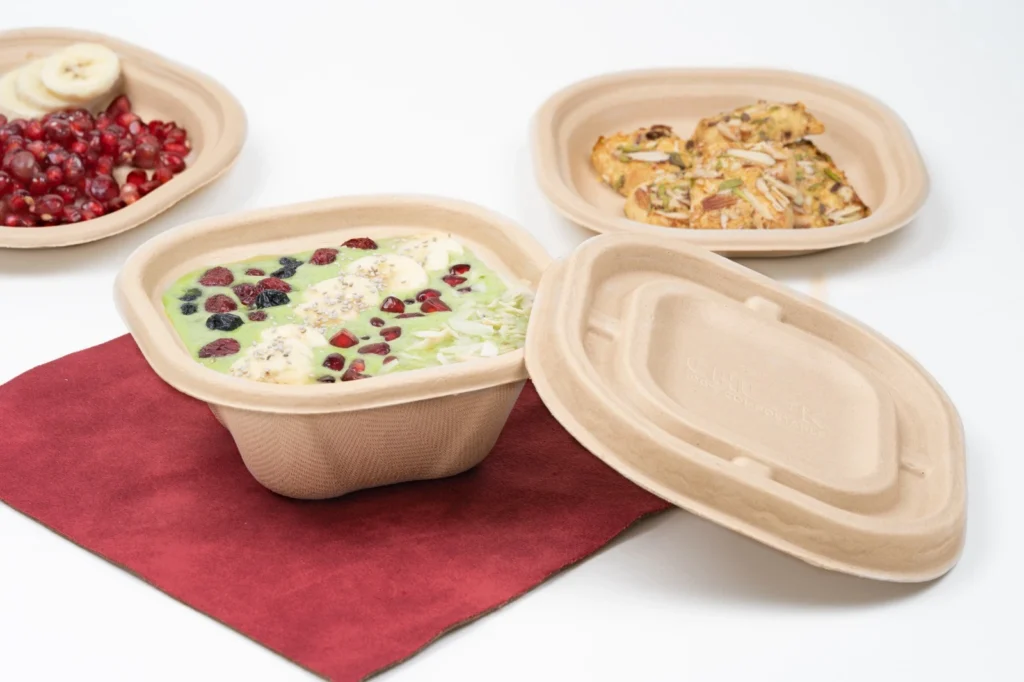
Compostable Food Packaging in India: Challenges, Opportunities, and What It Means for Your Business
If you run a restaurant, cloud kitchen, or catering business in India, you have probably noticed the shift happening around you. Swiggy and Zomato delivery riders picking up orders in brown sugarcane containers instead of white styrofoam. Wedding caterers swapping plastic plates for moulded fibre trays. QSR chains printing their logos on bagasse clamshells.
Compostable disposables are not a future trend. They are the present. But that does not mean the switch is simple.
This guide breaks down the real challenges you will face, the business opportunities waiting on the other side, and a practical framework for making the transition work for your bottom line.
Key Takeaways
- India’s sustainable packaging market is projected to reach USD 17.7 billion by 2034, growing at 6.31% CAGR.
- The single-use plastic ban (effective since July 2022) is being enforced with increasing rigour, including QR-code traceability from July 2025.
- Compostable disposables cost 15-30% more upfront but reduce regulatory risk, waste management fees, and brand reputation costs.
- Sugarcane bagasse, the most common compostable material in India, handles temperatures up to 120 degrees Celsius and resists oil and moisture.
- The biggest barriers are not cost but infrastructure: composting facilities, supply chain consistency, and customer education.
Why Compostable Food Packaging Matters Right Now
The Regulatory Push You Cannot Ignore
India’s Plastic Waste Management Rules have moved beyond announcements into active enforcement.
Here is what is already in effect or coming soon:
- July 2022: Ban on identified single-use plastic items including plates, cups, cutlery, straws, and stirrers.
- Extended Producer Responsibility (EPR): Producers and brand owners must register on the CPCB portal and report packaging quantities and disposal methods.
- July 2025: QR code or barcode mandatory on every piece of plastic packaging for full traceability back to the manufacturer.
- 2029 target: India aims for 60% recycling of all plastic packaging.
As a restaurant owner or foodservice operator, this means non-compliance is not just a fine. It is a supply chain disruption waiting to happen. Your packaging supplier could be shut down, your delivery partner could refuse non-compliant containers, and your brand could face public backlash.
The Market Opportunity
The numbers tell a clear story:
- India’s sustainable packaging market reached USD 10.2 billion in 2025.
- The compostable packaging segment is growing at 8.3% CAGR and expected to reach USD 6.4 million by 2030.
- The compostable flexible packaging sub-segment is projected to grow at 14.6% CAGR between 2026 and 2035.
This is not a niche movement. It is an industry-wide shift backed by policy, consumer demand, and investor interest.
The Real Challenges of Going Compostable
Let us be honest. Switching to compostable disposables is not as straightforward as swapping one supplier for another. Here are the challenges you need to plan for.
1. Higher Unit Costs
Compostable disposables typically cost 15-30% more than their plastic or styrofoam equivalents. For a cloud kitchen doing 500 orders a day, that adds up.
The honest truth: The price gap is narrowing as production scales. Three years ago, bagasse plates were nearly double the cost of plastic. Today, the difference is manageable, especially when you factor in the hidden costs of plastic.
2. Composting Infrastructure Gaps
Here is what most packaging companies will not tell you: compostable does not mean it disappears in any dustbin.
Compostable disposables need industrial composting facilities that maintain specific temperature and moisture conditions. India’s composting infrastructure is still developing, particularly in Tier 2 and Tier 3 cities.
What this means for you: If your city lacks composting facilities, your compostable containers may still end up in landfills. They will eventually break down (unlike plastic), but not at the speed the label promises.
3. Supply Chain Variability
Sugarcane bagasse, the most widely used raw material for compostable disposables in India, is an agricultural byproduct. Its availability fluctuates with sugarcane harvest seasons and regional output.
This can lead to:
- Inconsistent product quality across batches
- Delivery delays during off-season months
- Price fluctuations tied to raw material availability
4. Customer Confusion
Your customers may not understand the difference between compostable, biodegradable, and recyclable. This is not just a terminology issue. It affects:
- Disposal behaviour: Customers may toss compostable items into recycling bins, contaminating the recycling stream.
- Perceived value: Some customers see brown, natural-looking packaging as “cheap” rather than sustainable.
- Willingness to pay: Without education, customers may resist a small price increase tied to sustainable packaging.
5. Performance Concerns
Early-generation compostable containers had legitimate issues with hot liquids, oil seepage, and structural strength. Modern bagasse and moulded fibre products have largely solved these, but the perception lingers.
Challenges vs. Opportunities: A Practical Matrix
| Challenge | Impact Level | Corresponding Opportunity | Action for Your Business |
|---|---|---|---|
| Higher unit costs | Medium | Premium brand positioning, reduced waste fees | Negotiate bulk pricing, pass through as sustainability surcharge |
| Composting infrastructure gaps | High | Partner with local composting operators, earn carbon credits | Identify composting partners within your delivery radius |
| Supply chain variability | Medium | Diversify material sources (bagasse, palm leaf, areca) | Work with suppliers who maintain buffer inventory |
| Customer confusion | Medium | Brand differentiation through education | Add QR codes on packaging linking to disposal instructions |
| Performance perception | Low | Demonstrate product strength through live demos | Request samples, test with your hottest and oiliest menu items |
| Regulatory compliance | High | First-mover advantage in a tightening market | Get compliant now while competitors are still figuring it out |
| Greenwashing risk | Medium | Build trust through certified claims only | Use only IS/ISO 17088 certified products |
Business Opportunities That Make the Switch Worth It
Brand Differentiation in a Crowded Market
India has over 7.5 million restaurants. On food delivery platforms, your packaging is often the first physical touchpoint a customer has with your brand. Compostable disposables signal quality, care, and forward-thinking operations.
Restaurants that visibly commit to sustainability report:
- Higher repeat order rates from environmentally conscious urban consumers
- Better ratings and reviews mentioning packaging quality
- Stronger positioning for corporate catering and event contracts
Regulatory Compliance as Competitive Advantage
While many operators scramble to comply reactively, you can get ahead. The CPCB’s enforcement is intensifying, and early adopters face:
- Zero disruption when new rules kick in
- Lower compliance costs (no last-minute supplier changes)
- Eligibility for green certifications that unlock institutional contracts
Cost Savings You Do Not See on the Invoice
Plastic packaging carries hidden costs that rarely show up in your per-unit calculation:
- Waste management fees: Many municipalities are implementing differential waste charges, with higher fees for non-segregated or non-compostable waste.
- Regulatory fines: Non-compliance penalties under the Plastic Waste Management Rules can run into lakhs.
- Brand damage: One viral social media post about plastic waste from your restaurant can cost more than a year of premium packaging.
Menu Innovation and Packaging Synergy
Compostable disposables work particularly well with Indian food categories:
- Thali meals: Compartmented bagasse trays keep items separate without foil
- Biryani and rice dishes: Deep containers with secure lids prevent spills
- Chaat and street food: Moulded fibre bowls handle moisture and oil from chutneys
- Festival specials: Branded compostable packaging for Diwali mithai boxes, Holi party packs, and wedding favour containers
How to Make the Switch: A Step-by-Step Approach
Step 1: Audit Your Current Packaging
List every packaging item you use. Plates, bowls, containers, cups, cutlery, bags, wraps. Note the material, cost per unit, and monthly volume.
Step 2: Prioritise High-Impact Swaps
Start with items that have the highest visibility and regulatory risk:
- Plates and bowls (already banned in plastic)
- Takeaway containers (customer-facing, high volume)
- Cutlery (easy swap, low cost difference)
Step 3: Test Before You Commit
Order samples from multiple suppliers. Test each product with your actual menu items:
- Pour your hottest dal into the container and check for warping
- Pack your oiliest curry and check for seepage after 30 minutes
- Stack filled containers to test structural integrity during delivery
Step 4: Negotiate Smart
- Bulk pricing: Compostable disposable costs drop significantly at volume. Negotiate quarterly contracts.
- Mixed orders: Combine high-volume items (plates, containers) with lower-volume items (cups, trays) for better overall pricing.
- Payment terms: Suppliers serving the foodservice segment, like Chuk, often offer flexible credit terms for consistent buyers.
Step 5: Educate Your Team and Customers
- Train kitchen staff on proper storage (compostable products need dry, cool storage away from moisture).
- Add a small note on your delivery packaging explaining the material and how to dispose of it.
- Update your Swiggy and Zomato listings to mention sustainable packaging. It is a differentiator that platforms increasingly highlight.
Compostable vs. Recyclable vs. Biodegradable: What Your Customers Need to Know
| Feature | Compostable | Recyclable | Biodegradable |
|---|---|---|---|
| Breaks down naturally | Yes, in 90-180 days in composting conditions | No, requires industrial reprocessing | Yes, but timeline is undefined |
| End product | Nutrient-rich compost for soil | New material (with quality loss each cycle) | Smaller fragments (may include microplastics) |
| Certification standard | IS/ISO 17088 | Varies by material | No universal standard |
| Infrastructure needed | Industrial composting facility | Recycling plant | None specific, but results vary |
| Best for food packaging | Yes, handles food contamination | No, food residue contaminates recycling | Risky, may leave harmful residues |
| Regulatory status in India | Allowed with CPCB certification | Encouraged but not a replacement for banned items | Increasingly scrutinised for greenwashing |
Frequently Asked Questions
Are compostable disposables really more expensive than plastic?
Yes, by approximately 15-30% on a per-unit basis. However, when you account for regulatory compliance costs, waste management fees, and the brand value of sustainable packaging, the total cost of ownership is often comparable or lower. Bulk purchasing further narrows the gap.
Can compostable containers handle hot and oily Indian food?
Modern bagasse containers are engineered to withstand temperatures up to 120 degrees Celsius and resist oil and moisture. They are suitable for biryanis, curries, gravies, and fried items. Always test with your specific menu items before committing to a supplier.
What happens if my city does not have composting facilities?
Your compostable packaging will still break down in landfill conditions, though more slowly than in an industrial composting setup. Unlike plastic, it will not persist for centuries or release microplastics. You can also explore partnerships with local composting operators or municipal green waste programs.
How do I verify that my packaging is genuinely compostable and not greenwashed?
Look for IS/ISO 17088 certification and CPCB registration of the manufacturer. Ask your supplier for test reports from accredited labs. Avoid products that use vague terms like “eco-friendly” or “green” without specific certifications.
Will switching to compostable packaging affect my food delivery ratings?
Positively, in most cases. Customers on Swiggy and Zomato increasingly mention packaging quality in reviews. Sturdy, leak-proof compostable containers that keep food fresh during delivery tend to earn better feedback than flimsy plastic alternatives.
Can I get my logo printed on compostable disposables?
Yes. Most compostable packaging suppliers offer custom branding with food-safe inks. This turns your packaging into a marketing asset. Branded compostable containers reinforce your sustainability positioning with every order delivered.
In a Nutshell
The shift to compostable food packaging in India is not optional. It is regulatory, it is market-driven, and it is accelerating. The challenges are real but manageable: higher unit costs are narrowing, infrastructure is expanding, and customer awareness is growing.
For restaurant owners and foodservice operators, the question is not whether to switch but when. The businesses that move now will lock in better supplier relationships, build brand equity around sustainability, and avoid the compliance scramble that is coming for the rest of the industry.
Start with a packaging audit, test with your actual menu, negotiate bulk terms, and let your customers know what you are doing and why. That is how you turn a regulatory requirement into a genuine business advantage.
Chuk offers a full range of compostable disposables made from sugarcane bagasse, designed specifically for the Indian foodservice industry. From plates and bowls to takeaway containers and cutlery, every product is IS/ISO 17088 certified and built to handle the demands of real restaurant kitchens. Explore the range at chuk.in
Packaging that holds up is the cheapest kind
Whatever the format, the packaging is the last thing your customer touches. CHUK’s compostable bagasse range covers plates, bowls, containers and cutlery, and keeps you clear of single-use plastic rules.
Browse the CHUK range | Order a sample box | Get pricing on WhatsApp