What they don’t tell you about disposable plates: a buyer’s guide to choosing the right one
You placed a bulk order for disposable plates. They arrived, looked fine in the box. Then your kitchen staff loaded dal makhani onto one and the plate folded in half. Or a customer picked up biryani at your counter and the oil soaked straight through to their hand.
If you run a restaurant, a cloud kitchen, or a catering operation, you have probably lived through some version of this. The plate looked acceptable. It was cheap. It failed at the one job it had.
Nobody talks about this openly, but most buyers pick disposable plates on price per unit and appearance. Sellers know that. They optimize for exactly those two things and stay quiet about the rest. Heat tolerance, food grade certification, chemical leaching, compostability claims that fall apart under scrutiny — none of that shows up on the product listing.
This guide covers what actually matters when you evaluate disposable plates, how the five common materials perform under real kitchen conditions, and what to check before your next bulk purchase.
Key Takeaways
- Price per plate is a misleading number. Breakage, leakage losses, customer complaints, and disposal costs change the math completely
- Plastic and foam plates work in the short term but carry growing regulatory risk under India’s single-use plastics ban
- Paper plates without PE coating fall apart with wet or oily Indian food. Coated paper plates are not compostable, no matter what the box says
- Areca leaf plates are sturdy and fully natural but hard to scale for daily high-volume restaurant use
- Bagasse (sugarcane fiber) plates hit the best balance of durability, heat resistance, cost at scale, and genuine compostability
- Always verify BIS, FSSAI, and third-party lab certifications before you commit to a supplier
Picking plates on price alone is expensive
Walk through any wholesale market in India — Sadar Bazaar in Delhi, Chickpet in Bangalore, Begum Bazaar in Hyderabad — and disposable plates come at every price point. INR 1.50 per plate, INR 3, INR 5, INR 8.
What doesn’t get discussed at the billing counter:
- Cheap plates that crack when stacked or warp under heat give you 8-12% wastage before they reach a customer. On 500 plates a day, that is 40-60 plates in the bin.
- A flimsy plate that bends or leaks tells your diner the food is an afterthought. On delivery platforms, packaging complaints land directly in your star rating.
- Under India’s Plastic Waste Management Rules (amended 2024), restaurants using non-compliant disposables face penalties from INR 10,000 to INR 1 lakh depending on the municipal body.
The cheapest plate in the carton is almost never the cheapest plate once you account for what goes wrong.
Five plate types compared: what they actually deliver
The differences between disposable plate materials are not cosmetic. Below is a direct comparison across the five materials available to food service businesses in India.
Plate types comparison table
| Feature | Plastic (PP/PS) | Paper (PE-coated) | Foam (EPS) | Areca Leaf | Bagasse (Sugarcane Fiber) |
|---|---|---|---|---|---|
| Heat resistance | Up to 100-120°C | Up to 80°C | Up to 80°C | Up to 100°C | Up to 120°C |
| Oil and grease resistance | High | Low to medium (depends on coating) | Medium | High (natural) | High (natural) |
| Microwave safe | Some grades only | No (coating melts) | No | Yes | Yes |
| Leak resistance | High | Low for wet foods | Medium | High | High |
| Strength with heavy food | High | Low | Low | High | High |
| Compostable | No (500+ years) | No (PE lining blocks it) | No (never fully degrades) | Yes (60-90 days) | Yes (60-90 days) |
| FSSAI food grade compliant | Requires specific grades | Requires PE-free certification | Restricted under new rules | Naturally compliant | Naturally compliant |
| Cost per plate (approx.) | INR 1.50-3 | INR 1-2.50 | INR 1-2 | INR 4-7 | INR 2.50-5 |
| Bulk availability (India) | Very high | Very high | Declining (bans) | Limited (seasonal, regional) | High and growing |
| Regulatory risk (2026) | High (progressive bans) | Medium (coated variants) | Very high (banned in many states) | None | None |
Numbers on a chart tell part of the story. The rest comes from testing plates in your actual kitchen.
7 tests to run before you place a bulk order
Suppliers send samples. They look clean, feel sturdy, stack nicely. That tells you almost nothing about what happens during service.
1. The hot food hold test
Load the plate with the hottest, heaviest item on your menu. Biryani with gravy, dal with rice, chole bhature swimming in oil. Leave it for 15 minutes.
Watch for warping under weight, a soggy base, and food sliding or pooling to one side. Paper and foam plates usually fail this with oily Indian food. Plastic holds shape but may leach at high temperatures. Bagasse and areca handle it without fuss.
2. The leak and soak test
Pour 100ml of water onto the plate. Wait 15 minutes. Flip it.
Any moisture on the underside means the plate is absorbing liquid. A plate that absorbs water will absorb dal, sambar, and gravy exactly the same way. If you serve wet food — and most Indian food is wet — this test kills half the options right there.
3. The taste and odor transfer test
Put plain roti or white bread on the plate. Cover it. Wait 30 minutes. Taste the bread.
Any chemical, plastic, or woody taste means the plate is contaminating your food. Foam and cheap plastic plates often leave a faint chemical note. Natural fiber plates (areca, bagasse) should transfer nothing when properly manufactured. Your customer will notice this before they notice anything else about the plate.
4. The cut resistance test
Use a regular dinner knife and fork. Press with normal eating force.
Does the knife cut through? Does the fork puncture the base? Paper plates fail this almost across the board. Foam cracks. Good bagasse and areca plates take standard utensil pressure without damage.
5. The stack and store test
Stack 25 plates and leave them for 48 hours in your kitchen storage. Not air conditioned. Regular Indian kitchen humidity.
Do they stick together? Warp? Curl? Absorb moisture from the air? Now try pulling one plate cleanly from the stack while pretending it is rush hour. This one gets overlooked constantly, but a plate that won’t de-stack smoothly during service will slow your line down every single day.
6. The certification check
Ask your supplier for documentation. Not the marketing brochure. The actual lab reports.
You should be looking at:
- FSSAI food grade certification — confirms the material is safe for direct food contact
- BIS IS 18267:2023 compliance for tableware from agricultural by-products (covers bagasse and areca)
- Compostability certification (IS/ISO 17088 or equivalent) if the plate is sold as compostable
- NABL-accredited lab test results for migration testing, which checks whether chemicals leach from the plate into your food
No documents? Move on. A plate with a “food-safe” or “compostable” claim but no third-party verification is just a plate with a sticker on it.
7. The real cost calculation
Stop comparing per-unit prices. The number that matters is per-service cost.
Per-service cost = (plate price) + (breakage % x price) + (customer complaint cost) + (disposal and compliance cost)
For a restaurant doing 300 covers a day:
– Plastic at INR 2 per plate with 5% breakage, rising disposal costs, and regulatory fines in some states lands you at INR 2.80-3.50 per service
– Bagasse at INR 3.50 per plate with under 2% breakage, zero regulatory exposure, and no special disposal requirements sits at INR 3.60-3.80 per service
That gap is far smaller than the sticker price suggests. Factor in customer retention from better packaging and it disappears entirely.
The “compostable” label problem
The word “compostable” has no legal enforcement standard for disposable plates in India’s retail market right now. Any supplier can print it on the box without running a single test.
In practice, this plays out in three ways:
- Paper plates with PE (polyethylene) coating get marketed as compostable. They are not. The plastic lining blocks decomposition and contaminates compost.
- “Mixed fiber” plates blend recycled paper with chemical binders. They partially decompose but leave microplastic residue behind.
- Genuine compostable plates — bagasse or areca — break down in industrial composting within 60-90 days and carry IS/ISO 17088 certification to prove it.
This matters to you because municipal authorities are auditing food service waste more aggressively. If your “compostable” plates get classified as plastic waste during an inspection, the liability is yours.
The check is easy. Ask for the composting certification. Ask which standard it was tested against. Ask for the lab name. A manufacturer with real certifications won’t hesitate.
Where each plate type actually fits
Your menu, service format, and daily volume determine the right material. Not every plate needs to be the same.
Plastic (PP/PS)
Still dominates the market because of pricing inertia and supply chain habit. But progressive bans under India’s single-use plastics rules are tightening year over year. Several states already restrict polystyrene. Polypropylene faces increasing scrutiny. Building your operation around plastic plates in 2026 means building on a surface that is shrinking under your feet.
Paper (PE-coated)
Fine for dry snacks, chaat counters, and light appetizers. Anything where food is dry and the plate gets tossed within minutes. Beyond that, paper and Indian food don’t work. The PE coating that gives paper plates temporary water resistance also makes them non-compostable and questionable for food safety at higher temperatures.
Foam (EPS/Styrofoam)
Banned in multiple Indian states and municipalities already. Even where still legal, EPS foam raises health questions (styrene migration into hot food) and is an environmental dead end. The INR 0.50 per plate savings over bagasse does not justify the compliance exposure in 2026.
Areca leaf
Beautiful for premium catering. Wedding functions, festival events, temple prasad distribution — anywhere the natural, handcrafted look adds to the occasion. But supply is seasonal and concentrated in south India (Karnataka, Kerala, Tamil Nadu). Scaling past 200-300 plates a day needs serious advance planning, and the price runs 2-3x above bagasse. Not built for daily restaurant volume.
Bagasse (sugarcane fiber)
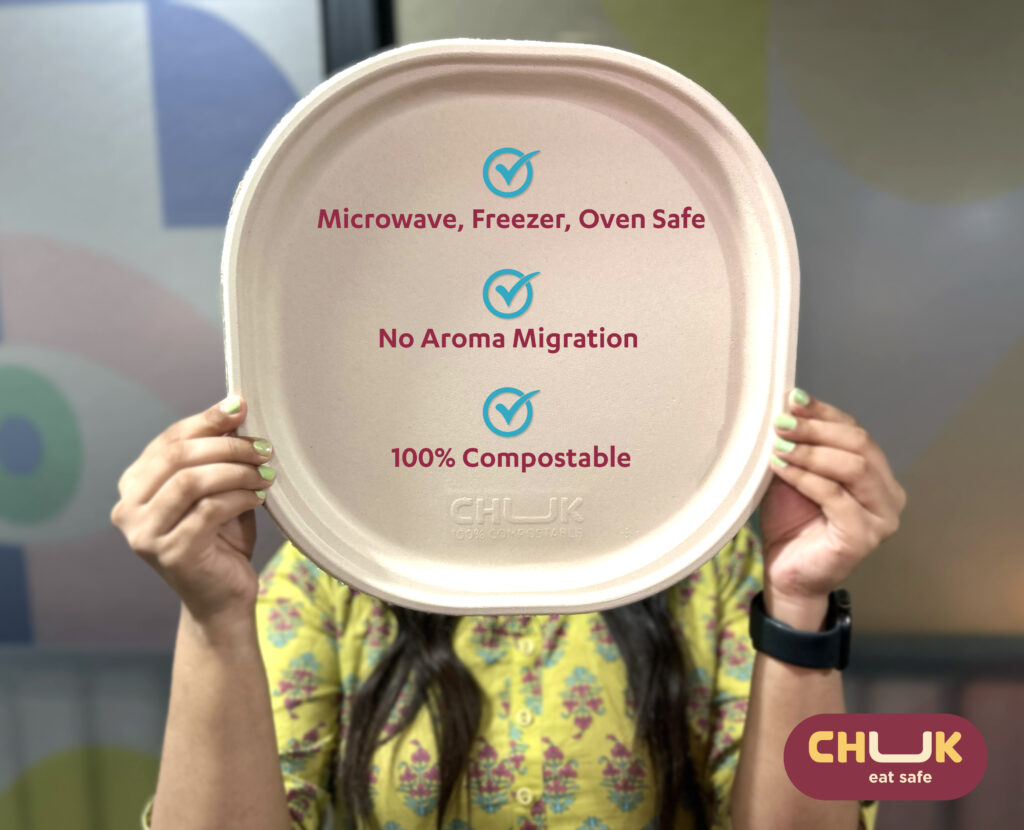
The daily workhorse for restaurants, cloud kitchens, QSR chains, and catering. Handles oil, heat, moisture, stacking. Microwave safe, freezer safe, certified compostable. Supply chains in India are strong because the raw material comes from the sugar industry, which is massive domestically.
For most restaurant owners and bulk buyers, bagasse compostable plates are the most practical option when you weigh performance, compliance, and cost together. Chuk manufactures these from sugarcane fiber sourced from Indian sugar mills, with BIS and FSSAI certification, and a product range built for Indian food service specifically.
Evaluating a supplier, not just a plate
A good plate from a bad supplier is still a bad deal. Beyond the product sample, check these:
- Can you order a trial batch of 500-1,000 plates before locking into 10,000?
- Ask for samples from three different production runs, not the showcase batch. Consistency across batches is what separates a real manufacturer from a trader.
- FSSAI, BIS, ISO 17088, NABL lab reports — all should be available on request, not “being processed.”
- For a restaurant doing 300+ covers daily, a delayed plate shipment is a service disruption. Ask about buffer stock and delivery commitments before you need them.
- If a batch arrives warped, damp, or off spec, what happens? A supplier that won’t accept returns on defective product is not one you want running your daily operations.
In a Nutshell
Choosing disposable plates is a kitchen operations decision, not a wholesale catalog exercise. It touches food presentation, customer experience, regulatory compliance, and your margins.
A few things worth remembering:
- Test with your actual menu items before ordering. Dry samples on a conference table prove nothing.
- Read certifications, not marketing copy. FSSAI food grade, BIS IS 18267, and ISO 17088 compostability are the claims that hold weight. Everything else is packaging.
- Calculate total cost per service, not unit price. Breakage, complaints, disposal fees, and fines make cheap plates expensive fast.
- Bagasse covers most food service needs. Areca works for premium occasions. Paper handles dry snacks. Plastic and foam are on borrowed time.
- Vet the supplier as hard as you vet the plate. Consistency, certification, and reliable delivery beat a low price on the first invoice every time.
Your plates carry your food. They are the first physical thing your customer touches. Treat that decision accordingly.
Frequently asked questions
Do bagasse plates hold up with heavy, gravy-based Indian dishes like butter chicken or rajma?
Yes. Sugarcane fiber handles temperatures up to 120°C and is naturally oil and grease resistant. No warping, no leaking, no sogginess with gravy-heavy dishes. The catch: quality varies by manufacturer. Buy from a certified producer, not a reseller stocking unbranded plates, and you won’t have this problem.
How do I verify if a plate sold as “compostable” actually is?
Ask for IS/ISO 17088 certification or composting test reports from a NABL-accredited lab. Real compostable plates break down in industrial composting within 60-90 days. If the supplier can’t show you lab-verified certification, the claim is marketing. PE-coated paper plates, despite what you’ll see printed on boxes everywhere, are not compostable.
Are areca leaf plates practical for daily restaurant use?
At 200+ plates per day, areca gets difficult. Supply is seasonal and concentrated in south India. Pricing runs 2-3x above bagasse. Consistent sizing across large batches is harder to guarantee. Where areca shines is catering, weddings, festival events, and temple functions — occasions where the natural look justifies the premium.
What certifications should I ask any plate supplier for?
Four documents minimum. FSSAI food grade compliance confirming food contact safety. BIS IS 18267:2023 for tableware from agricultural by-products. IS/ISO 17088 compostability certification if they claim compostability. And NABL-accredited migration test results confirming no chemical leaching. If any of these are missing, keep looking.
Will switching from plastic to compostable plates blow up my costs?
At 300+ plates a day, the per-plate gap between plastic and bagasse is INR 1-2. But plastic carries disposal costs that are rising, regulatory fines in states with active bans, and higher breakage on thin gauge options. Bagasse needs no special disposal, carries zero regulatory risk, and breaks at under 2%. Most operators find the net difference close to zero within 3-4 months. Some find it negative.
Can compostable plates go in the microwave and freezer?
Bagasse plates are microwave safe up to 120°C and freezer safe. No warping, no leaching, no special handling needed. That matters for delivery customers who reheat and for catering operations that prep and refrigerate ahead. Foam and PE-coated paper plates cannot be microwaved safely — the materials break down or release chemicals at temperature.
Moving off plastic usually starts with the plate
The plate is where most kitchens start when they move off plastic. CHUK’s compostable bagasse plates take hot, oily and wet food without going limp, and they compost after use.
Browse compostable plates | Order a sample box | Get pricing on WhatsApp