Are customers ready to pay more for sustainable packaging? What Indian data actually shows
You run a restaurant. You know compostable disposables cost more per unit than plastic. And every time someone suggests making the switch, the same question comes up: will my customers actually pay for this?
The honest truth is that the answer is more encouraging than most restaurant owners expect. But it comes with a catch that nobody talks about.
Key Takeaways
- 36% of Indian consumers say they would pay “a lot more” for sustainable packaging, the highest figure globally (McKinsey 2025)
- Indian consumers report willingness to pay a 20% premium for sustainable products, versus the global average of 12% (Bain & Company)
- Gen Z and millennials drive the strongest demand, with 47-49% willing to pay extra
- The real gap is not willingness but visibility: customers cannot reward what they cannot see
- Restaurants that frame compostable disposables as a quality signal, not a surcharge, see the strongest uptake
- CPCB fines can reach INR 1 lakh per violation, so regulation is pushing the switch regardless
The numbers are in, and India leads the world
If you have been putting off the switch to compostable disposables because you think Indian customers are too price sensitive, the data says otherwise.
McKinsey’s 2025 Global Packaging Survey found that 36% of Indian consumers would pay “a lot more” for sustainable packaging. That is the highest percentage of any country surveyed. Higher than Brazil, China, Mexico, every European market. Another 49% said they would pay “a little more.”
Add those up. Roughly 85% of Indian consumers say they are willing to pay some premium for sustainable packaging.
Bain & Company’s survey across 11 countries found something similar. Indian consumers said they would accept an over 20% premium for sustainable products. The global average was 12%.
Here is what that comparison looks like:
| Country | Willing to pay “a lot more” | Willing to pay “a little more” | Average premium accepted |
|---|---|---|---|
| India | 36% | 49% | ~20% |
| Brazil | 29% | 53% | ~15% |
| China | 25% | 54% | ~14% |
| Mexico | 22% | 58% | ~13% |
| USA | 15% | 42% | ~10% |
| Japan | 3% | 31% | ~5% |
| Global average | 18% | 44% | ~12% |
Indian consumers are not lagging behind on sustainability spending. They are ahead of most of the world.
Who is actually willing to pay? The age and city breakdown
Not every customer ordering on Swiggy or walking into your restaurant carries the same willingness to pay. Age and location matter. Knowing the breakdown helps you figure out where demand runs strongest.
By age group
Younger customers are more committed to paying for sustainability. McKinsey’s data:
- Gen Z (18-27): 49% willing to pay more
- Millennials (28-43): 47% willing to pay more
- Gen X (44-59): 41% willing to pay more
- Boomers (60+): 37% willing to pay more
If your restaurant serves a younger crowd, operates as a cloud kitchen, or delivers to office lunch zones in tech parks, your customer base is already there.
By city tier
Tier wise breakdowns are still limited in public research. But Bain & Company found that 52% of urban Indian consumers expect to spend more on planet friendly brands over the next three years.
Research on Tier-II cities shows that younger consumers in places like Visakhapatnam, Jaipur, and Lucknow carry strong pro-environmental attitudes. The gap in smaller cities is not about willingness. It is about availability. When compostable options are accessible, the uptake follows.
| Segment | Willingness to pay premium | What drives it |
|---|---|---|
| Metro Gen Z (18-27) | Very high (49%) | Social identity, peer influence, brand values |
| Metro millennials (28-43) | High (47%) | Health awareness, brand trust, delivery app habits |
| Tier-II Gen Z | Moderate to high | Pro-environmental attitudes, but constrained by what is available locally |
| Tier-II millennials | Moderate | Value driven, want visible proof before paying more |
| Gen X and boomers (all cities) | Moderate (37-41%) | Quality perception, awareness of regulations, family health |
The gap between what people say and what they do
This is the part that matters most if you are trying to make a business decision, not write a sustainability report.
Consumers say they will pay more. But the actual premium on sustainable products in India averages over 60%, according to Bain. Consumers say they will accept 20%. That is a 40 percentage point gap between what people tell surveyors and what the market charges.
So what does this actually mean if you are running a restaurant?
The premium for compostable disposables over plastic is typically 15-25%. That falls within the range consumers say they will accept. You are not asking for a 60% markup. You are asking for a few rupees per order.
And food packaging is not like buying a shampoo bottle off a shelf. Your customers are ordering food. The packaging is part of the experience, not a separate line on a comparison chart. Nobody opens Swiggy and thinks “I will order from the restaurant with compostable containers today.” They order food they want. The packaging is what they get.
Here is the part people miss: the premium gets absorbed into your food pricing. Your biryani costs INR 250 whether it arrives in plastic or a compostable container. The customer never sees the difference on the bill.
Restaurants that struggle with this switch tend to treat compostable disposables as an added cost they need to justify to someone. Restaurants that make it work just fold it into their standard.
Why food service is different from retail
Most willingness to pay research covers retail. A consumer standing in front of two bottles on a shelf, one with a green label, one without. Restaurant and delivery packaging works differently. And that difference is in your favour.
Nobody sees “compostable container surcharge: INR 5” on their Swiggy order. The cost sits inside your food price. It is invisible.
When food arrives in a sturdy, clean compostable container instead of a flimsy plastic box that has warped from the heat, customers associate that quality with the food. They do not think about the packaging material. They think the restaurant cares about what it sends out.
Delivery platforms are moving this direction too. Zomato launched Packathon 2025 with Startup India, pulling in restaurant owners and packaging startups to build plastic free solutions. Swiggy is adding compostable meal trays made from bagasse and cornstarch to its supplier catalogue.
And there is the review angle. Leaky containers, soggy boxes, plastic that buckles under hot dal, those lead to one star ratings. Bagasse containers handle heat up to 120 degrees Celsius without deforming. The functional upgrade alone can justify the cost.
When a customer pays INR 300 for a delivery meal and it arrives looking good, they do not question the price. When curry has leaked through a cheap plastic container onto the delivery bag, they question everything about your restaurant.
The regulatory push you cannot afford to ignore
Set consumer preferences aside for a moment. The regulatory environment in India is making plastic disposables a liability for food service businesses, regardless of what customers want.
What is already banned:
- Plastic plates, cups, glasses, forks, spoons, knives, and trays under 100 microns
- Polystyrene for decoration
- PVC banners under 100 microns
What is getting stricter:
- Fines up to INR 1 lakh per offence under the Environment (Protection) Act
- Imprisonment up to 5 years for repeated violations
- In the first month of enforcement, authorities seized over 7,75,000 kg of illegal plastics and collected INR 5.8 crore in penalties
- From July 2025, all packaging must carry producer information via barcode or QR code
- 30% recycled content is required for Category I packaging in 2025-26, rising to 60% by 2028
Single use plastics in food service are not getting cheaper or easier to use. They are getting more regulated and more expensive. The fines alone can wipe out months of whatever you saved by sticking with plastic.
Switching to compostable disposables is not only about customer preference. It is a compliance move.
How to make the switch without hurting your margins
If the demand picture makes sense but you are worried about cost, here is the practical version.
Start with delivery, not dine-in
Delivery is where customers notice packaging quality most. It is also where packaging complaints show up in reviews. Compostable containers for delivery add roughly INR 2-5 per order at volume. On an INR 200-400 order, that cost is invisible.
Absorb, do not surcharge
Never add a “sustainable packaging fee” as a line item. Customers dislike visible surcharges even when they support the idea behind them. Instead, adjust your base pricing by 1-2% across the menu. Nobody notices INR 5 more on a INR 300 biryani.
Lead with quality, not morality
“Our packaging keeps your food hot and leak free” works. “We are saving the planet” does not, at least not as a selling point for a food order. Customers respond to what the packaging does for their meal. Frame it as a quality upgrade.
Use it as marketing
Put a line on your packaging or your menu page: “Served in 100% compostable tableware. Returns to soil in 90 days.” The sustainability conscious crowd will share it on social media. Everyone else will not object to better packaging.
Track the impact
Watch your delivery ratings before and after the switch. Track complaint rates on leaks, sogginess, and food temperature. Check repeat order rates. Four to six weeks of data from your own restaurant will tell you more than any McKinsey survey.
What Zomato, Swiggy, and your competitors are already doing
You are not making this decision in a vacuum.
Zomato’s Plastic-Free Future Programme works with restaurants to transition to compostable containers. Swiggy is adding compostable packaging and bagasse trays to its supplier options. Cloud kitchens doing 50-200 orders a day are buying compostable containers in bulk, which drives the per unit cost down. QSR chains are rolling compostable disposables into their standard operations for both compliance and brand reasons.
India’s food delivery industry generates roughly 22,000 metric tons of plastic waste every year. Platforms are investing in alternatives. Regulators are tightening enforcement. And customers, especially younger ones ordering 3-4 times a week through apps, are paying attention to what their food arrives in. You can get ahead of this or react to it later when the options are fewer and the costs are higher.
In a Nutshell
Indian consumers are not just ready to pay more for sustainable packaging. By global standards, they are among the most willing in the world. McKinsey, Bain, and PwC data all show India outperforming most major markets on stated willingness to pay a sustainability premium.
For restaurant owners, the practical math works out. Compostable disposables cost 15-25% more per unit than plastic. That falls within the premium consumers say they will accept. Since the cost gets folded into food pricing rather than shown as a separate charge, most customers never notice. What they do notice is that their food arrived in something sturdier.
On the other side, staying on plastic is getting riskier every quarter. Fines are real. Labelling mandates are tightening. Recycled content thresholds are climbing.
The restaurants doing well with this switch stopped asking “Will customers pay more?” a while ago. They made the switch, absorbed the cost, and let their packaging do the rest.
Frequently asked questions
Will my customers actually pay more for food in compostable packaging?
Most of them will not even notice. Compostable disposables add INR 2-5 per delivery order at volume. Since packaging costs are bundled into food prices, what customers experience is better packaging, not a higher price. McKinsey’s 2025 survey found 85% of Indian consumers express some willingness to pay a premium for sustainable packaging.
How much more do compostable disposables cost compared to plastic?
Sugarcane bagasse disposables run 15-25% more per unit than plastic. At restaurant volumes, that works out to INR 2-5 more per delivery order. Most restaurants absorb this with a 1-2% menu price adjustment. On a INR 300 order, that is INR 3-6. Customers rarely notice.
Is the demand for sustainable packaging only in metros like Mumbai and Bangalore?
No. Metro consumers show the strongest willingness to pay, but younger demographics in Tier-II cities like Jaipur, Lucknow, and Visakhapatnam carry strong pro-environmental attitudes too. The gap in smaller cities is less about willingness and more about whether compostable options are available and accessible locally.
What happens if I do not switch from plastic? Are there legal risks?
Yes. India’s single use plastic ban covers plates, cups, glasses, forks, spoons, knives, and trays under 100 microns. Fines go up to INR 1 lakh per offence, with imprisonment up to 5 years for repeated violations. Mandatory labelling and recycled content requirements are getting stricter in 2025-26. Staying on plastic is not getting cheaper.
Do compostable containers work for hot, oily Indian food?
Bagasse containers handle temperatures up to 120 degrees Celsius. They are microwave safe, leak proof, and hold up against heavy gravies, biryanis, and oily dishes without getting soggy. Thousands of restaurants, cloud kitchens, and caterers across India use them daily.
How do I communicate the switch to my customers without it feeling like a price hike?
Do not announce it as a surcharge. Fold the cost into your regular pricing and let the packaging do the talking. A simple line on your packaging or Swiggy listing, “Served in 100% compostable tableware,” is enough. People who care about sustainability will notice. And nobody has ever complained about receiving food in a sturdier container.
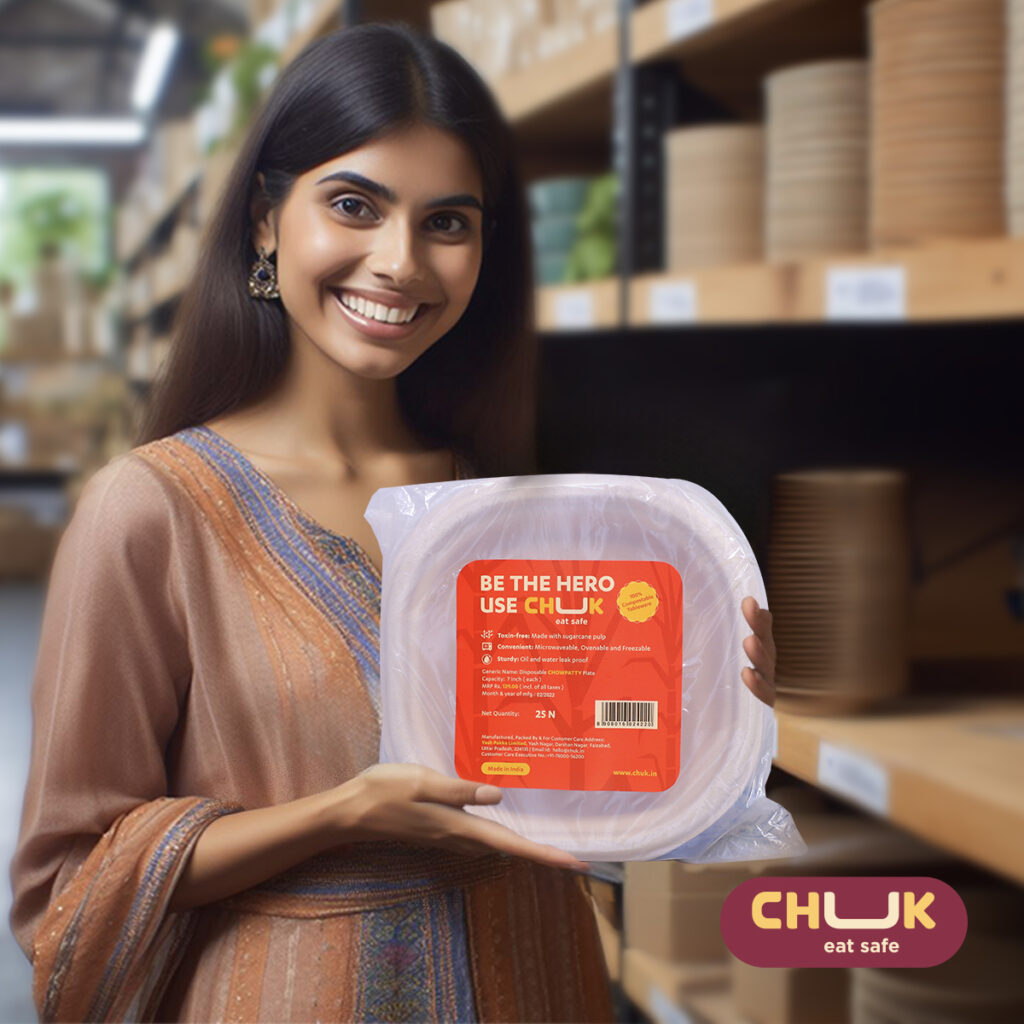
Thinking about switching to compostable disposables for your restaurant, cloud kitchen, or catering operation? Browse Chuk’s compostable tableware range built for Indian food service, from biryani containers to chai cups.