You have probably heard the pitch a hundred times by now: “India is banning plastic, so compostable tableware is the next big thing.” And honestly, there is truth in it. But the honest truth about this market is more nuanced than a single headline.
If you are evaluating the compostable tableware space as a business opportunity, whether as a manufacturer, distributor, caterer, or restaurant chain owner, this is the no-fluff breakdown of what the market actually looks like in 2026.
Key Takeaways
- India’s biodegradable tableware and packaging market is valued at approximately USD 2.15 billion (2024), growing at 6-8% CAGR toward USD 3.23 billion by 2030.
- The single-use plastic ban (July 2022) and CPCB enforcement have created a regulatory floor that guarantees sustained demand.
- Commercial food service (restaurants, QSRs, catering) accounts for over 62% of market demand.
- Bagasse (sugarcane fibre) dominates raw materials with a 38.4% share due to cost-effectiveness and India’s sugarcane surplus.
- Entry barriers are moderate, but illegal plastic competition and price sensitivity remain real challenges to navigate.
The Market Size: Where India Stands Right Now
Let’s start with what matters most: the numbers.
India’s biodegradable tableware and packaging products market was valued at USD 2.15 billion in 2024. Industry projections place it at USD 3.23 billion by 2030, growing at a steady CAGR of 6.0%.
Here is what that looks like in context:
| Metric | Value |
|---|---|
| India market size (2024) | USD 2.15 billion |
| Projected size (2030) | USD 3.23 billion |
| CAGR (2024-2030) | 6.0% |
| Global market (2030 est.) | USD 24.69 billion |
| Commercial segment share | 62.4% |
| Dominant raw material | Bagasse (38.4% share) |
India is expected to register among the highest growth rates globally through 2033. The reasons are straightforward: urban expansion, a booming food delivery infrastructure, and government policy that is not going away.
Why Now? The Regulatory Push You Cannot Ignore
The Single-Use Plastic Ban
India implemented a nationwide ban on select single-use plastic items on July 1, 2022, under the Plastic Waste Management Rules, 2016 (amended). This was not a suggestion. It was enforced with teeth:
- Fines up to Rs 1 lakh per offence under the Environment (Protection) Act
- Imprisonment up to 5 years for severe or repeated violations
- Special Task Forces operating in every state for enforcement
- Over 7.75 lakh kg of illegal plastic seized and Rs 5.8 crore in penalties collected in the first month alone
What Changed in 2025
Starting July 2025, every piece of plastic packaging requires a QR code or barcode for traceability. Extended Producer Responsibility (EPR) now mandates that producers collect and recycle the exact volume of plastic they introduce.
For compostable tableware businesses, this means two things:
- Demand is structurally guaranteed. The regulatory floor keeps rising. Restaurants, caterers, and cloud kitchens cannot legally fall back on banned plastic items.
- Compliance is a selling point. As a distributor or manufacturer of compostable disposables, you are not just selling plates. You are selling legal peace of mind.
Key Regulatory Bodies to Know
| Body | Role |
|---|---|
| CPCB (Central Pollution Control Board) | National enforcement, SUP ban compliance |
| MoEFCC | Policy framework for plastic waste management |
| State PCBs (SPCBs) | State-level enforcement and monitoring |
| BIS | Standards for compostable products (IS/ISO 17088) |
Where the Demand Actually Comes From
What they don’t tell you is that the compostable tableware market is not driven by individual households buying plates for home use. The real volume comes from commercial food service.
Demand Breakdown by Segment
| Segment | Market Share | Key Drivers |
|---|---|---|
| Restaurants, QSRs, Cloud Kitchens | ~62% | Delivery packaging, dine-in disposables, compliance |
| Catering and Events | ~18% | Weddings, corporate events, festival gatherings |
| Institutional (hospitals, schools, offices) | ~12% | Bulk contracts, canteen supplies |
| Household | ~8% | Growing but small; price-sensitive |
As a restaurant owner or caterer evaluating this space, you already know the demand from your own operations. Every parcel order on Swiggy or Zomato needs packaging. Every event needs plates, bowls, and cutlery.
The question is not whether the demand exists. It is how to position yourself to capture it.
Raw Materials: Understanding Your Options
The material you choose determines your cost structure, product quality, and market positioning. Here is the honest comparison:
Material Comparison
| Material | Cost | Durability | Heat Resistance | Availability in India | Market Share |
|---|---|---|---|---|---|
| Bagasse (sugarcane fibre) | Low-Medium | High | Microwave/oven safe | Abundant (India is the world’s 2nd largest sugarcane producer) | 38.4% |
| Bamboo | Medium | High | Good | Moderate (NE India) | Growing |
| Palm Leaf | Low | Medium | Good | Seasonal, regional | Niche |
| Cornstarch (PLA) | High | Medium | Limited | Import-dependent | Small |
| Wood/Birch | Medium-High | High | Good | Limited domestic supply | Cutlery-focused |
Bagasse leads for a reason. India crushes over 350 million tonnes of sugarcane annually, making raw material supply consistent and local. If you are entering the manufacturing side, proximity to sugar mills gives you a cost advantage that is hard to beat.
Regional Opportunities: Where to Focus
Not all of India is at the same stage of adoption. Here is where the market concentration stands:
| Region | Market Share | Why It Matters |
|---|---|---|
| North India (UP, Delhi-NCR, Haryana) | 33%+ | Largest consumer base, strongest enforcement, proximity to sugarcane belt |
| West India (Mumbai, Pune, Gujarat) | ~25% | Major manufacturing hub, high QSR density |
| South India (Bangalore, Hyderabad, Chennai) | ~22% | Fastest growth rate (6.8%+), tech-driven food delivery adoption |
| East India | ~15% | Emerging market, lower penetration but rising awareness |
For distributors, North and West India offer the highest immediate volume. For manufacturers looking at new capacity, South India’s growth trajectory makes it worth serious evaluation.
Five Realistic Business Models to Consider
1. Manufacturing (Bagasse Tableware)
- Investment: Rs 50 lakh to Rs 3 crore depending on scale
- Key requirement: Proximity to sugarcane mills for raw material
- Margin potential: 20-35% at scale
- Certification needed: BIS (IS/ISO 17088), FSSAI (food contact)
2. Distribution and Wholesale
- Lower capital requirement than manufacturing
- Focus: Building relationships with restaurants, catering companies, and institutional buyers
- Margin: 15-25% depending on volume and exclusivity agreements
3. White-Label and Custom Branding
- Opportunity: Many restaurants and cloud kitchen chains want branded packaging
- Value add: Printing, custom sizing, and design differentiation
- Growing demand from D2C food brands wanting sustainable packaging identity
4. Food Delivery Platform Partnerships
- Zomato and Swiggy are actively looking for sustainable packaging partners
- Institutional contracts offer volume stability
- Chuk’s own partnerships with major platforms demonstrate this model works
5. Export
- Target markets: UK, Australia, EU (all tightening plastic regulations)
- Margin advantage: 30-50% higher realisation compared to domestic pricing
- Requirement: International certifications (EN 13432, ASTM D6400)
The Challenges: What Could Go Wrong
Being transparent about the risks is just as important as highlighting the opportunity.
Price Gap
Compostable disposables still cost 2-3x more than conventional plastic alternatives. For mass-market adoption, especially among street food vendors and smaller eateries, this remains the biggest hurdle. Costs are coming down, but slowly.
Illegal Plastic Competition
Despite the ban, illegal plastic manufacturing and sale continues. In price-sensitive markets, enforcement gaps allow banned items to persist. This undercuts legitimate compostable tableware businesses on price.
Raw Material Seasonality
Bagasse availability is tied to the sugarcane crushing season (October to March). Off-season procurement requires storage infrastructure or alternative supply arrangements.
Composting Infrastructure
Here is what most market reports skip: compostable products need proper composting facilities to actually decompose. India’s industrial composting infrastructure is still developing. Without it, compostable products in landfills may not break down as intended.
Certification and Compliance Costs
Meeting BIS, ISO 17088, and FSSAI standards requires investment in testing, documentation, and ongoing compliance. Budget for this from day one.
How Compostable Disposables Fit Into Your Existing Business
If you are already running a restaurant, catering business, or food service operation, the compostable tableware market presents a dual opportunity:
- Reduce your own compliance risk by switching to certified compostable disposables for your daily operations
- Explore the supply side by becoming a local distributor for brands like Chuk that manufacture sugarcane bagasse tableware at scale
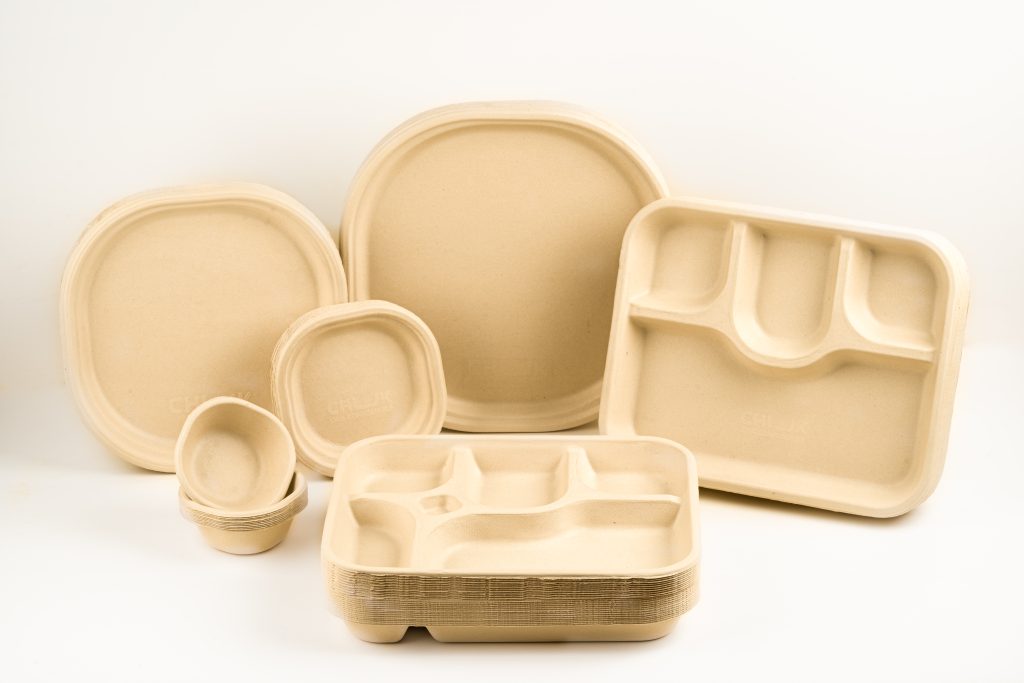
Chuk’s product range, from plates and bowls to meal trays and clamshells, is designed specifically for the commercial food service workflow. They are microwave-safe, leak-resistant, and certified compostable, which means they check the compliance box while performing the way your kitchen needs them to.
The point is not to sell you on a brand. It is to show that established supply chains already exist. You do not need to build everything from scratch.
Getting Started: A Practical Checklist
Whether you are entering as a manufacturer, distributor, or switching your operations to compostable disposables, here is your starting point:
- [ ] Research your local SPCB requirements for manufacturing or selling compostable products
- [ ] Identify your target segment (restaurants, catering, institutional, or export)
- [ ] Evaluate raw material access (proximity to sugarcane mills for bagasse)
- [ ] Get BIS and FSSAI certifications sorted before you start selling
- [ ] Build a sample kit and start with pilot orders from local restaurants and caterers
- [ ] Connect with food delivery platforms for institutional partnership opportunities
- [ ] Track CPCB enforcement updates as regulations continue to tighten
In a Nutshell
The compostable tableware market in India is not a speculative bet anymore. It is a structurally supported business opportunity backed by regulation, rising consumer awareness, and a food service industry that is physically unable to go back to banned plastics.
The market is projected to nearly double from USD 2.15 billion to USD 3.23 billion by 2030. Commercial food service drives over 62% of demand. Bagasse leads as the most cost-effective raw material, and India happens to be the world’s second-largest sugarcane producer.
The challenges are real, particularly the price gap and illegal competition. But for operators who get the positioning right, whether in manufacturing, distribution, or simply switching their own food business to compostable disposables, the timing has never been better.
Frequently Asked Questions
What is the current market size of the compostable tableware industry in India?
India’s biodegradable tableware and packaging products market was valued at approximately USD 2.15 billion in 2024. It is projected to grow at a CAGR of 6.0% and reach USD 3.23 billion by 2030, driven primarily by the single-use plastic ban and expanding food delivery infrastructure.
How does the single-use plastic ban affect food service businesses?
The ban, enforced since July 2022 under the Plastic Waste Management Rules, prohibits the manufacture, sale, and use of specified single-use plastic items. Penalties include fines up to Rs 1 lakh per offence and imprisonment up to 5 years. Food service businesses must switch to compliant alternatives like compostable disposables, paper-based packaging, or reusable options.
Why is sugarcane bagasse the most popular raw material for compostable tableware?
Bagasse accounts for 38.4% of the raw material market share because of three factors: India is the world’s second-largest sugarcane producer ensuring consistent supply, the cost of bagasse is significantly lower than alternatives like PLA or bamboo, and the resulting products offer high durability with microwave and oven safety.
Can a small business or startup enter the compostable tableware market?
Yes. While manufacturing requires Rs 50 lakh to Rs 3 crore in investment, lower-capital entry models exist. Distribution, white-label branding, and becoming a local supplier for restaurant clusters all have lower barriers. The key is securing BIS (IS/ISO 17088) and FSSAI certifications and building reliable supply chain relationships.
How do compostable disposables compare to plastic alternatives in cost?
Compostable disposables currently cost 2-3x more than conventional plastic alternatives. However, the price gap is narrowing as production scales up. More importantly, the cost calculation has changed since the plastic ban. Using banned plastics risks fines of Rs 1 lakh per offence, which makes the “cheaper” option significantly more expensive when compliance costs are factored in.
What certifications are needed to manufacture or sell compostable tableware in India?
You need BIS certification (conforming to IS/ISO 17088 for compostability standards), FSSAI approval for food-contact materials, and compliance with the Plastic Waste Management Rules. For export, additional certifications like EN 13432 (EU) or ASTM D6400 (US) may be required depending on target markets.
Moving off plastic usually starts with the plate
The plate is where most kitchens start when they move off plastic. CHUK’s compostable bagasse plates take hot, oily and wet food without going limp, and they compost after use.
Browse compostable plates | Order a sample box | Get pricing on WhatsApp