Key Takeaways
- India’s green packaging market is projected to grow at 22.5% CAGR, reaching USD 57.2 billion by 2033 — local food businesses are driving this shift.
- Zomato’s Plastic-Free Future Program already covers 10,000+ restaurants across 490+ cities. Swiggy’s Packaging Assist connects restaurants with compostable suppliers.
- FSSAI’s 2025 packaging regulations and single-use plastic bans are making sustainable packaging a compliance requirement, not a choice.
- Compostable disposables cost 10-15% more per unit — but lifecycle savings from waste fees, compliance costs, and customer retention often cancel that gap out.
- Sustainability is not charity work. It is a competitive advantage that directly impacts your margins, your ratings, and your ability to stay on delivery platforms.
The Honest Truth About Sustainability in Indian Food Businesses
Here is what nobody tells you about sustainability in the food service industry: it is not about saving the planet. Not primarily. It is about saving your business.
If you are a restaurant owner, caterer, or cloud kitchen operator in India right now, you are staring at a market that is changing faster than your menu. Single-use plastic bans are tightening. Zomato and Swiggy are introducing sustainability filters. Your customers — especially the 30% of Indian consumers who now prioritize sustainable choices — are making purchasing decisions based on your packaging.
The food businesses that figured this out early are not just surviving. They are growing. Let us look at what they are actually doing, what it costs, and whether it makes sense for your operation.
What Indian Food Businesses Are Actually Changing
Sustainability in a food business is not one big dramatic switch. It is a series of small operational decisions that compound over time. Here is what the most successful local businesses across India are doing:
Packaging Overhaul
This is the most visible change — and the one your customers notice first.
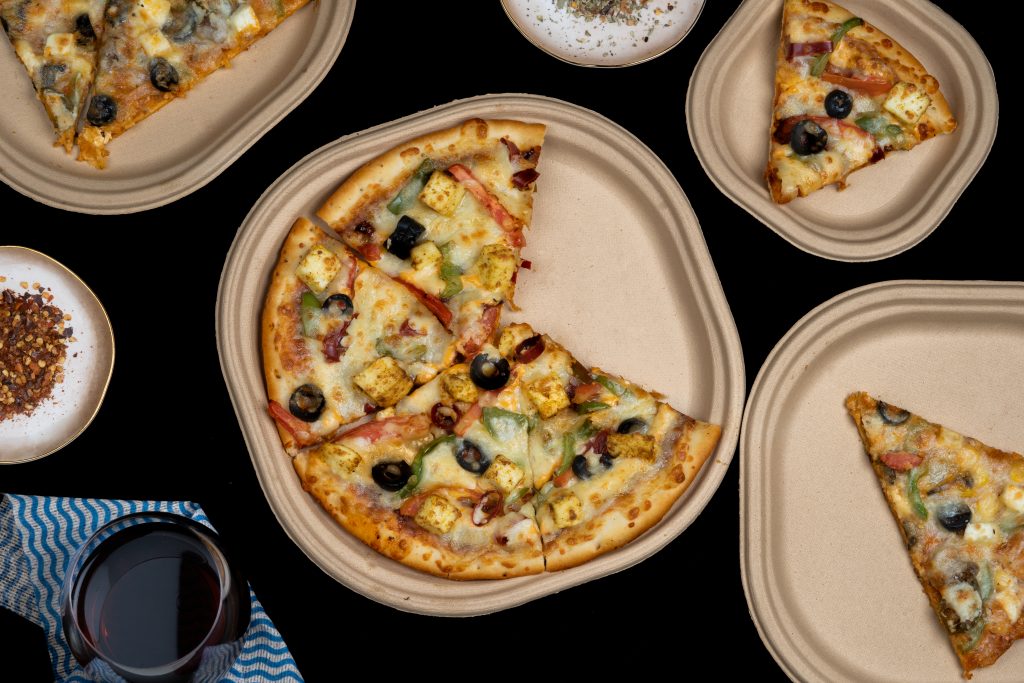
- Switching from plastic containers to compostable disposables made from sugarcane bagasse, areca leaf, or cornstarch
- Eliminating plastic cutlery in favor of wooden or compostable alternatives
- Using compostable carry bags instead of polythene
- Labeling packaging clearly so customers know it can be composted
The shift is not theoretical. India’s biodegradable food service disposables market hit USD 53.7 million in 2024 and is projected to reach USD 88 million by 2033. That growth is coming from real businesses making real switches.
Sourcing and Menu Decisions
- Local sourcing to cut transportation emissions and support regional farmers
- Seasonal menus that reduce cold storage dependency
- Root-to-stem cooking to minimize food waste
- Plant-forward menu sections that lower the carbon footprint per plate
Waste Management
- Segregation at source — wet waste, dry waste, and compostable packaging separated in the kitchen itself
- Composting programs for food scraps, sometimes in partnership with local municipal bodies
- Oil recycling partnerships that convert used cooking oil into biodiesel
The Regulatory Push You Cannot Ignore
If the business case alone does not convince you, the regulatory environment will. India’s approach to packaging regulation has shifted dramatically.
Key Regulations Impacting Food Businesses
| Regulation | What It Means for You |
|---|---|
| Single-Use Plastic Ban (2022, expanded) | Plastic plates, cups, cutlery, straws, and stirrers are banned. Violations attract fines up to Rs 1 lakh. |
| FSSAI Packaging Regulations 2025 | New rules on recycled plastics in food contact. Strict migration limits and lab testing requirements. |
| Plastic Waste Management Rules 2025 | All plastic bags and multilayered packaging must carry a barcode or QR code from July 2025. Full traceability required. |
| Extended Producer Responsibility (EPR) | Brands and producers are financially responsible for collecting and recycling the packaging they put into the market. |
The honest truth? Compliance is getting expensive for plastic users. If you are still using plastic disposables, you are not just risking fines — you are paying more for packaging that is becoming harder to source legally.
Compostable disposables side-step most of these regulations entirely. They do not fall under plastic waste management rules. They do not need barcode tracking. They decompose in 90-180 days and return to soil.
What Zomato and Swiggy Are Doing (And Why It Matters to You)
If you are a restaurant that depends on delivery orders, pay attention. The platforms are actively pushing sustainability — and it is affecting visibility.
Zomato’s Moves
- Plastic-Free Future Program (launched December 2024): Over 10,000 restaurants from 290+ brands across 490+ cities have joined
- Low Plastic Packaging filter: Customers can now filter specifically for restaurants using sustainable packaging
- Packathon 2025: A collaboration with Startup India to co-create plastic-free packaging solutions
Swiggy’s Moves
- Swiggy Packaging Assist: A marketplace with ~30 eco-friendly packaging products, connecting restaurants directly with compostable packaging vendors
- Food-grade certified materials: All products on the marketplace are verified for leak-proofing, sturdiness, and heat resistance
What does this mean practically? Restaurants using compostable packaging are getting a trust marker badge. They show up when customers apply sustainability filters. In a market where visibility on these platforms directly impacts revenue, this is not a feel-good initiative. It is a distribution advantage.
The Real Cost Breakdown: Compostable vs. Plastic
Let us talk money. Because if you are running a food business, that is what matters.
Per-Unit Cost Comparison
| Item | Plastic (Approx.) | Compostable (Approx.) | Difference |
|---|---|---|---|
| 500ml container with lid | Rs 2.50-3.00 | Rs 3.50-4.50 | +30-50% |
| Cutlery set (fork, spoon, knife) | Rs 1.50-2.00 | Rs 2.50-3.50 | +40-75% |
| Carry bag | Rs 1.00-1.50 | Rs 2.00-3.00 | +50-100% |
| 7-inch round plate | Rs 1.00-1.50 | Rs 2.00-2.50 | +40-65% |
Yes, compostable disposables cost more per unit. That is the honest truth. But the per-unit comparison is misleading. Here is why.
The Hidden Costs of Sticking with Plastic
- Compliance fines: Up to Rs 1 lakh per violation under single-use plastic bans
- EPR fees: Annual registration and recycling contribution costs
- Waste management charges: Plastic waste collection and disposal is getting pricier as municipalities crack down
- Lost platform visibility: No sustainability badge means fewer eyeballs on Zomato and Swiggy
- Customer churn: 30% of Indian consumers actively prefer sustainable options — losing them costs more than the packaging difference
The Business Gains from Switching
- Zero compliance risk on plastic waste regulations
- Higher platform visibility through sustainability badges and filters
- Customer retention and word-of-mouth from conscious consumers
- Premium pricing potential: Businesses using compostable packaging report that customers accept 5-10% higher prices without pushback
- Waste management savings: Compostable waste is simpler and cheaper to manage than segregated plastic waste
When you factor in total cost of ownership — not just the per-unit price — the gap narrows significantly. For many businesses, it disappears entirely.
How Local Businesses Are Making It Work: Practical Playbook
You do not need a massive budget or a sustainability department. Here is how small and mid-sized food businesses across India are making the switch practically.
Step 1: Start with High-Visibility Items
Do not overhaul everything at once. Start with what your customers see and touch:
- Containers and plates — switch to bagasse-based compostable options
- Cutlery — replace plastic forks and spoons with wooden or cornstarch alternatives
- Carry bags — move to compostable or paper bags
These three changes cover 70-80% of your customer-facing packaging and make an immediate visual impact.
Step 2: use Platform Marketplaces
- Use Swiggy Packaging Assist to source compostable packaging at competitive rates
- Apply for Zomato’s Plastic-Free Future Program to get the trust badge
- Negotiate bulk rates directly with compostable packaging suppliers for better pricing
Step 3: Communicate the Switch
Your customers want to know. Tell them.
- Add a line on your menu or packaging: “Served in 100% compostable packaging”
- Post the switch on your social media — before-and-after content performs well
- Train your delivery and counter staff to mention the packaging when handing over orders
Step 4: Track and Optimize
- Monitor your packaging costs monthly for the first quarter
- Track customer feedback and online reviews mentioning packaging
- Compare waste management costs before and after the switch
The Market Is Moving — With or Without You
India’s green packaging market is growing at 22.5% CAGR. The food and beverage packaging market will hit USD 52.49 billion by 2030. Online food delivery apps are generating an estimated 22,000 tonnes of plastic waste per month — and the regulatory and consumer backlash against that is only intensifying.
The food businesses that are switching to compostable disposables and sustainable operations are not doing it because it feels good. They are doing it because:
- Their customers demand it
- Their delivery platforms reward it
- Their compliance costs drop
- Their margins improve over time
This is not a trend. It is an operational shift. And the window to be early is closing.
In a Nutshell
Local food businesses across India are going sustainable — not because of moral obligation, but because it makes hard business sense. Between tightening regulations (FSSAI 2025, single-use plastic bans, EPR mandates), platform incentives (Zomato and Swiggy sustainability badges), and shifting consumer preferences, the math now favors compostable disposables and sustainable operations.
The per-unit cost is higher. The total cost of ownership is often lower. And the competitive advantage — in platform visibility, customer retention, and compliance simplicity — is real.
If you are a restaurant owner, caterer, or cloud kitchen operator, the question is not whether to switch. It is how fast you can.
Frequently Asked Questions
Are compostable disposables really more expensive than plastic?
Per unit, yes — typically 30-75% more depending on the item. But the total cost comparison flips when you factor in compliance fines, EPR fees, waste management costs, and lost customer revenue from not having sustainability badges on delivery platforms. Many businesses report break-even within 3-6 months of switching.
What are the FSSAI rules on compostable packaging for food businesses?
FSSAI’s 2025 Packaging Regulations primarily target recycled plastics, requiring strict migration testing and lab certification. Compostable disposables made from sugarcane bagasse, areca leaf, or other plant-based materials fall outside plastic waste regulations entirely. However, they must still meet general food safety standards — look for FDA-approved, food-grade certified products.
Will switching to compostable packaging affect my food delivery ratings?
Likely positively. Zomato’s Plastic-Free Future Program gives participating restaurants a trust badge visible to customers. The platform’s Low Plastic Packaging filter means sustainability-conscious customers can find you specifically. Swiggy’s Packaging Assist similarly connects you with certified eco-friendly packaging vendors.
How do I start switching without a big upfront investment?
Start with the three items customers touch most: containers, cutlery, and carry bags. Use Swiggy Packaging Assist or negotiate bulk rates with local compostable packaging suppliers. A typical small restaurant (50-100 orders/day) can expect an additional Rs 3,000-5,000/month in packaging costs — often offset by reduced waste management charges and increased customer retention.
What happens to compostable disposables after use? Do they actually decompose?
Compostable disposables made from sugarcane bagasse break down within 90-180 days in composting conditions, returning safely to soil. They do not leave behind microplastics. In landfill conditions, decomposition takes longer but still occurs — unlike plastic, which persists for 400+ years. For best results, customers should dispose of them in wet waste bins.
Is there government support for food businesses switching to sustainable packaging?
India’s PLI Scheme for Food Processing Industries supports capacity building in the sector. Several state governments offer incentives for businesses adopting sustainable practices. Also, being compliant with plastic waste management rules means you avoid the cost of fines and EPR obligations — which is itself a form of financial benefit.