How restaurants can embrace a circular economy: a practical playbook for food service operators
Every restaurant generates waste. That part is unavoidable. But where that waste ends up, what it costs you every month, and whether any of it circles back into something useful — that is where the circular economy enters the picture.
India’s food service sector generates roughly 11.9 million tonnes of food waste every year, and industry estimates put waste at around 14% of total operating expenses. If you run a restaurant, cloud kitchen, or catering operation, those numbers are real money walking out of your back door daily.
The honest truth? Most restaurant owners treat waste as a fixed cost. A circular economy flips that. Instead of extract-use-dispose, you run on a use-return-reuse cycle where waste from one process feeds the next.
Here is what that looks like for your restaurant.
Key Takeaways
- A circular economy turns restaurant waste into inputs for composting, energy generation, or supplier partnerships instead of landfill
- Indian restaurants spend 10-15% of operating costs on waste disposal — circular practices cut that by 30-40%
- Switching from plastic to compostable disposables is the fastest circular economy move for food service operators
- Local sourcing, composting, portion control, and packaging redesign are the four pillars of a circular restaurant
- These practices line up directly with FSSAI compliance, Swachh Bharat mandates, and what customers now expect on sustainability
What a circular economy actually means for your restaurant
In a linear economy (how most restaurants still operate), the flow is simple: buy ingredients, cook, serve on disposable plates, everything leftover goes into the garbage.
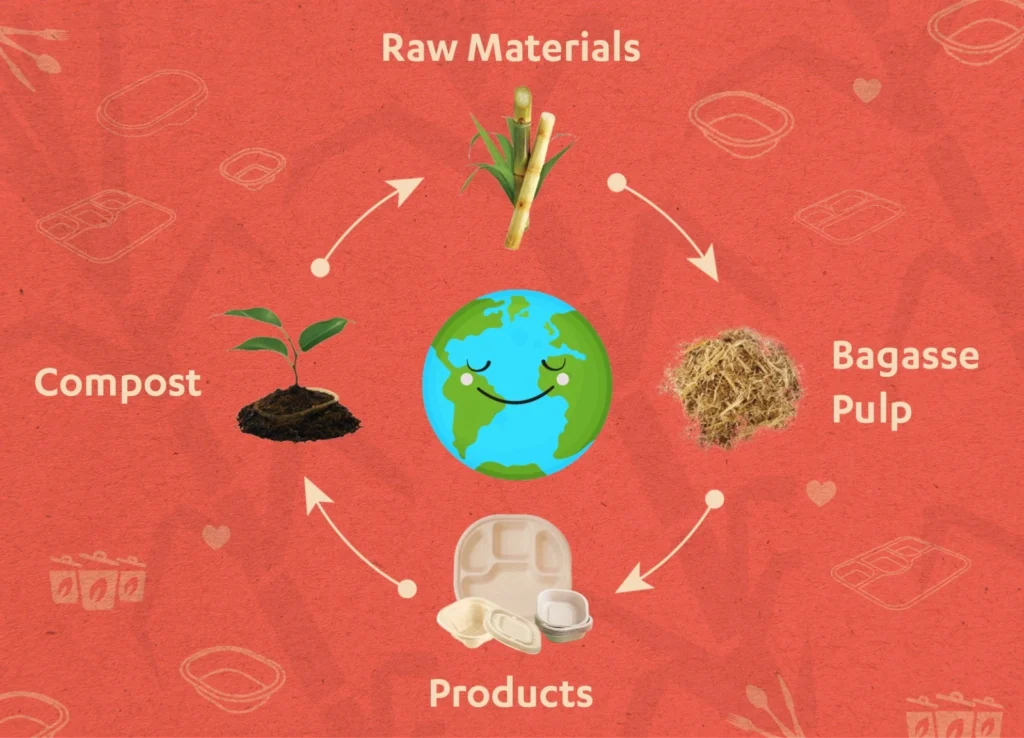
A circular economy redesigns that flow so waste loops back into the system:
- Food scraps go into composting units instead of landfills, producing fertiliser for local farms that supply your kitchen
- Packaging is compostable, breaks down in 60-90 days and returns nutrients to the soil
- Used cooking oil gets collected and converted to biodiesel instead of clogging drains
- Surplus food reaches community kitchens or staff meals instead of dumpsters
The goal is not zero waste overnight. It is closing loops wherever your operation currently leaks money and materials.
Linear vs circular economy: what it means for your restaurant
If you recognise your current operation in the left column, every item on the right is a saving opportunity.
| Area | Linear (use and dispose) | Circular (use and return) |
|---|---|---|
| Ingredients | Distant suppliers, high transport costs, seasonal waste | Local farms, lower transport, supplier takes back organic waste |
| Food prep waste | Goes to garbage, per-kg disposal fees | On-site composting or biogas, compost sold or used |
| Packaging (dine-in) | Plastic plates and cups, waste surcharges | Compostable disposables, lower disposal rates |
| Packaging (delivery) | Plastic containers, regulatory risk, negative perception | Bagasse containers, full compliance, brand lift |
| Surplus food | Thrown away, pure food cost loss | Donated, repurposed for staff meals, or composted |
| Cooking oil | Dumped with mixed waste, drainage problems | Biodiesel processors collect it (some pay you) |
| Energy | Grid electricity, no waste recovery | Biogas offsets fuel costs, efficient equipment cuts bills 15-20% |
| Waste disposal cost | INR 5,000-15,000/month, rising 10-15% yearly | INR 2,000-8,000/month, drops as composting matures |
That right column is not theoretical. Restaurants across Bengaluru, Pune, Mumbai, and Chennai already operate this way.
Six practical steps to build a circular restaurant
1. Source locally and build supplier loops
This one has nothing to do with packaging. It starts with your supply chain.
When you source vegetables, dairy, and grains from farms within 50-100 km:
- Transportation costs drop
- Produce arrives fresher, so you lose less to spoilage
- You can negotiate waste return arrangements where the supplier takes back organic waste for composting
Some operators in south India have arrangements where farm suppliers collect kitchen scraps during their regular delivery runs. The compost feeds their fields, and your food cost stays stable because the supplier’s input costs go down too.
2. Audit your waste streams before spending a rupee
Before you invest in anything, you need to know where your waste actually comes from. Run a one-week waste audit:
- Weigh every category separately: food prep waste, plate waste, packaging waste, cooking oil, general trash
- Track by meal period — lunch and dinner generate different waste profiles
- Identify the top three waste categories by weight and by cost
Most operators are surprised by the results. Plate waste often outweighs prep waste, and packaging waste from delivery can exceed dine-in waste by 3-4x in cloud kitchens. You cannot close loops you have not measured.
3. Switch to compostable disposables for dine-in and delivery
For most food service operators, replacing plastic plates, bowls, cups, and delivery containers with compostable disposables is the move that pays back fastest.
It simplifies waste segregation because compostable packaging goes into the organic waste stream with food scraps. No more sorting plastic from food waste, which your staff never do properly under time pressure anyway.
It removes regulatory risk. India’s Plastic Waste Management Rules have been tightening since 2022, and states like Maharashtra, Karnataka, and Tamil Nadu run active enforcement drives. Compostable packaging means zero fines.
And it cuts disposal costs. Organic waste disposal rates are lower than mixed waste rates in cities with segregation mandates. High volume operators save INR 3,000-6,000 per month on waste bills alone.
Compostable containers from sugarcane bagasse handle temperatures up to 120 degrees Celsius, resist oil and grease without chemical coatings, and hold up during delivery. For delivery heavy operations, this also protects your Swiggy and Zomato ratings — sturdier containers, fewer complaints about leaking or crushed food, and better heat retention than thin plastic.
4. Start composting, even at small scale
You do not need an industrial composting setup on day one. Start with what makes sense for your volume.
If you do 50-100 covers a day, a basic composting bin in your backyard or terrace handles food prep waste. If space is tight, partner with a local composting service for pickup. Municipal corporations in Bengaluru and Pune offer subsidised composting units for commercial kitchens.
For 200+ cover operations, on-site composting machines process up to 100 kg of organic waste daily and produce usable compost within 24 hours. Hotels and large restaurants using these report saving INR 10 lakh or more per year on waste management.
What goes in: vegetable peels and trimmings, plate waste, compostable packaging (bagasse plates, containers, cups), coffee grounds, tea leaves, eggshells, paper napkins.
When your packaging is compostable, everything from the dining table and delivery bag goes into the same bin. That matters in a fast moving kitchen where nobody has time to sort twelve different waste categories.
5. Tackle food waste with portion control and menu engineering
Food waste is the biggest cost leak in most restaurant operations. A circular approach works both ends: reduce what gets wasted and pull value from what does.
To reduce waste at the source:
- Analyse plate waste data. If a dish consistently comes back half-eaten, the portion is wrong or the dish needs reworking.
- Offer half portions on high waste items. Many customers actually prefer it, and you cut food cost per cover.
- Train kitchen staff on FIFO inventory rotation. Spoilage from poor stock management is money in the bin.
- Prep based on historical order data, not guesswork.
To recover value from surplus:
- Partner with Feeding India, Robin Hood Army, or local NGOs. You may qualify for tax deductions under Section 80G.
- Repurpose day-old bread into croutons, vegetable trimmings into stock, overripe fruit into smoothies. This is how circular kitchens operate day to day.
6. Close the energy loop
Energy is the piece of restaurant circularity that gets overlooked because it is less visible than packaging or food waste.
Small scale biogas digesters convert organic waste into cooking gas. For restaurants generating 50+ kg of food waste daily, a biogas unit offsets 15-20% of your LPG costs.
On the equipment side, replacing older refrigeration, switching to LED lighting, and using induction cooking cuts electricity bills 15-20%. Payback period is 12-18 months. Customers will not notice. Your P&L will.
The compliance angle you cannot afford to ignore
Circular economy practices are not just smart business. They are increasingly mandatory.
Regulatory space as of 2026:
- Plastic Waste Management Rules: single-use plastics banned nationally since 2022, state level enforcement expanding to food service packaging. Fines INR 10,000-25,000 per violation.
- Swachh Bharat Mission: bulk waste generators (including restaurants above a certain size) must segregate and process organic waste on-site or through authorised agencies.
- FSSAI packaging standards: food contact materials must meet safety and labelling requirements. FSSAI compliant compostable disposables keep you clear of inspections.
- Extended Producer Responsibility (EPR): using compliant packaging from EPR registered suppliers shields you from downstream liability.
For franchise operators and multi-location chains, standardising on circular practices across outlets simplifies compliance when you operate across states with different enforcement timelines.
What this costs and what it saves
Realistic numbers for a mid size restaurant doing 150-200 covers daily.
Upfront: compostable disposables carry a 15-25% premium per unit (INR 1-2 more per container). A basic composting setup runs INR 15,000-50,000. The waste audit is free if you do it with existing staff.
Monthly savings (visible by month 3-6): INR 3,000-7,000 on waste disposal, 5-8% food cost reduction from portion control, zero regulatory fines, and INR 2,000-5,000 from energy efficiency.
No single change looks dramatic. Stack them and you are looking at a different P&L within two quarters.
In a Nutshell
A circular economy for your restaurant is not an environmental gesture. It is an operating model that runs cheaper and keeps you ahead of where Indian regulations are going.
Four moves pay back fastest: switch to compostable disposables, start composting organic waste, tighten portion control, and source locally. Each one plugs a hole where your business currently loses money.
Nobody making this shift got there by reading a sustainability report. They got there because waste disposal costs kept climbing, plastic bans kept expanding, and their customers started paying attention to packaging.
If you are wondering where to start, the waste audit from step two will answer that within a week.
Frequently asked questions
What is a circular economy in the context of restaurants?
It means redesigning operations so waste loops back into the system instead of going to landfill. Food scraps become compost, packaging breaks down and returns to soil, cooking oil converts to biodiesel, surplus food reaches communities. The goal is not zero waste but closing as many loops as your operation allows.
How much can a restaurant save by adopting circular economy practices?
A mid size restaurant doing 150-200 covers daily typically saves INR 5,000-12,000 per month within 3-6 months. Lower waste disposal costs make up the bulk of it, with food cost reductions and energy savings adding to the total. The per-unit premium on compostable packaging gets offset by reduced disposal fees and zero regulatory fines.
Is composting practical for small restaurants with limited space?
Yes. A basic composting bin handles prep waste for a 50-100 cover operation. If space is tight, partner with a local composting service for scheduled pickup. Municipal corporations in Bengaluru, Pune, and Chennai offer subsidised units for commercial kitchens.
How do compostable disposables fit into a circular economy?
They are one of the most direct wins. Plastic goes to landfill and stays for centuries. Compostable packaging from sugarcane bagasse breaks down in 60-90 days and returns nutrients to the soil. For your restaurant, this means packaging and food waste go into the same organic waste bin, which simplifies segregation and lowers disposal costs.
Will switching to circular practices affect my food quality or delivery experience?
If anything, it improves things. Bagasse containers insulate better than thin plastic, so food stays warmer during delivery. Thicker walls mean less crushing in the delivery rider’s bag. Restaurants that switched report fewer packaging complaints on Swiggy and Zomato. And local sourcing means fresher ingredients, which shows up on the plate.
Where should a restaurant start with circular economy adoption?
A one-week waste audit. Weigh and categorise everything your kitchen throws away. The data shows you where you are losing the most money. For most operators, switching to compostable disposables has the highest immediate impact because it solves waste segregation, compliance, and customer perception in one move. Composting and food waste reduction follow naturally after that.
Ready to close the packaging loop first? Explore Chuk’s full range of compostable disposables built for Indian kitchens — delivery containers, plates, bowls, and cutlery. FSSAI compliant, built for heat and oil, and fully compostable within 90 days.