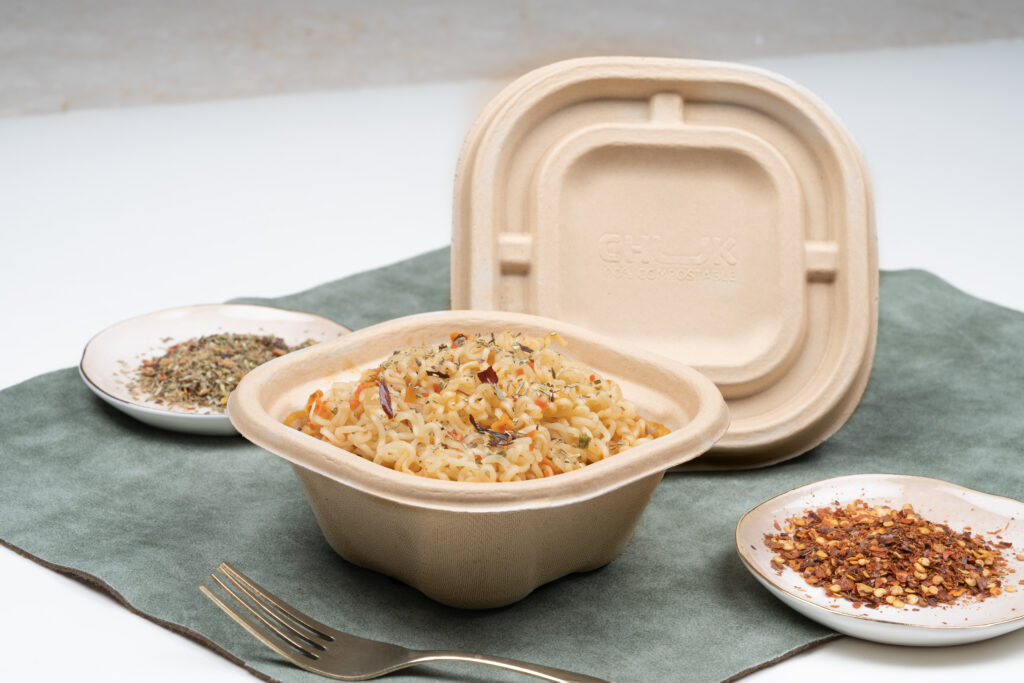
How to choose the right food delivery packaging for your restaurant in 2026
Your food left the kitchen perfect. Biryani layered right, gravy sealed hot, dessert plated clean. Thirty minutes later, a customer opens a soggy box, snaps a photo, and posts a 2-star review on Zomato.
The honest truth? Most delivery complaints have nothing to do with your cooking. They start the moment food hits the wrong container.
If you run a restaurant, cloud kitchen, or takeaway brand in India, the container you choose is the last point of quality control before your food reaches the customer. Get it wrong and your ratings drop, returns spike, and repeat orders vanish. Get it right and your packaging quietly becomes your best brand ambassador.
This guide breaks down exactly how to match packaging to cuisine type, what Zomato and Swiggy actually expect, and where compostable disposables fit into the equation for restaurants that want to stay future-ready.
Key Takeaways
- Wrong packaging is the top reason for poor delivery ratings, not food quality
- Every cuisine type (biryani, curry, Chinese, desserts, beverages) needs a specific container format
- Zomato and Swiggy both have packaging standards that directly affect your listing visibility
- Compostable disposables meet FSSAI compliance and signal quality to customers
- Leak-proof, ventilated, and compartmented containers solve 90% of delivery packaging failures
- Packaging upgrades of INR 2-4 per order pay for themselves through better ratings and repeat orders
Why food packaging is a core business decision, not an afterthought
As a restaurant owner, you already know food cost, labour, and rent inside out. But packaging? Most operators treat it as a line item to minimise. That thinking costs you more than you realise.
Here is what packaging actually controls in a delivery-first operation:
- Food temperature and texture — the difference between crispy and soggy on arrival
- Leak and spill prevention — one curry leak ruins the entire order and triggers a refund
- Brand perception — customers judge your restaurant before the first bite, based on what they unbox
- Platform ratings — Zomato and Swiggy factor packaging complaints into your restaurant score
- Compliance — FSSAI food-contact regulations apply to every container your food touches
The uncomfortable truth is that a INR 3 container upgrade per order can be the difference between a 3.8 and a 4.5 rating on Swiggy. And that rating gap translates directly into order volume.
What goes wrong with delivery packaging (and how to fix it)
Before choosing containers, you need to understand the five failure modes that tank delivery orders:
1. Leaking and spill damage
Gravies, dals, and sauces leak through weak seals or ill-fitting lids. The fix: containers with secure snap-on lids and leak-proof rims. For anything liquid-heavy, a sealed inner container inside an outer box adds a safety layer.
2. Sogginess from trapped steam
Hot food in a sealed container without ventilation creates condensation. Fried items go limp. Rice turns mushy. The fix: micro-ventilated lids for fried foods, and containers that manage moisture without compromising warmth.
3. Mixed flavours from poor separation
When raita meets biryani in transit, or chutney soaks into naan, customers notice. The fix: compartmented containers or separate sauce cups for items that need to stay apart.
4. Temperature loss
Food that arrives lukewarm gets blamed on the restaurant, not the delivery rider. The fix: insulated or thick-walled containers that hold temperature. Compostable bagasse containers naturally insulate better than thin plastic.
5. Crushed or deformed packaging
Thin containers buckle under stacking. Delivery bags compress on bike rides. The fix: rigid-walled containers that maintain shape under pressure.
Packaging types matched to Indian cuisine: the complete guide
This is where most packaging guides fail you. They talk about materials in the abstract. What you actually need is a direct match between what your kitchen sends out and what container it should go in.
The cuisine-to-container matching table
| Cuisine Type | Container Format | Key Requirement | Recommended Material | Common Mistakes |
|---|---|---|---|---|
| Biryani / Pulao | Round deep container with tight lid (750ml-1000ml) | Heat retention, no steam sogginess | Bagasse with snap lid | Flat containers that compress layers; plastic that sweats |
| Curries / Gravies / Dal | Deep bowl with leak-proof sealed lid (250ml-500ml) | Zero-leak seal, stackable | Bagasse bowl with secure rim | Shallow containers that spill; lids that pop off in transit |
| Chinese / Indo-Chinese | Rectangular container with compartments | Sauce separation, noodle integrity | Compartmented bagasse tray | Single-compartment boxes where sauce drowns noodles |
| Desserts (Gulab Jamun, Kheer, Cake) | Small sealed cups or flat trays with clear lids | No movement, no spill, visual appeal | PLA-lined cups or flat trays | Oversized containers that let desserts slide and smash |
| Beverages (Lassi, Chaas, Juices) | Sealed cups with tamper-evident lids | Leak-proof, tamper-proof | PLA cups with sealed lids | Loose lids that pop during transit; no tamper evidence |
| Tandoori / Kebabs / Starters | Flat tray or clamshell with ventilation | Crispness retention, grease management | Ventilated bagasse clamshell | Sealed containers that trap steam and make items soggy |
| Rotis / Naan / Breads | Foil-lined wrap or flat clamshell | Warmth retention, flexibility | Foil wrap inside bagasse tray | Open containers that let bread dry out and turn stiff |
| Thali / Combo Meals | Multi-compartment tray with lid | Portion separation, single-pack convenience | 3-5 compartment bagasse tray | Single containers where dal leaks into rice and sabzi |
How to read this table for your kitchen
If your restaurant serves biryani and curries (which covers most North Indian cloud kitchens), your core packaging kit is:
- Deep round containers (750ml) for biryani
- Deep bowls (250-500ml) with leak-proof lids for gravies
- Flat clamshells for tandoori starters
- Multi-compartment trays for thali combos
- Sauce cups (50-100ml) for raita, chutney, pickle
That is five container types covering 80% of your menu. You do not need fifteen different packaging SKUs.
What Zomato and Swiggy actually want from your packaging
Both platforms have packaging guidelines that most restaurants either ignore or never read. Here is what matters:
Zomato packaging standards
- Tamper-evident packaging is mandatory for all delivery orders
- Containers must prevent spillage during vertical and horizontal transit
- Food-contact materials must be FSSAI-compliant
- Branded packaging with restaurant name/logo is recommended for visibility
- Sustainable packaging earns a “green badge” that improves listing visibility
Swiggy packaging standards
- Leak-proof containers required, especially for liquids and gravies
- Adequate insulation for hot food items
- Proper sealing that survives bike transit across Indian road conditions
- Food-grade materials only — no recycled newspaper or non-food-safe plastics
- Packaging quality factors into the Swiggy restaurant score algorithm
The practical takeaway: if you are still using thin, unbranded plastic containers with loose lids, you are actively hurting your platform rankings. Both Zomato and Swiggy now factor packaging complaints into their scoring, and restaurants with consistent packaging get more visibility in search results.
Why compostable disposables make business sense for delivery
Let us address the elephant in the room. You have heard the sustainability pitch before. Here is why compostable disposables are a business decision, not just an environmental one:
- FSSAI compliance built in — compostable bagasse and PLA containers are food-grade certified, so you skip the compliance headaches that come with unverified plastic suppliers
- Better insulation — bagasse (sugarcane fibre) naturally holds temperature better than thin polystyrene or plastic, which means your food arrives warmer
- Grease and moisture resistance — quality compostable containers handle oily, spicy Indian food without breaking down during transit
- Platform advantages — Zomato’s green badge for sustainable packaging directly improves your listing visibility
- Customer perception — a growing segment of urban delivery customers actively choose restaurants that use non-plastic packaging
- Regulatory direction — single-use plastic bans are tightening across Indian states. Switching now means you do not scramble when the next regulation drops
The cost difference between bottom-tier plastic and quality compostable containers is INR 2-4 per order. On a delivery operation doing 100 orders per day, that is INR 200-400 daily. Compare that against the revenue impact of even a 0.2-point rating improvement on Swiggy or Zomato.
Chuk’s compostable container range is designed specifically for Indian food delivery — deep bowls for curries, compartmented trays for thalis, sealed cups for beverages, and clamshells for starters. All FSSAI-compliant, all built to handle the oil, spice, and heat that Indian cuisine demands.
A step-by-step packaging audit for your delivery kitchen
Not sure where to start? Run this quick audit on your current packaging setup:
- Pull your last 30 days of delivery reviews — filter for packaging complaints (leaks, sogginess, temperature, presentation). Count them.
- Map your top 10 selling delivery items — write down what container each one ships in today.
- Check the match — compare your current containers against the cuisine-to-container table above. Flag mismatches.
- Calculate the cost gap — price out the correct container for each mismatched item. The upgrade is usually INR 1-4 per container.
- Run a 2-week test — switch your top 3 delivery items to matched packaging. Track your ratings and complaint count.
- Evaluate and expand — if ratings improve (they almost always do), roll the packaging upgrade across your full delivery menu.
Most restaurant owners who run this audit find that 60-70% of their delivery complaints trace back to 2-3 packaging mismatches. Fix those and you are already ahead of most competitors in your area.
Common packaging mistakes Indian restaurants still make
After working with food businesses across India, the same mistakes keep showing up:
- Using the same container for everything — one-size-fits-all packaging means nothing fits well
- Choosing the cheapest option by default — INR 1 saved on a container costs you INR 50 in a refund or lost repeat order
- Ignoring lid quality — the lid matters more than the container for delivery. Loose lids cause 80% of spill complaints
- No tamper-evidence — customers increasingly refuse orders without tamper-proof sealing
- Skipping sauce separation — every curry order should have gravy in a separate sealed container or compartment
- Not testing under real conditions — your container should survive a 30-minute bike ride across potholes, not just a walk from kitchen to counter
In a Nutshell
Your delivery packaging is the last touchpoint before a customer judges your restaurant. And on platforms like Zomato and Swiggy, that judgment directly controls your ratings, visibility, and order volume.
The fix is not complicated. Match your container to your cuisine type — deep bowls for gravies, compartmented trays for combos, ventilated clamshells for fried items, sealed cups for beverages. Use the cuisine-to-container table in this guide as your starting checklist.
Compostable disposables from suppliers like Chuk give you FSSAI compliance, better insulation, and platform advantages in one switch. The INR 2-4 per order upgrade pays for itself through fewer complaints, better ratings, and more repeat customers.
Run the packaging audit. Fix the top 3 mismatches. Watch your delivery ratings climb.
Frequently asked questions
What is the best packaging material for Indian food delivery?
Compostable bagasse (sugarcane fibre) works best for most Indian cuisines. It handles high temperatures, resists oil and grease, insulates well, and meets FSSAI food-contact standards. For beverages and cold desserts, PLA-lined cups provide leak-proof sealing. The key is matching material to cuisine type rather than using one container for everything.
How does packaging affect my Zomato and Swiggy ratings?
Both platforms factor packaging complaints into your restaurant score. Leaks, sogginess, and presentation issues trigger negative reviews that drag your rating down. Zomato also offers a green badge for restaurants using sustainable packaging, which improves your visibility in search results. Consistent, quality packaging is one of the easiest ways to protect and improve your platform rating.
What containers should I use for biryani delivery?
Deep round containers (750ml-1000ml) with tight-fitting snap lids. The container needs enough depth to hold layered rice without compressing it, and the lid must create a seal that prevents steam from escaping and making the rice soggy. Avoid flat or shallow containers that compress biryani layers during transit.
Are compostable containers strong enough for oily and spicy food?
Yes. Quality compostable bagasse containers are specifically engineered for grease and moisture resistance. They handle hot, oily Indian food without breaking down or leaking. The key is sourcing from certified manufacturers — not all compostable containers are equal. Look for FSSAI-compliant, food-grade certified options that have been tested with Indian food conditions.
How much does it cost to upgrade delivery packaging?
The typical upgrade from basic plastic to quality compostable containers costs INR 2-4 per order. For a restaurant doing 100 delivery orders daily, that is INR 200-400 per day. Compare this against the revenue impact of packaging complaints — a single refund on a INR 500 order wipes out the packaging savings from 125-250 orders. The maths consistently favours better packaging.
Do I need different containers for dine-in and delivery?
Yes. Dine-in presentation and delivery survival are different problems. Delivery containers need leak-proof seals, structural rigidity for stacking, and insulation for transit. Dine-in can use lighter, presentation-focused options. Most restaurants maintain two packaging inventories — a delivery-optimised set and a dine-in/takeaway set. Your delivery containers should be your investment priority since platform ratings drive order volume.
Looking for compostable containers built for Indian food and Indian delivery conditions? Browse Chuk’s delivery container range or get in touch for a sample kit matched to your menu.
The container decides whether the customer orders again
Once the order leaves the kitchen the container is the only thing protecting it. CHUK’s compostable bagasse delivery containers hold heat, resist leaks and keep you clear of single-use plastic rules.
Browse delivery containers | Order a sample box | Get pricing on WhatsApp