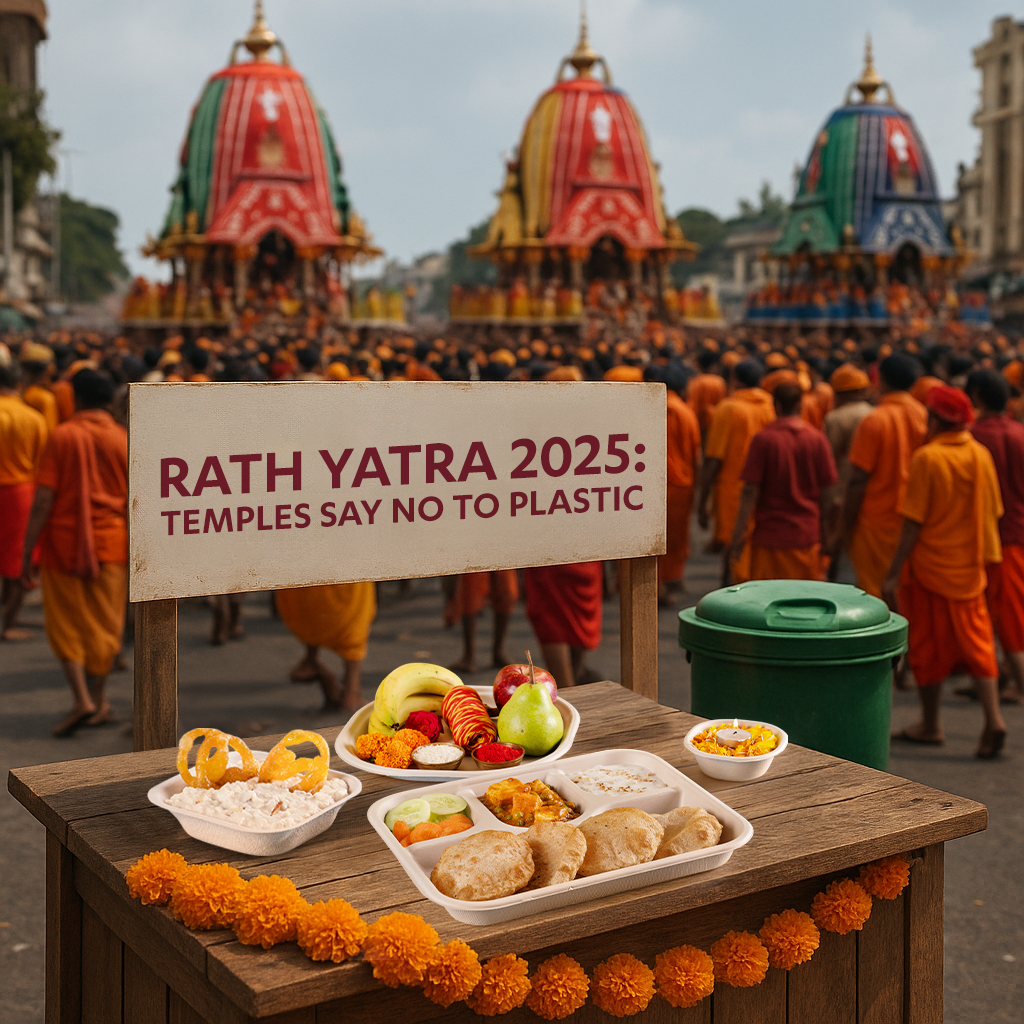
Plastic-free Rath Yatra: why Jagannath Puri and Indian temples are choosing compostable disposables
Every year, millions of devotees line the streets of Puri, Odisha, to watch the towering chariots of Lord Jagannath, Devi Subhadra, and Lord Balabhadra roll down the Bada Danda. The air fills with chants, conch shells, and the aroma of mahaprasad.
But until recently, the streets also filled with something else: plastic plates, thermocol cups, polyethene bags, and single-use bottles. Tonnes of it. Every single day of the yatra.
That is changing. The Shree Jagannath Temple Administration (SJTA), the Odisha state government, and a growing coalition of temples across India are drawing a firm line. No more single-use plastic at religious gatherings. Compostable disposables, earthenware, and leaf plates are replacing the plastic that once choked temple drains and washed into the sea.
If you organise temple events, manage prasad distribution, run a community kitchen, or cater at religious festivals — from Rath Yatra bhandaras to a full Janmashtami 56 bhog spread — this shift affects you directly. Here is what is happening, why it matters, and how to stay ahead of it.
Key Takeaways
- The SJTA has banned all single-use plastic on Jagannath Puri temple grounds and surrounding walkways during Rath Yatra
- Vendors must use compostable disposables, earthenware, or leaf plates for prasad and pilgrim meals
- Puri generates tonnes of waste daily during yatra season, with plastic historically forming the largest share
- Multiple Indian temple towns, including Prayagraj, Ranchi, Varanasi, and Ayodhya, have implemented similar bans
- Compostable disposables made from sugarcane bagasse offer the strength, heat resistance, and food safety that large-scale prasad distribution requires
What is Rath Yatra and why does waste matter here?
Rath Yatra is one of India’s most significant religious processions, centred on the worship of Lord Jagannath. Originating at the Jagannath Temple in Puri, the festival draws devotees from every corner of the country and beyond.
The scale is staggering
- Millions of pilgrims converge on Puri over the course of the festival
- Mahaprasad (the sacred temple food of Jagannath) is served on a massive scale, with the temple kitchen being one of the largest in the world
- Street food vendors, bhandara organisers, and hospitality services line every route from the temple to the Gundicha Mandir
At this volume, every plate, bowl, cup, and spoon adds up. When those items are plastic, the environmental cost is severe: clogged drains during monsoon, contaminated water flowing into the Bay of Bengal, harm to marine life, and piles of non-degradable waste in a city that holds deep spiritual significance for millions.
The honest truth about festival waste
Here is what most people do not talk about. Indian religious gatherings are among the highest-density food service events on earth. The combination of free prasad distribution, street food stalls, and community bhandaras means that disposable tableware consumption spikes dramatically for concentrated periods.
When that tableware is plastic:
- It does not decompose. A single plastic plate takes 400 to 1,000 years to break down.
- It contaminates soil and groundwater around temple complexes.
- It enters waterways. In Puri, plastic waste has been found in canals that feed into the ocean.
- It harms the sacred ecology of pilgrimage towns.
The shift to compostable disposables is not about following a trend. It is about protecting the very places that devotees travel thousands of kilometres to visit.
How Jagannath Puri is leading the plastic-free movement
The SJTA has taken a clear stance: no plastic on temple grounds, no plastic on the Bada Danda, no plastic in any vendor stall serving pilgrims during the Rath Yatra period.
What the ban covers
- Plastic plates, bowls, cups, and cutlery
- Polyethene bags of all sizes
- Plastic water bottles (only reusable or paper-based alternatives permitted in designated zones)
- Thermocol (expanded polystyrene) containers
- Plastic packaging for prasad
What vendors must use instead
| Banned Item | Approved Alternative |
|---|---|
| Plastic plates | Compostable bagasse plates, leaf pattal, or earthenware |
| Plastic bowls | Compostable bagasse bowls or earthen kulhads |
| Plastic cups | Paper cups, earthen kulhads, or bagasse cups |
| Polyethene bags | Jute bags, cloth bags, or paper bags |
| Thermocol boxes | Compostable clamshell containers |
| Plastic cutlery | Wooden or compostable spoons and forks |
This is not a suggestion. The Puri municipality enforces it with fines and vendor licence conditions. If you are a food vendor operating anywhere near the temple complex during Rath Yatra, compliance is mandatory.
Government backing
Senior government officials, including Union ministers, have publicly campaigned for a total single-use plastic ban during the Rath Yatra to Bahuda Yatra period. The messaging ties plastic-free practices directly to the spiritual values of the festival:
- Lord Jagannath’s benevolence extends to all creation, including the environment
- Keeping the Bada Danda clean is an act of devotion, not just sanitation
- The “Swachh Odisha” initiative frames environmental care as civic and spiritual duty
When a Union Minister makes a video appeal urging devotees to reject single-use plastic at Rath Yatra, the signal to vendors and organisers is unmistakable: this is the new standard.
Why compostable disposables work for temple-scale food service
As a temple organiser or event caterer, you need tableware that works under pressure. Large-scale prasad distribution is one of the most demanding food service environments anywhere: hot foods, oily gravies, outdoor serving conditions, rapid turnover, and zero tolerance for spills or breakage.
Here is why compostable disposables made from sugarcane bagasse have become the practical choice for temple events.
Performance where it counts
- Heat resistance: Bagasse plates and bowls handle temperatures well above what hot dal, rice, sabzi, and sambar require. No warping, no softening.
- Leak-proof construction: Oily foods like halwa, khichdi, and fried prasad items stay contained. No seepage through the base.
- Structural strength: Compartmented plates hold multiple items without bending. This matters when volunteers are serving hundreds of plates per minute at a bhandara line.
- No chemical coatings: Unlike many paper plates that use a plastic or wax lining to achieve leak resistance, bagasse tableware is made entirely from natural sugarcane fibre. No plastic lining. No PFAS. Food-grade safe from edge to edge.
The composting advantage
After use, compostable bagasse tableware breaks down fully in composting conditions within 90 to 180 days. Compare that to plastic:
| Factor | Plastic Plates | Compostable Bagasse Plates |
|---|---|---|
| Decomposition time | 400-1,000 years | 90-180 days |
| Recyclable in practice | Less than 10% actually recycled | Fully compostable in organic waste |
| Chemical leaching | Leaches microplastics into soil/water | No chemical residue |
| Temple waste stream | Requires segregation and transport to landfill | Goes directly into organic waste or composting |
| Suitability for hot food | Warps at high temperatures (thermocol) | Handles hot, oily, and wet foods |
For temple complexes that generate enormous volumes of post-meal waste daily, the ability to route all used tableware into organic composting eliminates the logistics nightmare of plastic segregation and disposal.
The nationwide movement: temples beyond Puri
Jagannath Puri is leading, but it is far from alone. A wave of plastic bans is sweeping through India’s temple towns and religious gatherings.
Prayagraj
During Rath Yatra celebrations in Prayagraj, local authorities have directed that all idols be crafted from soil and recycled paper, with no plastic components. Artisans must follow eco-friendly guidelines. Food vendors at yatra melas are restricted to leaf plates, earthenware, and compostable disposables.
Ranchi
At Rath Mela events in Ranchi, all food vendors are barred from using plastic plates or disposables. Only leaf plates, bamboo-based items, earthenware, and compostable tableware are permitted. Enforcement is handled through vendor licence conditions tied to the mela permit.
Varanasi (Kashi Vishwanath Temple)
The Kashi Vishwanath Temple has announced a comprehensive ban on single-use plastic covering all packaging, food service items, and vendor materials within the temple corridor. This extends to the street food stalls that line the approach to the temple.
Ayodhya (Ram Mandir)
Following the Pran Pratishtha ceremony, the Ayodhya Development Authority directed all tent cities to adopt compostable tableware for bhandaras. Lakhs of devotees were served prasad on sugarcane bagasse plates and bowls, not a single plastic plate in sight.
What this means for you
If you are a caterer, hospitality provider, or community kitchen organiser operating at any major Indian pilgrimage site, the trajectory is clear. Plastic bans at religious events are expanding, not contracting. Stocking compostable disposables is no longer a forward-thinking choice. It is a compliance requirement.
Waste management at scale: how Puri makes it work
Banning plastic is one thing. Managing the alternative waste stream is another. Puri has developed a multi-layered waste management approach for Rath Yatra that other temple towns are beginning to replicate.
Segregation infrastructure
- Segregated bins every 50 metres along all chariot routes and pilgrim pathways
- Colour-coded bins for organic waste (including compostable disposables), recyclables, and residual waste
- Volunteer “Safai Sathis” stationed at intervals to guide pilgrims on correct disposal
Collection and recycling partnerships
- NGOs and corporate partners collaborate with the Puri municipality on waste collection
- PET bottle collection drives have recovered lakhs of bottles during past yatra seasons for recycling
- Reverse Vending Machines placed along routes incentivise pilgrims to return recyclable bottles
Composting pathways
When temple complexes and bhandara sites use compostable disposables, the post-meal waste stream becomes dramatically simpler:
- Used bagasse plates, bowls, and containers go directly into organic waste
- No need for plastic segregation, which is labour-intensive and often fails at festival scale
- Organic waste, including food scraps and compostable tableware, can be composted locally
- The resulting compost can be used in temple gardens, adding a full-circle dimension to the practice
How to transition your temple or event to compostable disposables
Whether you manage a temple trust, organise community bhandaras, or cater at religious festivals, here is a practical roadmap for going plastic-free.
Step 1: Audit your current usage
Start by mapping exactly what disposable items you use and in what quantities.
- How many plates per meal service?
- Do you need bowls with lids for packaged prasad, or open bowls for served meals?
- What about cups for chai, lassi, or buttermilk?
- Do you distribute packed prasad that needs sealed containers?
Step 2: Match products to your menu
Not every compostable product suits every food item. Here is a quick matching guide:
| Prasad/Food Item | Recommended Compostable Product |
|---|---|
| Thali meals (rice, dal, sabzi) | Compartmented bagasse plates (5-section) |
| Kheer, halwa, or wet sweets | Bagasse bowls (250 ml or 500 ml) |
| Packed dry prasad (laddu, peda) | Bagasse containers with lids |
| Chai, lassi, buttermilk | Bagasse or paper cups |
| Served meals at bhandara lines | Round bagasse plates (9″ or 10″) |
| Individual sweet boxes | Bagasse clamshell containers |
Step 3: Order in advance
Large religious events have predictable dates. Order your compostable tableware well ahead of time to ensure availability, especially during peak festival season when demand surges nationwide.
Step 4: Brief your volunteers and vendors
The people actually handling food service need to know:
- Where to find the compostable stock
- How to direct pilgrims to the correct waste bins
- That compostable disposables go into organic waste, not the recyclable or general waste bins
Step 5: Set up composting or organic waste collection
Partner with your local municipality or a waste management organisation to ensure that used compostable tableware enters a composting pathway rather than ending up in a mixed landfill.
The spiritual case for going plastic-free
This is where the conversation gets deeper. For many temple trusts and religious organisers, the decision to go plastic-free is not primarily about compliance. It is about consistency with the values they represent.
Purity of offering
In Hindu tradition, prasad is food that has been offered to the deity and returned to the devotee as a blessing. The vessel that holds prasad matters. Leaf plates and earthenware have always been the traditional choice because they are natural, untouched by chemical processing, and ritually pure.
Plastic contradicts that principle. It is a petroleum-derived, chemically processed, synthetic material. Serving prasad on plastic is a modern compromise made for cost and convenience, not for any spiritual or practical reason.
Compostable disposables made from sugarcane bagasse restore that alignment. They are:
- Derived from a natural agricultural source (sugarcane)
- Free of chemical coatings and plastic linings
- Single-use and compostable, just like the traditional leaf plate
- Capable of returning to the earth after use
Seva to creation
Many Hindu philosophical traditions teach that the divine is present in all creation. Protecting the environment is not separate from devotion. It is an expression of it.
When a temple trust chooses compostable disposables over plastic, it makes a statement: our responsibility to the earth is part of our responsibility to the divine. That message resonates with devotees. It strengthens the moral authority of the institution. And it sets a visible example for millions of pilgrims who carry those practices back to their own communities.
What Chuk brings to temple food service
Chuk, India’s compostable disposable brand made from sugarcane bagasse, has been part of this movement from the ground up.
The product range for temple and event use
- Round plates (7″, 9″, 10″): For individual meals and prasad servings
- Compartmented plates (3-section and 5-section): For thali-style bhandara meals
- Bowls (250 ml, 500 ml): For kheer, halwa, sabzi, and wet prasad items
- Containers with lids: For packed prasad distribution
- Cups: For chai and beverages
- Spoons and forks: For complete place settings without any plastic
Every Chuk product is:
- Made from sugarcane bagasse (the fibre left after juice extraction)
- 100% compostable and certified food-safe
- Free of plastic, wax, and chemical linings
- Designed for hot, oily, and wet Indian foods
- Tree-free (no deforestation involved in production)
Partnership with hospitality services
Chuk has partnered with hospitality providers at major pilgrimage events, including collaborations with food service operators at Rath Yatra and other large-scale religious gatherings. When pilgrims dine at partner outlets, they eat from compostable tableware that supports both the government’s plastic-free mandate and the spiritual values of the occasion.
This is not a sales pitch. It is infrastructure. When you serve millions of meals, you need a supply chain that delivers certified, food-safe, compostable tableware at volume, on time, and to specification. That is what the partnership model provides.
The bigger picture: why plastic-free festivals are the future
Rath Yatra is not an isolated case. The trajectory across India’s religious and cultural festivals points in one direction.
Regulatory momentum
- India’s national ban on specific single-use plastic categories has been in effect since July 2022
- State governments are layering additional bans for temple towns and festival zones
- Enforcement is tightening, with fines reaching INR 10,000 to INR 25,000 per violation
- Vendor licensing at melas and yatras increasingly requires proof of plastic-free compliance
Devotee expectations
Pilgrims notice. When a temple is cleaner, when the streets around it are free of plastic waste, when the prasad arrives on a natural plate rather than a flimsy synthetic one, it registers. Temples that adopt compostable practices earn goodwill and trust.
Environmental reality
- Over 9 billion tonnes of plastic have been produced globally since 1950, with less than 10% recycled
- In India, religious festivals are among the highest single-event generators of disposable waste
- Every plate, bowl, and cup that is compostable instead of plastic is one less item that persists in the environment for centuries
The institutions that lead on this, the temple trusts, the mela organisers, the community kitchen operators, become the proof that devotion and environmental responsibility are not competing priorities. They are the same priority.
In a Nutshell
Rath Yatra’s plastic-free movement is not a temporary campaign. It is a structural shift in how India’s largest religious gatherings manage food service and waste. Jagannath Puri’s SJTA has set the benchmark by banning all single-use plastic from temple grounds and chariot routes, and temple towns across India are following.
For temple organisers, caterers, and community kitchen operators, the practical takeaway is straightforward:
- Compliance is here. Plastic bans at religious events are expanding nationally. Plan for it.
- Compostable disposables work. Sugarcane bagasse plates and bowls handle the demands of large-scale prasad distribution without the environmental cost of plastic.
- The spiritual alignment is real. Serving prasad on natural, chemical-free, compostable tableware is consistent with the tradition of purity that leaf plates and earthenware have represented for centuries.
- Waste management gets simpler. When your tableware is compostable, your post-event cleanup is organic waste, not a plastic segregation problem.
The chariot moves forward. So should the way we serve what comes from it.
Frequently Asked Questions
Why is single-use plastic banned during Rath Yatra?
The SJTA and Odisha state government have banned single-use plastic during Rath Yatra to protect the temple environment, the Bada Danda processional route, and the surrounding waterways from plastic pollution. Millions of pilgrims generate enormous volumes of disposable waste over the festival period. Plastic waste clogs drains, contaminates canals that flow into the Bay of Bengal, harms marine life, and degrades the spiritual atmosphere of one of India’s holiest pilgrimage sites. The ban mandates compostable disposables, earthenware, and leaf plates as alternatives.
What are compostable disposables made from?
Compostable disposables from brands like Chuk are made from sugarcane bagasse, the fibrous residue left after extracting juice from sugarcane. This natural fibre is moulded into plates, bowls, cups, containers, and cutlery using heat and pressure, with no chemical binders, plastic coatings, or wax linings. The resulting products are 100% compostable, breaking down fully in composting conditions within 90 to 180 days. They are also tree-free, meaning no forests are cut to produce them.
Can compostable plates handle hot, oily Indian food?
Yes. Sugarcane bagasse tableware is specifically designed for hot, wet, and oily foods. Bagasse plates and bowls maintain structural integrity when serving items like hot dal, rice, sambar, halwa, and fried snacks. They do not warp, leak, or become soggy. Unlike paper plates that rely on plastic or wax coatings for moisture resistance, bagasse products achieve this naturally through the density and structure of the pressed fibre. This makes them suitable for the full range of prasad and bhandara meals served at temple events.
How do compostable disposables compare to traditional leaf plates?
Compostable bagasse disposables and traditional leaf plates (dona pattal) share the same core principle: natural material, single-use, returns to the earth. The differences are practical. Leaf plates depend on seasonal leaf availability and require skilled hand-stitching, which limits production volume. Bagasse tableware is manufactured year-round at industrial scale, comes in standardised sizes with compartments and lids, and offers greater structural strength for hot and oily foods. For small community pujas, leaf plates remain a beautiful choice. For large-scale yatras and bhandaras serving thousands of meals daily, bagasse disposables provide the consistency and volume that leaf plates cannot match.
Are plastic bans at Indian temples legally enforced?
Yes. India’s national ban on specific single-use plastic items has been in effect since July 2022 under the Plastic Waste Management Amendment Rules. Several states have introduced additional restrictions for temple towns, pilgrimage sites, and religious festivals. In Odisha, the ban during Rath Yatra is enforced through vendor licensing, municipal fines, and on-ground monitoring. In Uttar Pradesh, Ayodhya and Varanasi have specific plastic-free mandates for temple zones. Fines for violations range from INR 10,000 to INR 25,000, with repeat offenders risking licence cancellation. Enforcement is tightening each year as more states adopt similar frameworks.
How can temple trusts procure compostable tableware at scale?
Start by estimating your daily and total tableware requirements based on the number of meals served. Identify the product types you need: round plates for individual meals, compartmented plates for thali service, bowls for wet items, containers with lids for packed prasad, and cups for beverages. Contact compostable tableware manufacturers like Chuk well in advance of your event dates, especially during peak festival season when demand surges. Many manufacturers offer bulk pricing, custom sizing, and logistics support for large temple and mela orders. Ensure the products carry food-safety and compostability certifications so you meet both regulatory and spiritual purity standards.
What happens to compostable plates after use?
Used compostable bagasse plates, bowls, and containers should go into organic waste bins, not recycling or general waste. In composting conditions, either industrial or well-maintained community composting setups, they break down fully within 90 to 180 days into organic matter that enriches soil. At temple complexes with gardens, the compost can be used on-site, completing a closed loop. Even in municipal organic waste streams, compostable disposables integrate without the segregation challenges that plastic creates. The key is ensuring your waste management setup routes compostable items into organic pathways rather than mixed landfill.