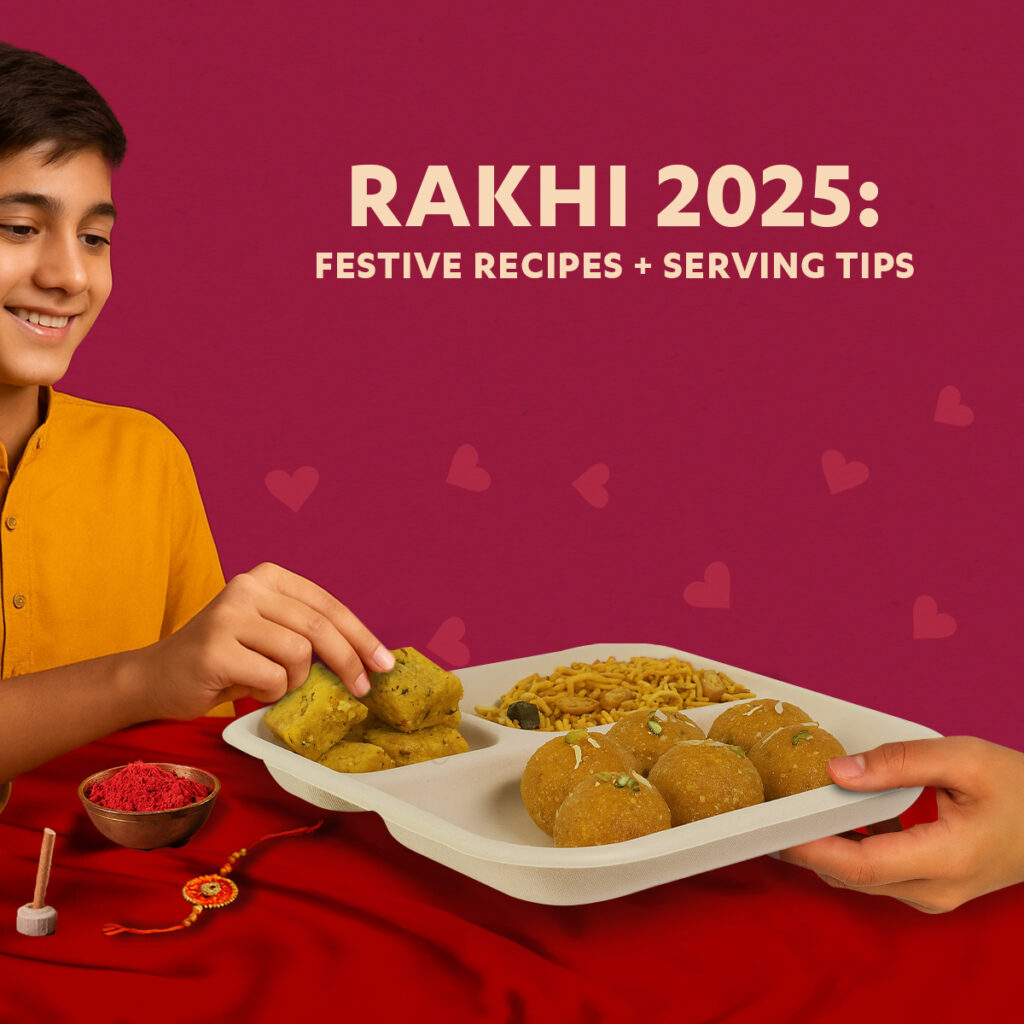
Raksha Bandhan recipes and serving tips: traditional dishes for a memorable Rakhi feast
Raksha Bandhan is one of those festivals that does not need a grand stage. A living room. A thali. A thread tied around a wrist. That is enough to make the day complete.
But ask anyone who has hosted Rakhi at home, and they will tell you: the real effort happens in the kitchen. The kheer has to be just right. The laddus need to hold their shape. The chole must taste exactly like the ones your mother made. Because on Rakhi, food is not a side note. It is the centrepiece.
Whether you are cooking for four siblings or catering a community Rakhi gathering, this guide covers the traditional dishes that belong on every Raksha Bandhan table, along with practical tips for serving them well.
Key Takeaways
- Raksha Bandhan revolves around food as much as the rakhi itself — traditional sweets and meals are central to the celebration
- Five classic dishes every Rakhi table needs: kaju katli, besan laddu, rasgulla, chole bhature, and malai kofta
- Modern twists like rose kaju katli and air-fried paneer give health-conscious hosts festive options without losing flavour
- A complete Rakhi menu plan (starter through dessert) helps home hosts and caterers stay organised
- Compostable disposables handle hot, oily Indian food and cut post-celebration cleanup time dramatically
Why food is the heart of Raksha Bandhan
Raksha Bandhan is built on a simple ritual. A sister ties a rakhi on her brother’s wrist. He offers protection. They exchange sweets.
That exchange is not symbolic. It is literal. The mithai matters. The thali matters. The act of feeding someone you love, with your own hands, is the festival’s emotional core.
Before the rakhi is tied, the puja thali is prepared: diya, roli, akshat, mishri, and of course, a piece of mithai. After the ceremony, the real celebration begins at the dining table. Families gather around platters of homemade sweets and a full festive meal.
This is why getting the food right is not optional. It is Raksha Bandhan.
5 traditional Raksha Bandhan dishes (with recipes)
Every household has its own Rakhi speciality. But some dishes show up on tables across the country, year after year. Here are five classics that belong on your menu, whether you are a home host preparing for family or a sweet shop owner planning your festive inventory.
1. Kaju katli
A diamond-shaped sweet that sparkles on any thali. Kaju katli is the undisputed queen of Indian festival mithai, and Raksha Bandhan is no exception.
Quick recipe:
- Blend 1 cup cashews to a fine powder (do not over-blend or it turns oily)
- Heat half a cup sugar with quarter cup water in a pan until you get a one-string consistency syrup
- Add cashew powder and stir continuously until it forms a soft, non-sticky dough
- Let it cool slightly, roll it between parchment sheets, and cut into diamond shapes
Serving tip: Arrange kaju katli on a flat compostable plate with silver varq on top. The natural off-white tone of bagasse tableware complements the silver beautifully. As a sweet shop owner, you can package these in compostable clamshell containers for takeaway orders — they hold shape better than plastic boxes and your customers notice the difference.
2. Besan laddu
Earthy, nutty, and rich with ghee. Besan laddus are the kind of sweet that makes a kitchen smell like a festival is happening.
Quick recipe:
- Roast 1 cup gram flour (besan) in half a cup ghee on a low flame, stirring constantly, until golden and fragrant
- Remove from heat, let it cool until warm (not hot)
- Mix in half a cup powdered sugar and a pinch of cardamom powder
- Add chopped almonds or pistachios if you like
- Shape into round laddus while the mixture is still warm enough to hold together
Serving tip: Besan laddus are oily by nature. If you are a caterer serving these at a Rakhi event, you need plates that can handle ghee without turning soggy. Compostable disposables made from sugarcane bagasse are oil-resistant and hold up for hours, which means no embarrassing plate collapses mid-celebration.
3. Rasgulla and sandesh
For a touch of Bengali tradition that every Indian household loves. Rasgulla’s spongy sweetness and sandesh’s delicate texture make them perfect for Rakhi gifting.
Quick recipe (rasgulla):
- Boil 1 litre full-cream milk and curdle it with 2 tablespoons lemon juice or white vinegar
- Drain through a muslin cloth, wash the chenna under cold water to remove sourness
- Knead the chenna on a flat surface for 8 to 10 minutes until completely smooth and crack-free
- Roll into small equal-sized balls
- Prepare a sugar syrup (1 cup sugar, 4 cups water), bring to a rolling boil
- Drop the balls in, cover, and pressure cook for 7 to 8 minutes on medium flame
- Let them cool in the syrup — they will puff up and absorb sweetness
Quick recipe (sandesh):
- Use the same chenna preparation as above
- Knead with powdered sugar and a pinch of cardamom
- Shape into moulds or flatten into discs
- Chill in the refrigerator for an hour before serving
Serving tip: Both rasgulla and sandesh look stunning on small compostable bowls. If you are running a sweet shop, offering these in compostable packaging instead of plastic containers signals quality and care — two things customers associate with homemade mithai.
4. Chole bhature
If your Rakhi celebration includes a proper sit-down meal (and it should), chole bhature is the dish that gets siblings fighting over the last bhatura.
Quick recipe:
- Soak 1 cup chickpeas overnight, then pressure cook until soft (about 4 to 5 whistles)
- In a pan, saute chopped onions, ginger-garlic paste, and tomatoes until the oil separates
- Add chole masala, red chilli powder, turmeric, and amchur (dry mango powder)
- Add the cooked chickpeas, simmer for 15 to 20 minutes, and finish with a squeeze of lemon
- For bhature: knead maida with yogurt, a pinch of baking soda, salt, and a teaspoon of oil. Let it rest for 2 hours. Roll into oval shapes and deep fry until golden and puffed
Serving tip: Chole bhature is hot, oily, and saucy — the combination that destroys flimsy plastic plates. As a home host, serve this on sturdy compostable plates that can handle the heat and moisture. The meal looks better, holds together better, and cleanup afterwards takes minutes instead of an hour.
5. Malai kofta
Creamy, indulgent, and worthy of a special occasion. Malai kofta turns any Rakhi meal into a feast.
Quick recipe:
- Mix 1 cup grated paneer with 2 boiled and mashed potatoes, plus chopped cashews, raisins, and a pinch of salt
- Shape into smooth round balls and deep fry until golden
- For the gravy: blend sauteed onions, tomatoes, cashews, ginger, and garlic into a smooth paste
- Cook the paste with cream, butter, kasuri methi, and garam masala
- Add the koftas to the gravy just before serving (not while cooking, or they break apart)
Serving tip: Malai kofta gravy is rich and heavy. Serve it in deep compostable bowls alongside jeera rice or tandoori roti. If you are catering a Rakhi party, keep koftas and gravy separate until plating — this keeps the koftas crisp and the presentation clean.
Quick-reference recipe table
| Dish | Key Ingredients | Prep Time | Difficulty | Best Served In |
|---|---|---|---|---|
| Kaju katli | Cashews, sugar, cardamom | 30 minutes | Easy | Flat plate or clamshell box |
| Besan laddu | Gram flour, ghee, powdered sugar | 25 minutes | Easy | Plate or mithai tray |
| Rasgulla | Milk, lemon juice, sugar | 45 minutes | Medium | Small bowls with syrup |
| Sandesh | Chenna, sugar, cardamom | 30 minutes + chilling | Easy | Small plate or gift box |
| Chole bhature | Chickpeas, spices, maida, yogurt | 60 minutes + soaking | Medium | Deep plate or compartment plate |
| Malai kofta | Paneer, potato, cashews, cream | 50 minutes | Medium-hard | Deep bowl with rice or roti on the side |
Modern twists for the new-age Rakhi host
Tradition is the foundation. But if you like adding a contemporary touch to your celebrations, these variations keep the festive spirit alive while fitting modern dietary preferences.
Rose kaju katli — Add 1 teaspoon rose water and a sprinkle of dried rose petals to the classic cashew mix before rolling. The floral fragrance turns an ordinary mithai box into something gift-worthy.
Vegan gulab jamun — Swap regular milk solids for a mix of almond milk powder and semolina. Use vegan ghee for frying. The texture stays soft, and no one at the table will know the difference.
Air-fried tandoori paneer — Marinate paneer cubes in hung curd, tandoori spices, and lemon juice for an hour. Air-fry at 200 degrees Celsius for 12 to 15 minutes until charred at the edges. All the flavour, a fraction of the oil.
Rava laddu — Roast 1 cup semolina in ghee until golden, mix with powdered sugar, a splash of warm milk, and shape into laddus. Lighter than besan laddu and just as satisfying.
These modern variations work especially well for Rakhi get-togethers where guests have mixed dietary needs. And the serving principle stays the same: let the food be the star. Compostable plates and bowls with clean lines keep the focus on what you have cooked, not on the tableware.
A complete Raksha Bandhan menu plan
Planning a full Rakhi meal? Here is a balanced menu that covers every course, whether you are cooking for family at home or organising a catered celebration.
| Course | Dish | Notes |
|---|---|---|
| Starter | Khaman dhokla with green chutney | Light, steamed, and easy to prepare in advance |
| Main course | Paneer butter masala or malai kofta | Rich gravies that pair well with both rice and roti |
| Bread | Tandoori roti and bhature | Offer both for variety |
| Rice | Jeera rice | Sautee cumin in ghee, add soaked basmati, cook until fluffy |
| Sides | Cucumber raita and mixed pickle | Balance the richness of the mains |
| Dessert | Gulab jamun and kheer | One dry sweet, one wet sweet — the classic combination |
| Drinks | Mango lassi or rose sharbat | Refreshing, festive, and loved by all age groups |
Pro tip for caterers: Pre-portion starters and desserts in individual compostable bowls before guests arrive. This speeds up service and reduces food waste — two things that matter when you are handling 50 or more guests.
Serving tips that make the difference
The food may be perfect, but how you serve it shapes the entire experience. Here are practical serving tips sorted by who you are.
If you are a home host
- Prepare mithai a day in advance. Kaju katli and besan laddus taste better after resting overnight.
- Set up a self-serve mithai station using compostable plates and bowls. It keeps things relaxed and encourages people to try everything.
- Use small compostable bowls for wet dishes like rasgulla and kheer. No spills, no stains on your dining table.
- Skip the post-party dishwashing marathon. Compostable disposables go straight into your wet waste bin. The celebration ends when you want it to, not when the last utensil is scrubbed clean.
If you are a caterer
- Invest in sturdy, stackable compostable plates that handle hot gravies and oily bhature without warping.
- Separate koftas from gravy until plating. Serve rice and roti on compartment plates to keep portions neat.
- Offer compostable takeaway containers for guests who want to carry leftover mithai home. It doubles as a brand touchpoint for your catering business.
- Presentation matters at scale. The natural, clean look of bagasse tableware elevates a buffet line more than cheap, shiny plastic ever could.
If you are a sweet shop owner
- Package Rakhi mithai assortments in compostable clamshell containers. They protect the sweets during transport and look premium on a gift shelf.
- Label your packaging as compostable. Customers buying gifts for health-conscious families will choose your shop over competitors who still use plastic.
- Offer pre-set Rakhi mithai boxes: one for traditional (kaju katli, besan laddu, gulab jamun) and one for modern (rose kaju katli, rava laddu, sandesh). Customers love curated choices.
Why your serving choices matter on Raksha Bandhan
Raksha Bandhan is, at its core, a promise of care. A sister prays for her brother’s well-being. A brother pledges to protect. The entire festival is built around looking out for the people you love.
That spirit of care does not stop at the rakhi. It extends to the food you cook, the way you serve it, and what happens to the plates after the last guest leaves.
Plastic plates leach chemicals when they come in contact with hot food. Styrofoam cups release toxins into hot chai. These are not abstract environmental problems. They are health concerns sitting on your Rakhi table.
Compostable disposables made from sugarcane bagasse are toxin-free, chlorine-free, and designed to handle the full range of Indian festive food — from boiling hot chole to syrup-soaked gulab jamun. They do not bend under weight. They do not leak oil. And after the celebration, they break down into compost within 90 to 180 days.
Serving your family on tableware that is safe for them and safe for the earth — that is Raksha Bandhan done right.
In a Nutshell
Raksha Bandhan is about connection, gratitude, and the joy of feeding the people you love. The food carries the emotion. The serving carries the intention.
- Cook from tradition: Kaju katli, besan laddu, rasgulla, chole bhature, and malai kofta are the building blocks of every great Rakhi feast.
- Add your own twist: Rose kaju katli, vegan gulab jamun, and air-fried paneer give modern hosts options without losing the festive feel.
- Plan the full menu: Starter through dessert, with drinks. A complete thali says you planned with love.
- Serve smart: Whether you are a home host, caterer, or sweet shop owner, how you present the food is as important as how you cook it.
- Choose compostable: Toxin-free, oil-resistant, and planet-friendly. Compostable disposables handle Indian festive food the way it deserves to be handled.
Let the rakhi be tied, the mithai be shared, and the feast be served on a table that reflects what the festival stands for — care, in every sense of the word.
Frequently Asked Questions
What are the most traditional sweets served during Raksha Bandhan?
The most common traditional sweets for Raksha Bandhan include kaju katli, besan laddu, gulab jamun, rasgulla, barfi, and kheer. These sweets are tied to the ritual of the festival itself — the sister offers mithai to her brother after tying the rakhi, making sweets an essential part of the celebration rather than just a dessert course.
How do I plan a Raksha Bandhan menu for a large family gathering?
Start with a structured menu: one starter (khaman dhokla or paneer tikka), one or two main gravies (malai kofta, paneer butter masala), bread options (tandoori roti and bhature), jeera rice, sides like raita and pickle, and at least two desserts (one dry sweet like laddu, one wet sweet like gulab jamun). Prepare mithai and chutneys a day in advance. Use individual compostable bowls for wet dishes to simplify serving and reduce spills.
Can I make Raksha Bandhan sweets ahead of time?
Absolutely. Kaju katli stays fresh for 5 to 7 days when stored in an airtight container at room temperature. Besan laddus last up to 2 weeks. Rasgulla keeps well in its sugar syrup in the refrigerator for 4 to 5 days. Sandesh is best consumed within 2 to 3 days. Making sweets a day or two before Rakhi gives you more time to focus on the main meal and the puja preparations.
What are some healthy or modern alternatives to traditional Rakhi sweets?
For health-conscious celebrations, try rose kaju katli (adds floral notes without extra sugar), rava laddu (lighter than besan), vegan gulab jamun (made with almond milk and semolina), or air-fried tandoori paneer as a savoury alternative. You can also reduce sugar in traditional recipes by 20 to 30 percent without noticeably affecting taste, especially in dishes where cardamom and dry fruits provide flavour.
Why should I use compostable disposables instead of plastic plates for Raksha Bandhan?
Plastic plates can leach harmful chemicals when they come into contact with hot or oily food — both of which are standard at any Rakhi feast. Compostable disposables made from sugarcane bagasse are toxin-free, chlorine-free, microwave-safe, and oil-resistant. They hold up under heavy gravies and hot sweets without bending or leaking. After the celebration, they decompose into compost within 90 to 180 days instead of sitting in a landfill for centuries.
How can sweet shop owners prepare for Raksha Bandhan demand?
Start by planning your inventory 2 to 3 weeks before Rakhi. Stock up on core items: kaju katli, besan laddu, gulab jamun, and mixed dry fruit barfi. Offer curated Rakhi gift boxes — one traditional assortment and one modern assortment. Use compostable packaging to differentiate your brand and appeal to gift buyers who value quality presentation. Train staff on portion consistency and display your mithai in clean, well-lit counters.
What is a good Raksha Bandhan meal idea for someone living away from family?
Even if you are celebrating alone or with roommates, a simple thali goes a long way. Cook one gravy (dal makhani or paneer masala), make jeera rice, pick up sweets from a local shop, and prepare a small puja thali with a diya and mishri. Video call your sibling during the meal. Raksha Bandhan is about connection, not scale. A thoughtfully prepared thali for one carries just as much meaning as a feast for twenty.