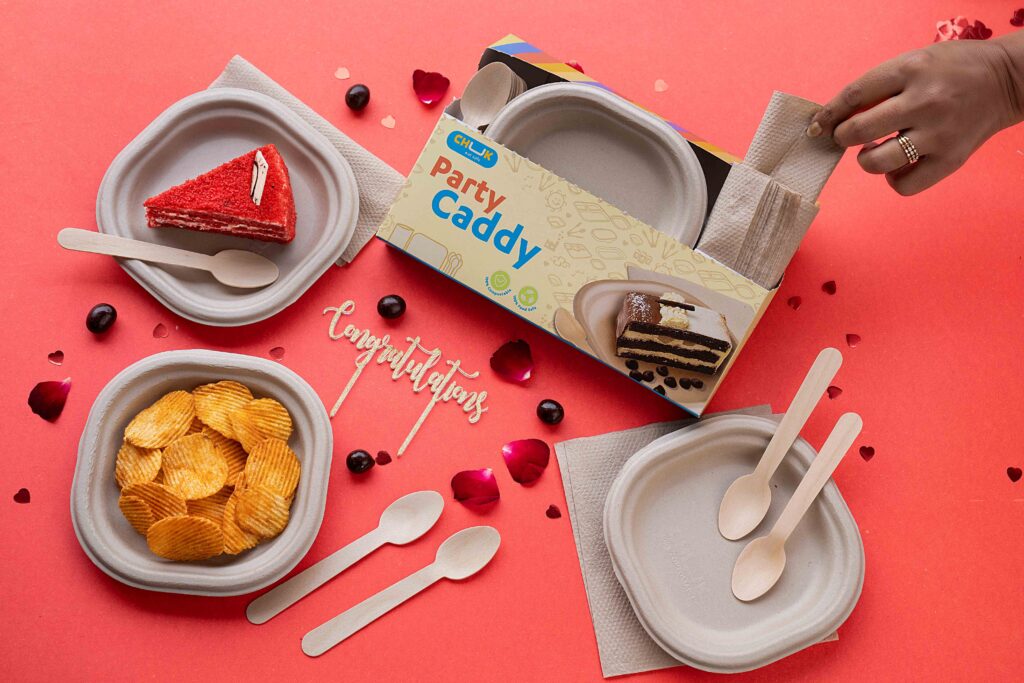
You have spent weeks planning the menu, the playlist, and the guest list. But when the party ends, you are left staring at a mountain of plastic plates, crushed cups, and food-smeared cutlery that will sit in a landfill for the next 400 years.
Here is the honest truth: hosting a memorable party and being responsible about waste are not competing goals. Compostable disposables make it possible to serve 50, 100, or even 500 guests without the guilt trip or the garbage pile.
Whether you are planning a Diwali get-together, a housewarming dinner, a kid’s birthday bash, or a destination wedding, this guide walks you through exactly how to pull it off.
Key Takeaways
- Compostable disposables made from sugarcane bagasse handle hot, oily Indian food without leaking or collapsing
- A 50-guest party generates roughly 8-12 kg of single-use waste; switching to compostable tableware makes nearly all of it industrially compostable
- Compostable plates and bowls cost approximately 20-30% more per unit than plastic, but eliminate post-party waste guilt and disposal headaches
- Setting up clearly labelled waste stations (wet waste, dry waste, compostable tableware) takes 10 minutes and dramatically improves actual composting rates
- India’s Single-Use Plastics ban applies to events and parties too, not just restaurants and commercial establishments
Why Compostable Disposables Are the Practical Choice for Events
Let us get the obvious question out of the way. Why not just use regular plastic plates? They are cheaper and available at every corner store.
Three reasons this logic falls apart for anyone hosting events in India today:
- The regulatory angle. India’s SUP ban (active since July 2022) covers items like plastic plates, cups, cutlery, and straws. While enforcement at private parties is softer than at commercial venues, community events, society functions, and catered occasions are increasingly under scrutiny from municipal authorities.
- The disposal problem. Plastic disposables contaminated with food cannot be recycled. They go straight to landfill or, worse, into open dumps and water bodies. Your three-hour party creates waste that persists for centuries.
- The guest perception shift. Indian consumers, especially in metro and tier-1 cities, notice these things now. Serving on compostable tableware quietly signals that you care. No announcement needed.
Compostable disposables decompose within 90 to 180 days under industrial composting conditions. They are made from agricultural waste like sugarcane bagasse and plant fibres. They perform the same job as plastic, handle the same food, and then return to the earth.
That is not idealism. That is a practical advantage.
Your Complete Party Checklist: Compostable Tableware for 50 Guests
Planning quantities is where most hosts either overshoot (wasting money) or undershoot (running out mid-event). Here is a practical checklist calibrated for a 50-guest Indian party with a sit-down or buffet meal.
Tableware Checklist for 50 Guests
| Item | Quantity for 50 Guests | Compostable Option | Notes |
|---|---|---|---|
| Dinner plates (9-10 inch) | 75 | Sugarcane bagasse round plates | Extra 50% buffer for seconds and spills |
| Quarter plates / side plates (6 inch) | 60 | Bagasse small plates | For starters, chaat, dessert |
| Bowls (12 oz) | 75 | Bagasse bowls | Dal, raita, curries, gulab jamun |
| Cups (200-300 ml) | 100 | Bagasse or PLA-lined cups | Chai rounds happen multiple times |
| Spoons | 75 | Wooden or CPLA spoons | One per course minimum |
| Forks | 50 | Wooden forks | Needed for starters and snacks |
| Napkins | 150 | Unbleached paper napkins | Three per guest is realistic |
| Food containers with lids | 20 | Bagasse clamshell boxes | For packing leftovers and guest takeaways |
| Serving trays | 5-8 | Bagasse rectangular trays | For buffet display |
| Straws | 50 | Paper or PLA straws | Only if serving cold drinks or mocktails |
Pro tip: Always order 40-50% more plates and bowls than your headcount. Indian meals involve multiple servings, and guests often take fresh plates for each course. Running out of plates at an Indian party is a hosting emergency nobody forgets.
Matching Compostable Tableware to Indian Occasions
Not every party is the same. The food, the serving style, and the guest count vary wildly between a Holi brunch and a wedding reception. Here is how to think about compostable tableware for the occasions that matter most.
Diwali Parties and Festival Gatherings
Diwali parties typically involve rich, oily snacks (samosas, kachoris, mithai), multiple chai rounds, and sometimes a full dinner. Your tableware needs to handle:
- Oil and ghee without soggy bottoms. Sugarcane bagasse plates have a natural grease resistance that paper plates simply do not. They hold up through a full plate of pakoras without buckling.
- Hot liquids. Diwali means chai. Lots of it. Bagasse cups handle temperatures up to 100 degrees Celsius comfortably.
- Presentation. Festival occasions deserve tableware that looks clean and presentable. The natural off-white finish of bagasse plates actually complements traditional Indian food better than the stark white of plastic.
House Parties and Weekend Get-Togethers
Smaller gatherings of 15 to 30 people are where compostable disposables really shine. The per-unit cost difference is negligible at this scale, and cleanup is genuinely easier.
- Go with a standard plate-bowl-cup-spoon setup
- Add a few clamshell containers for guests who want to take leftovers home
- Skip the straws unless you are making cocktails or mocktails
Weddings and Large-Scale Events (200+ Guests)
Indian weddings generate staggering amounts of single-use waste. A 500-guest wedding with a multi-course meal can produce 200+ kg of disposable tableware waste in a single evening.
At this scale, compostable tableware requires advance planning:
- Order 4-6 weeks ahead. Large quantities of bagasse products need manufacturing lead time.
- Coordinate with your caterer. Make sure the catering team knows the tableware is compostable and handles it accordingly. Some caterers still default to plastic if you do not explicitly specify.
- Negotiate bulk pricing. At 500+ guest volumes, the per-unit cost of compostable disposables drops significantly. Ask for custom quotes.
- Arrange composting pickup. Contact your city’s composting facility or waste management service before the event. For Mumbai, Bengaluru, and Delhi NCR, several private composting services handle event waste specifically.
Kids’ Birthday Parties
Children’s parties are high-mess, high-energy affairs. Compostable tableware holds up better than you might expect:
- Bagasse plates handle cake, ice cream, and spilled juice without disintegrating
- Wooden spoons and forks are sturdy enough for little hands
- The natural material is safer than plastic if curious toddlers decide to chew on a plate edge
How to Set Up Waste Stations That Actually Work
Here is what they don’t tell you about eco-friendly events: buying compostable tableware is only half the job. If everything ends up in the same garbage bag, the composting benefit vanishes.
Setting up proper waste stations takes 10 minutes and makes the difference between genuine sustainability and feel-good theatre.
The Three-Bin System
Place these at every exit point and near the food service area:
- Bin 1: Wet Waste (Green Label). Food scraps, leftover food, fruit peels, used tea bags. This goes to composting.
- Bin 2: Compostable Tableware (Brown Label). Used plates, bowls, cups, wooden cutlery. Scrape food into the wet waste bin first, then place tableware here. This also goes to composting, but separating it makes the process cleaner.
- Bin 3: Dry Waste / Non-Compostable (Blue Label). Plastic wrappers, foil, glass bottles, PET bottles, anything that is not compostable. This goes to recycling or municipal waste.
Making Guests Actually Use the Bins
- Label bins with pictures, not just text. At a noisy party, nobody reads. A photo of a plate on the compostable bin does the job.
- Station a helper at each bin for the first 30 minutes. Once a few guests sort correctly, social proof kicks in and the rest follow.
- Keep bins accessible. If the bins are hidden in a corner, guests will dump everything on the nearest table. Place them in plain sight, ideally within 5 steps of where guests eat.
- Announce it once. A brief mention by the host at the start of the meal normalises the sorting process without making it feel preachy.
Common Mistakes Hosts Make With Compostable Tableware
Even well-intentioned hosts trip up on a few common issues. Avoid these:
Mistake 1: Buying “Biodegradable” Instead of “Compostable”
These are not the same thing. “Biodegradable” has no standardised timeframe. A product labelled biodegradable might take 10 years to break down. “Compostable” means it meets specific standards (like IS 17088 in India) and decomposes within 90 to 180 days under industrial composting conditions.
Always look for:
– CPCB certification
– IS 17088 or equivalent composting standard compliance
– BIS mark for food-contact safety
Mistake 2: Using Compostable Tableware for Extremely Liquid Dishes
Bagasse plates and bowls handle gravies, curries, and dal perfectly well. But if you are serving soup as a standalone course, use deeper bagasse bowls specifically designed for liquids rather than shallow plates.
Mistake 3: Ordering Too Late
Compostable tableware is not always available off-the-shelf at local packaging shops, especially in smaller cities. Order online at least 2 weeks before your event. For large orders above 500 pieces, contact manufacturers directly for better rates and guaranteed availability.
Mistake 4: Forgetting Guest Takeaway Containers
Indian hospitality means sending guests home with food. Stock up on compostable clamshell containers or meal boxes with lids. This small detail prevents guests from reaching for plastic bags or aluminium foil.
Mistake 5: Not Briefing Your Help Staff
If you have hired servers, caterers, or kitchen help for the event, brief them explicitly. Tell them the tableware is compostable, explain the waste stations, and make sure they do not mix compostable plates into general garbage.
The Numbers: What an Eco-Friendly Party Actually Costs
Let us put real numbers on this so you can plan your budget without surprises.
Cost Comparison for a 50-Guest Party
| Expense | Plastic Disposables | Compostable Disposables |
|---|---|---|
| Plates (75 pcs) | Rs 90 | Rs 115 |
| Bowls (75 pcs) | Rs 75 | Rs 100 |
| Cups (100 pcs) | Rs 70 | Rs 95 |
| Cutlery (125 pcs) | Rs 100 | Rs 140 |
| Napkins (150 pcs) | Rs 45 | Rs 55 |
| Containers (20 pcs) | Rs 50 | Rs 65 |
| Total | Rs 430 | Rs 570 |
| Difference | +Rs 140 |
An extra Rs 140 for a 50-guest party. That is less than the cost of a single appetiser dish. For a party where you are already spending thousands on food, decor, and entertainment, the tableware upgrade is negligible.
At wedding scale (500 guests), the total difference ranges from Rs 1,200 to Rs 2,000 depending on the menu complexity. Against a wedding budget running into lakhs, this is a rounding error.
A Quick Word on Composting After the Party
Once the party ends and guests leave, your compostable tableware needs proper disposal to actually decompose.
If you have a home compost setup: Bagasse plates and bowls can go into a home composting bin, though they take longer to break down than food scraps. Cut or break them into smaller pieces to speed up decomposition.
If your city has composting services: Mumbai, Bengaluru, Pune, Delhi NCR, Chennai, and Hyderabad all have municipal or private composting services. Schedule a pickup for the day after your event. Most services accept compostable tableware along with wet waste.
If neither option is available: Compostable tableware in a landfill still breaks down significantly faster than plastic, though the conditions are not ideal. The material is still derived from renewable agricultural waste, not fossil fuels.
In a Nutshell
Hosting an eco-friendly party in India does not require a lifestyle overhaul or a premium budget. It requires one deliberate choice: swap plastic disposables for compostable disposables.
The tableware handles the same food. It looks as good or better. It costs marginally more. And when the party is over, it does not haunt the planet for 400 years.
Plan your quantities using the checklist above. Set up three labelled waste bins. Brief your staff. That is genuinely all it takes.
Your guests will remember the food, the music, and the company. The tableware will quietly do its job and then disappear, exactly as it should.
Frequently Asked Questions
Can compostable plates handle hot, oily Indian food like biryani and paneer tikka?
Yes. Compostable plates made from sugarcane bagasse are specifically designed for high-temperature, high-oil food. They handle curries, biryanis, fried snacks, and gravies without leaking, buckling, or going soggy. Look for products tested up to 100 degrees Celsius for food contact safety.
How far in advance should I order compostable tableware for a large event?
For events with fewer than 100 guests, 2 weeks is generally sufficient when ordering online. For weddings or large gatherings above 200 guests, order 4-6 weeks in advance. Manufacturer-direct orders at scale give you better pricing and guaranteed stock availability.
Are compostable disposables safe for kids?
Absolutely. Compostable tableware made from sugarcane bagasse and plant fibres contains no harmful chemicals, BPA, or plastic residues. Wooden cutlery is splinter-resistant and safe for children. The material is a safer option than plastic if small children put tableware in their mouths.
What is the difference between compostable and biodegradable tableware?
Compostable tableware meets specific standards (IS 17088 in India) guaranteeing decomposition within 90 to 180 days under industrial composting conditions. Biodegradable is a vaguer term with no standardised timeframe. A product labelled biodegradable could take years to break down. Always choose certified compostable products for genuine environmental impact.
Can I compost used tableware at home or does it need an industrial facility?
Sugarcane bagasse tableware can go into a home compost bin, though it breaks down slower than food scraps. Breaking plates into smaller pieces helps. For faster decomposition, industrial composting facilities are ideal. Major Indian cities including Mumbai, Bengaluru, Delhi NCR, Chennai, Pune, and Hyderabad have municipal or private composting services that accept compostable tableware.
Do compostable cups work for hot chai and coffee?
Yes. Bagasse and PLA-lined compostable cups handle hot beverages up to 100 degrees Celsius. They maintain structural integrity through multiple chai rounds without getting soft or leaking. For iced drinks, PLA-lined cups also prevent condensation from weakening the cup.
Planning your next party or event? Explore Chuk’s full range of compostable tableware designed for Indian food, Indian weather, and Indian hospitality at chuk.in.