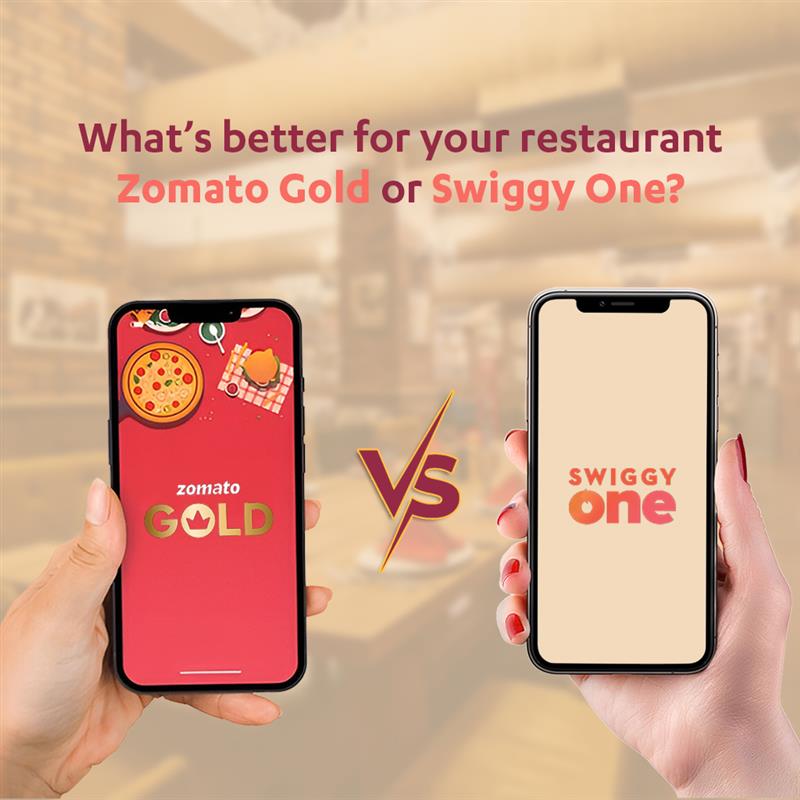
What Is Better for Your Restaurant — Zomato Gold or Swiggy One?
You are running a restaurant. Orders are flowing in from Zomato. Orders are flowing in from Swiggy. Both platforms are now pushing their premium membership programs hard — Zomato Gold and Swiggy One.
The pitch sounds great from the customer side. Free delivery, exclusive discounts, priority support. But here is the question nobody at these platforms will answer directly: which one actually puts more money in your pocket as a restaurant owner?
That is what this guide breaks down. No fluff. No corporate jargon. Just a straight comparison of Zomato Gold and Swiggy One from the only perspective that matters — yours.
How Zomato Gold and Swiggy One Actually Work
Before we compare, let us get the basics right.
Zomato Gold is a paid membership that gives customers:
– Free delivery on orders above a threshold
– Exclusive discounts (typically 20-40% off) at partner restaurants
– Priority customer support
– Dining-out offers at select restaurants
Swiggy One is a paid membership that gives customers:
– Free delivery on food orders
– Extra discounts and deals on food orders
– Benefits extended to Swiggy Instamart (grocery delivery)
– Access to Swiggy Genie (package and document delivery)
Both programs exist to lock customers into one platform. The more a customer orders, the more they justify the membership fee. For you as a restaurant owner, the real question is — what does participation cost you, and what do you get back?
The Order Volume Question
This is usually the first thing restaurant owners want to know. Will signing up for these programs get you more orders?
The short answer: yes, but with conditions.
- Zomato reports that Gold members order roughly 40% more frequently than non-members
- Swiggy One members also show higher ordering frequency, though the exact numbers are harder to pin down since Swiggy bundles food with grocery and delivery data
- Restaurants on both platforms have reported a 20-30% bump in total order volume after enrolling
- Membership subscribers tend to have higher average order values — they feel they are getting a deal, so they add more to the cart
The honest truth? Both platforms bring in more orders. But higher volume means nothing if your margins are getting crushed. That is the next piece of this puzzle.
The Discount Trap — Where Your Margins Go
Here is what they do not tell you upfront.
Zomato Gold frequently runs discounts of 20-40% for its members. And in most cases, that discount comes straight from your revenue. Unless you have negotiated a specific co-funding arrangement with Zomato, you are absorbing that hit.
Swiggy One takes a different approach. The platform partly absorbs delivery costs for its members, which means the discount pressure on your food prices is somewhat lower. Swiggy also gives you more control over the discount levels you offer.
What this means for your bottom line:
- On Zomato Gold, you may see higher order volume but lower per-order profit
- On Swiggy One, the discount structure tends to be gentler on your margins
- Some restaurant owners report that steep Zomato Gold discounts actually eat into profits enough to cancel out the volume gains
As a restaurant owner, run this math yourself. Pull your last three months of order data. Calculate revenue per order after discounts. If one platform is driving volume but leaving you with thinner margins, that is a red flag.
Zomato Gold vs Swiggy One — Full Comparison Table
Here is a side-by-side breakdown of everything that matters:
| Feature | Zomato Gold | Swiggy One |
|---|---|---|
| Membership Type | Paid (customer-facing) | Paid (customer-facing) |
| Free Delivery | Yes, above order threshold | Yes, on eligible orders |
| Discount Range | 20-40% (mostly restaurant-funded) | Moderate (platform shares some cost) |
| Impact on Restaurant Margins | Higher pressure due to steep discounts | Lower pressure, more control |
| Monthly Active Users (Platform) | ~17 million | ~20 million |
| Paying Members | 3 million+ | 2.5 million+ |
| Geographic Strength | Northern and Eastern India | Southern and Western India |
| Payment Cycle | 3-5 business days | 3-4 business days |
| Dining-Out Benefit | Yes (drives in-store visits) | No |
| Grocery/Delivery Ecosystem | No | Yes (Instamart + Genie) |
| Priority Listing for Partners | Yes | Limited |
| Customer Retention Tools | Moderate | Strong (loyalty program) |
| Best For | High-footfall, high-volume restaurants | Margin-focused, steady-growth restaurants |
Which Platform Has a Bigger Customer Base?
Reach matters. You want your restaurant visible to as many hungry customers as possible.
Here is how the numbers stack up:
- Zomato has around 17 million monthly active users
- Swiggy has around 20 million monthly active users
- Zomato Gold has over 3 million paying subscribers
- Swiggy One has over 2.5 million paying subscribers
Now, raw user counts do not tell the whole story. Geography plays a huge role.
- Swiggy dominates in Southern and Western India — cities like Bengaluru, Hyderabad, Chennai, Mumbai, and Pune
- Zomato dominates in Northern and Eastern India — cities like Delhi-NCR, Lucknow, Kolkata, and Jaipur
If your restaurant is in Bengaluru, Swiggy might drive more orders simply because it has deeper penetration there. If you are in Delhi, Zomato Gold could be the better bet.
The practical move? Check your own order data. Which platform already brings in more orders for your specific location? Double down on that one first.
Payment Speed — Cash Flow Matters
When you are managing a restaurant, cash flow is everything. Supplier payments, staff salaries, rent — none of these wait for platform payouts.
- Zomato pays partner restaurants in 3-5 business days
- Swiggy pays partner restaurants in 3-4 business days
The difference is small. But over a month, that extra day can matter if you are running a tight operation. Swiggy has a slight edge here.
Extra Features That Affect Your Business
Beyond orders and payments, both platforms offer features that can influence your decision.
Zomato Gold gives you:
– Priority listing on the app — higher visibility means more eyeballs on your restaurant
– Dining-out discounts — this is unique to Zomato and can drive physical foot traffic to your restaurant, not just delivery orders
– Better data insights on customer ordering patterns
Swiggy One gives you:
– Access to the Swiggy ecosystem (Instamart, Genie) — customers who use these services are already on the app and more likely to order food
– Stronger loyalty programs that encourage repeat orders
– More granular control over promotional offers
If visibility and foot traffic are your priorities, Zomato Gold has a clear advantage with its dining-out program. No other platform offers this.
If repeat orders and customer loyalty matter more to you, Swiggy One’s ecosystem approach tends to keep customers coming back.
How Your Packaging Choices Fit Into This
Here is something most restaurant owners overlook when thinking about delivery platforms.
Both Zomato and Swiggy have been tightening their packaging guidelines. Customer complaints about leaky containers, soggy food, or flimsy packaging directly affect your restaurant’s rating on these platforms. A lower rating means fewer orders. Fewer orders means the membership program is not working for you.
This is where your packaging decisions start affecting your platform performance.
Compostable disposables — containers, plates, bowls made from sugarcane bagasse — solve multiple problems at once:
- They hold up during delivery. Bagasse containers handle hot, gravy-heavy, and oily food without leaking or getting soggy. Your biryani arrives the way it should.
- They look professional. Customers notice when packaging feels premium versus cheap plastic. Good packaging drives better reviews.
- They align with platform sustainability goals. Both Zomato and Swiggy have made public commitments to reducing plastic waste in food delivery. Restaurants using compostable disposables get a quiet advantage in how platforms treat them.
- They give you a marketing angle. “We deliver in 100% compostable packaging” is a line that earns customer goodwill — and better ratings.
As a restaurant owner juggling Zomato Gold and Swiggy One, your packaging is not a separate decision. It is part of your platform strategy. Strong packaging protects your ratings. Strong ratings drive more orders. More orders justify the membership investment.
The Smart Play — Can You Use Both?
Here is the honest answer: yes, and many successful restaurants do exactly this.
Listing on both Zomato Gold and Swiggy One is not an either-or decision. It is a testing strategy. Here is how to do it right:
- Sign up for both programs and run them for 3-6 months
- Track these numbers monthly:
- Total orders from each platform
- Revenue per order after discounts and commissions
- Average customer rating on each platform
- Repeat order percentage
- Payment speed and reliability
- Compare your net profit from each platform, not just gross order volume
- Double down on the winner — increase promotions and visibility on the platform that delivers better margins
Many restaurants find that one platform outperforms the other by 15-25% on net revenue. That data tells you where to invest your energy.
Common Mistakes Restaurant Owners Make
Avoid these traps when working with delivery platform memberships:
- Chasing volume over margins. 500 orders at thin margins can be worse than 300 orders at healthy margins. Track profit, not just order count.
- Ignoring packaging quality. A 4.2 rating and a 4.6 rating on Zomato can mean the difference between appearing on page one or page three. Packaging is the easiest lever to pull.
- Not negotiating. Both platforms offer different terms based on your restaurant’s size and volume. If you process over 100 orders per day, you have use. Use it.
- Offering the same discounts everywhere. Tailor your discount strategy per platform. What works on Zomato Gold might not be the right approach on Swiggy One.
- Forgetting about dine-in. Zomato Gold’s dining-out program can bring customers through your door. If you have a physical space worth visiting, lean into this.
What Works Best for Different Restaurant Types
Your ideal platform depends on what kind of restaurant you run:
Cloud kitchens and delivery-only brands:
– Swiggy One might be better — lower margin pressure, broader ecosystem reach
– Focus on packaging quality since you have no dine-in experience to fall back on
Dine-in restaurants with delivery:
– Zomato Gold has the edge — the dining-out benefit drives both foot traffic and delivery orders
– Use premium compostable disposables for delivery to match the quality your dine-in guests already experience
QSRs and fast-casual chains:
– Both platforms work well at scale
– Negotiate custom terms since volume gives you bargaining power
– Standardize on compostable disposables across locations to simplify operations and boost brand consistency
Small single-location restaurants:
– Start with whichever platform dominates in your specific city
– Test both for 3 months before committing budget to either
– Keep packaging costs in check by choosing compostable disposables that offer bulk pricing
In a Nutshell
There is no universal winner between Zomato Gold and Swiggy One. The right choice depends on your restaurant’s location, volume, margin tolerance, and business type.
Choose Zomato Gold if:
– You want higher order frequency and are comfortable with steeper discounts
– You operate in North or East India where Zomato has stronger reach
– You have a dine-in space and want to drive foot traffic alongside delivery
– Visibility and priority listing matter to you
Choose Swiggy One if:
– You want to protect your margins with a gentler discount structure
– You operate in South or West India where Swiggy dominates
– You prefer a platform that offers more control over promotions
– Repeat customer retention is your priority
Or choose both, run them side by side, and let your own data decide.
Whichever direction you go, do not overlook the basics that affect your performance on both platforms. Strong packaging — compostable disposables that protect food quality and earn positive reviews — is one of the most underestimated tools in your delivery strategy.
Frequently Asked Questions
What is Zomato Gold and how does it affect restaurants?
Zomato Gold is a paid customer membership that offers free delivery and exclusive discounts. For restaurants, it can increase order volume by 20-40%, but the discounts (typically 20-40% off) often come directly from the restaurant’s revenue. This means higher order volume but potentially lower profit per order unless you negotiate co-funded discount arrangements with Zomato.
Is Swiggy One better for restaurant profit margins than Zomato Gold?
Many restaurant owners find that Swiggy One is gentler on margins compared to Zomato Gold. Swiggy partly absorbs delivery costs for its members and gives restaurants more control over discount levels. Zomato Gold tends to push steeper discounts that come from the restaurant’s pocket, which can eat into profits even when order volume increases.
Can a restaurant be on both Zomato Gold and Swiggy One at the same time?
Yes, and it is a common strategy. Many restaurants list on both platforms simultaneously and track performance over 3-6 months. Compare total orders, revenue after discounts, customer ratings, and payment speed on each platform. Your own data will tell you which membership program delivers better net results for your specific restaurant.
Which platform is better for restaurants in South India?
Swiggy has deeper market penetration in Southern and Western India, particularly in cities like Bengaluru, Hyderabad, Chennai, and Mumbai. If your restaurant is based in these regions, Swiggy One is likely to drive more orders since the platform has a larger active user base there. Zomato is stronger in Northern and Eastern Indian cities.
How does packaging quality affect restaurant ratings on Zomato and Swiggy?
Packaging quality directly impacts your star ratings on both platforms. Leaky containers, soggy food, or flimsy packaging leads to negative reviews and lower ratings. A drop from 4.6 to 4.2 can push your restaurant down in search results significantly. Compostable disposables made from sugarcane bagasse hold up well during delivery — they handle hot, oily, and gravy-heavy food without degrading, which protects your ratings.
How fast do Zomato and Swiggy pay restaurants?
Zomato pays partner restaurants in 3-5 business days, while Swiggy processes payments in 3-4 business days. The difference is marginal, but for restaurants managing tight cash flow, Swiggy’s slightly faster payment cycle can be helpful over time.
What commissions do Zomato Gold and Swiggy One charge restaurants?
Both platforms charge commission rates that vary based on your restaurant’s location, order volume, and negotiated terms. Standard commission rates typically range from 15-30% of order value. High-volume restaurants (100+ orders per day) have more use to negotiate lower rates. Always factor in both the commission and the membership discount impact when calculating your true cost per order.
Should a cloud kitchen choose Zomato Gold or Swiggy One?
Cloud kitchens and delivery-only brands often benefit more from Swiggy One due to its lower margin pressure and broader ecosystem reach through Instamart and Genie. Since cloud kitchens have no dine-in component, Zomato Gold’s dining-out benefit has no value. Focus on packaging quality with compostable disposables since your food’s condition at delivery is your entire customer experience.
Related reading
- How to Rank Higher on Zomato & Swiggy (and Get More Ord
- How to Optimize Your Restaurant’s Delivery Experience on Zom
- How to Get More Orders on Zomato and Swiggy & Rank High
Discount programmes squeeze margin, packaging waste squeezes it further
If you are already giving away margin on Gold or One, the packaging line is where discipline pays. CHUK’s compostable bagasse containers cost 10-15% more than plastic and remove the single-use plastic compliance risk entirely.
Browse delivery containers | Order a sample box | Get pricing on WhatsApp