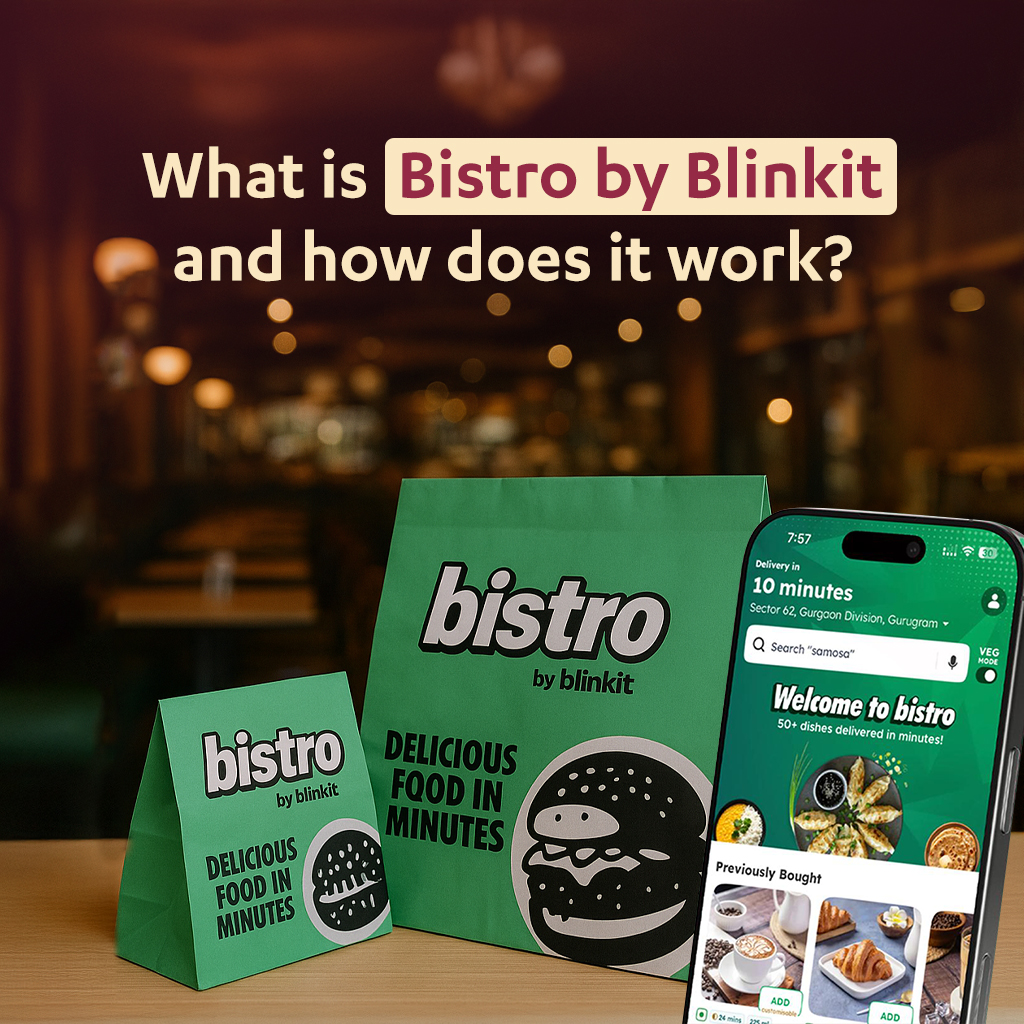
What Is Bistro by Blinkit and How Does It Work?
A standalone food delivery app that promises hot meals in 10 minutes flat. If you run a restaurant, QSR, or cloud kitchen in India, Bistro is a development you cannot afford to ignore.
Bistro by Blinkit: The 10-Minute Meal Model Explained
Blinkit, the quick-commerce arm under Zomato, launched Bistro as a standalone app in December 2024. The premise is straightforward. Customers order ready-to-eat meals, snacks, or beverages through the Bistro app. The food reaches their doorstep within 10 minutes.
What makes that speed possible is the operating model. Bistro does not rely on partner restaurants. Instead, it runs its own in-house kitchens set up inside Blinkit’s existing dark store network. That means the food is prepared, packed, and dispatched from the same facility that already handles Blinkit’s grocery deliveries.
For customers, this translates to canteen-style meals at competitive prices without the typical 30-to-45-minute delivery window. For food service operators like you, it signals a fundamental shift in how urban consumers think about ordering food.
How Does Bistro Actually Operate?
The mechanics behind Bistro are built on three pillars that Blinkit already had in place:
- Dark store infrastructure: Blinkit operates hundreds of dark stores across metro cities. Bistro kitchens are embedded within these locations, eliminating the need for separate real estate.
- Existing delivery fleet: The same riders who deliver groceries in under 10 minutes now handle Bistro orders. No new logistics setup required.
- Centralized food preparation: Meals are prepared fresh in these micro-kitchens without preservatives or microwave reheating. The menu is designed for speed, with items that can be assembled and packed in minutes.
This setup keeps operational costs low and delivery times tight. It also means Bistro can scale rapidly by plugging into any new dark store Blinkit opens.
What Is on the Bistro Menu?
The menu leans toward everyday canteen-style food rather than elaborate restaurant dishes. Think items that work well for a quick lunch, a mid-afternoon snack, or an early dinner:
| Category | Examples |
|---|---|
| Snacks | Samosas, sandwiches, puffs, pastries |
| Full meals | Rice bowls, dal combos, roti-based thalis |
| Beverages | Chai, coffee, cold drinks |
| Light bites | Wraps, rolls, small plates |
The pricing tends to undercut traditional food delivery platforms. That is a deliberate play for the segment of customers who want something fast, filling, and affordable rather than a restaurant-quality dining experience.
Where Is Bistro Available Right Now?
As of early 2026, Bistro operates in select areas of:
- Gurugram
- Delhi-NCR
- Noida
- Bengaluru
Expansion plans are underway. Given that Blinkit already has dark store presence in over 30 Indian cities, rolling Bistro into those markets is primarily a matter of setting up kitchen operations within existing facilities. If you operate in any metro or tier-1 city, this service is likely headed your way.
Why Should Restaurant Owners and Cloud Kitchen Operators Pay Attention?
The honest truth is that Bistro is not just another food delivery player. It is a vertically integrated competitor. Here is why that distinction matters if you are in the food service business.
The Competitive Challenge
Traditional food delivery works through a marketplace model. Zomato and Swiggy connect customers with your restaurant. You cook. They deliver. You share revenue.
Bistro removes you from the equation entirely. Blinkit sources, prepares, packs, and delivers the food. There is no commission to a restaurant partner because there is no restaurant partner.
For certain meal occasions, particularly the quick, affordable, everyday eating moments, Bistro can offer:
- Lower prices (no restaurant margin or marketplace commission built in)
- Faster delivery (food is already at the dark store, not waiting to be prepared after the order comes in)
- Consistency (centralized preparation with standardized recipes)
If a chunk of your delivery orders fall into the “quick, affordable meal” category, you are looking at direct competition.
The Opportunity Side
Not everything about Bistro is a threat. The model also opens doors for the food service industry:
- Partnership potential: Blinkit may eventually onboard restaurant brands as co-branded menu items within Bistro. If your brand has recognition value, this is a new distribution channel worth exploring.
- Consumer habit formation: Bistro is training millions of urban consumers to order food for delivery even more frequently. The overall market for delivered food grows, which benefits restaurants that compete on quality, variety, and brand loyalty.
- Operational learning: The dark store kitchen model offers lessons in lean operations. As a cloud kitchen operator, studying how Bistro handles prep speed, menu simplification, and inventory management can sharpen your own efficiency.
The takeaway for food service professionals is clear. You cannot out-speed Bistro. But you can out-quality, out-variety, and out-experience them. Double down on what a dark store kitchen cannot replicate: your signature dishes, your chef’s specialties, and your brand story.
How Packaging Becomes a Competitive Advantage in the 10-Minute Delivery Era
Here is a dimension many restaurant owners overlook when thinking about delivery competition. Packaging.
In Bistro’s model, the food spends barely a few minutes in transit. But in your delivery model, meals travel 20 to 45 minutes. That time gap means your packaging has to work much harder.
What Your Delivery Packaging Needs to Handle
- Temperature retention: Hot food arriving warm (not lukewarm) after 30+ minutes of transit
- Leak resistance: Gravies, dals, curries, and sauces staying inside the container, not soaking through the bag
- Structural integrity: Containers that do not buckle, warp, or collapse when stacked in a delivery bag
- Presentation on arrival: The customer’s first visual impression of your food happens when they open the packaging. A soggy, deformed container kills appetite before the first bite.
Why Compostable Disposables Give You an Edge
As a restaurant owner or cloud kitchen operator, switching to compostable disposables is one of the smartest packaging moves you can make right now. Here is the business case, not the lecture:
- Customer perception: Urban consumers, especially in metros where Bistro operates, increasingly prefer brands that take sustainability seriously. Compostable packaging signals that your brand is forward-thinking.
- Regulatory readiness: Single-use plastic bans are tightening across Indian states. Compostable disposables keep you compliant without last-minute scrambles.
- Functional performance: Bagasse-based containers (made from sugarcane fiber) are naturally microwave-safe, oil-resistant, and sturdy enough for delivery. They hold up better in transit than many plastic alternatives.
- Brand differentiation: When a customer compares your food against a Bistro delivery, the packaging quality becomes part of the experience. A well-designed compostable container tells a story that a generic plastic box never will.
What to Look for in Delivery-Ready Compostable Packaging
If you are evaluating compostable disposables for your delivery operations, here is a quick checklist:
| Feature | Why It Matters |
|---|---|
| Leak-proof seal | Prevents gravy spills during transit |
| Microwave-safe | Customers can reheat without transferring to another container |
| Grease and oil resistant | No soggy bottoms on fried or oily items |
| Stackable design | Fits neatly in delivery bags without shifting |
| Customizable branding | Your logo on the container reinforces recall |
| FSSAI-compliant material | Mandatory for food-contact packaging in India |
Chuk’s compostable containers, made from bagasse (sugarcane residue), tick every box on this list. They are designed specifically for the demands of food delivery, with the added advantage of composting naturally after use. No landfill guilt, no compliance headaches, and your food looks good when the lid comes off.
How to Stay Competitive Against Bistro and Similar Models
Whether Bistro enters your city tomorrow or is already pulling orders away from your delivery channel, here is a practical action plan.
1. Own Your Brand Experience
Bistro delivers generic meals. You deliver your brand. Every touchpoint from the container design to the napkin to the thank-you note inside the bag is a chance to build loyalty that a dark store kitchen cannot match.
2. Optimize Your Menu for Delivery
Not every dish on your dine-in menu works for delivery. Identify items that:
- Travel well without losing quality
- Can be prepped faster to reduce order-to-dispatch time
- Work in packaging that maintains temperature and presentation
3. Upgrade Your Packaging
This is the lowest-hanging fruit. Switching to sturdy, leak-proof, compostable disposables improves your delivery experience immediately. Your food arrives looking better, staying hotter, and feeling more premium.
4. use Your Delivery Platform Presence
Bistro is a separate app. Your Zomato and Swiggy listings still reach millions of customers who prefer restaurant food over canteen-style meals. Optimize your listings with strong photos, accurate descriptions, and consistent ratings.
5. Build Direct Ordering Channels
Reduce your dependence on aggregator platforms by building your own ordering system (WhatsApp ordering, a simple website, or a branded app). Every direct order saves you the 25-30% commission that platforms charge.
6. Focus on Occasions Bistro Cannot Serve
Bistro works for a quick solo lunch or an office snack run. It does not work for:
- Family dinners
- Party orders and bulk catering
- Festival specials and seasonal menus
- Celebration meals (birthdays, anniversaries)
These high-value occasions are where restaurants and cloud kitchens can dominate. Build your menu and marketing around them.
What the Rise of 10-Minute Food Delivery Means for India’s F&B Industry
Bistro is not an isolated experiment. It reflects a broader trend in India’s food service industry where speed, convenience, and vertical integration are becoming standard expectations.
Here is what to watch:
- More quick-commerce players entering food: If Blinkit succeeds with Bistro, expect Swiggy Instamart, Zepto, and others to launch similar offerings.
- Dark store kitchens becoming mainstream: The model of cooking food in micro-kitchens embedded within delivery hubs will grow. This puts pressure on standalone cloud kitchens to differentiate.
- Packaging regulations getting stricter: As food delivery volumes surge, the environmental impact of single-use packaging will draw more regulatory attention. Compostable disposables will shift from nice-to-have to must-have.
- Customer expectations rising: 10-minute delivery for groceries has already trained urban consumers to expect speed. That expectation will spill over into restaurant food delivery, pushing you to tighten your prep-to-dispatch times.
For food service professionals who adapt, this is a growth era. The total delivered food market in India is expanding year over year. Bistro grows the pie, not just the competition. The operators who will thrive are the ones who combine quality food, smart packaging, strong branding, and operational efficiency.
In a Nutshell
Bistro by Blinkit is a 10-minute food delivery service that operates through in-house kitchens inside Blinkit’s dark stores. It bypasses traditional restaurants entirely, delivering affordable canteen-style meals directly to consumers.
For restaurant owners, QSR chains, and cloud kitchen operators, Bistro is both a wake-up call and a catalyst. It competes directly on speed and price for everyday meals, but it cannot replicate the quality, variety, and brand experience that your business offers.
Your competitive response starts with three things: a delivery-optimized menu, a strong brand presence, and packaging that protects your food and projects your quality. Compostable disposables from Chuk give you the functional performance for delivery (leak-proof, microwave-safe, sturdy) along with the sustainability credentials that today’s consumers value.
The 10-minute delivery era is here. The question is not whether it affects your business. The question is whether you are ready to compete on the dimensions that matter most.
Frequently Asked Questions
What is Bistro by Blinkit?
Bistro is a standalone food delivery app launched by Blinkit (a Zomato subsidiary) in December 2024. It delivers ready-to-eat meals, snacks, and beverages within 10 minutes using in-house kitchens located inside Blinkit’s dark store network. Unlike Zomato or Swiggy, Bistro does not partner with external restaurants. It prepares and delivers all food itself.
How does Bistro by Blinkit deliver food so fast?
Bistro achieves 10-minute delivery by preparing food in micro-kitchens embedded within Blinkit’s existing dark stores. Since the food is already at the delivery hub (not at a separate restaurant location), the order-to-delivery time drops dramatically. Blinkit’s existing rider fleet handles the last-mile delivery.
Where is Bistro by Blinkit available in India?
As of early 2026, Bistro operates in select neighborhoods of Gurugram, Delhi-NCR, Noida, and Bengaluru. Expansion to additional cities is planned, and Blinkit’s existing dark store presence in 30+ cities makes rapid scaling feasible.
Is Bistro by Blinkit a threat to restaurants and cloud kitchens?
For the specific segment of quick, affordable, everyday meals, yes. Bistro competes directly by offering lower prices and faster delivery without restaurant commissions. However, it does not serve complex cuisines, customized orders, family meals, bulk catering, or premium dining experiences. Restaurants that differentiate on quality, brand, and variety remain well-positioned.
What kind of food does Bistro by Blinkit serve?
Bistro focuses on canteen-style food: samosas, sandwiches, rice bowls, dal combos, wraps, pastries, chai, and coffee. The menu prioritizes items that can be prepared quickly and priced affordably. It is designed for convenience, not for culinary exploration.
How can restaurants compete with Bistro by Blinkit?
Focus on what Bistro cannot replicate. Optimize your menu for delivery with dishes that travel well. Invest in high-quality compostable packaging that keeps food hot and presentable. Build your brand through memorable unboxing experiences. Target high-value occasions like family dinners, celebrations, and festival specials. And develop direct ordering channels to reduce platform dependency.
Why does packaging matter more in the age of 10-minute food delivery?
When Bistro delivers food in 10 minutes, packaging barely matters because transit time is minimal. But your restaurant’s food spends 20-45 minutes in transit. Your packaging has to retain temperature, prevent leaks, maintain structure, and present your food attractively on arrival. Compostable disposables made from bagasse deliver on all these requirements while keeping you compliant with plastic ban regulations.
What are compostable disposables and why should food businesses use them?
Compostable disposables are food packaging products made from natural materials like bagasse (sugarcane fiber) that break down into compost after use. They are microwave-safe, oil-resistant, leak-proof, and sturdy enough for delivery. For food businesses, they offer regulatory compliance (as plastic bans tighten), better customer perception, and functional performance that matches or exceeds plastic alternatives.
Curious how delivery-only brands actually get built? Read our complete guide on how to start a cloud kitchen business in India in 2026.
Quick-commerce food only works if it survives the ride
Bistro-style 10-minute delivery puts the container under more stress, not less. CHUK’s compostable bagasse delivery containers hold heat, resist leaks and keep you clear of single-use plastic rules.
Browse delivery containers | Order a sample box | Get pricing on WhatsApp