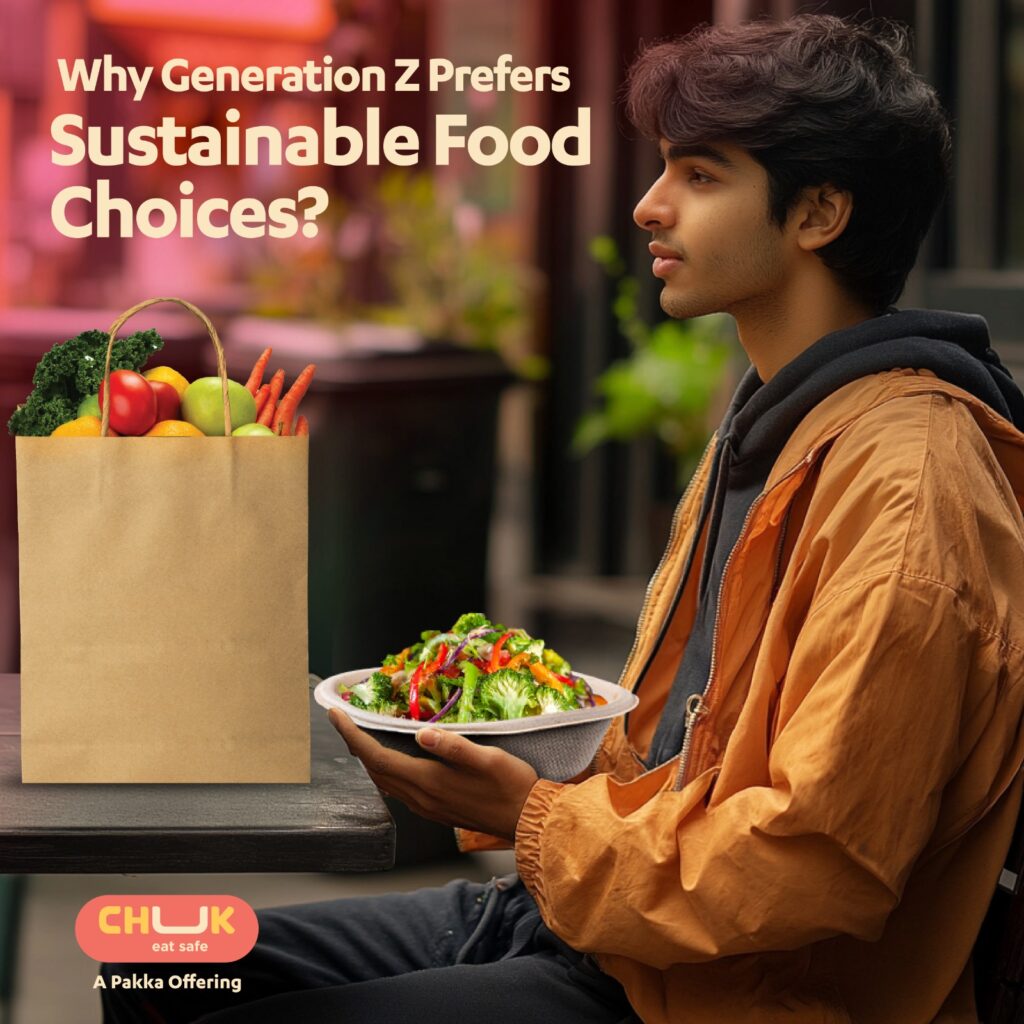
Why Gen Z is all in on sustainable food choices and what it means for your restaurant
If you run a restaurant, cloud kitchen, or catering operation in India right now, there is one demographic you cannot afford to ignore: Gen Z.
This is not some future prediction. Gen Z already makes up over 27% of India’s population. They are ordering on Swiggy and Zomato today. They are choosing where to eat based on values, not just taste. And they are reshaping how the entire food service industry operates.
The honest truth is that most restaurant owners still treat sustainability as a nice-to-have. Gen Z treats it as a dealbreaker.
Key Takeaways
- Gen Z (born 1997-2012) accounts for 27% of India’s population and controls growing food spending power
- 73% of Gen Z consumers globally say they would pay more for sustainable products (First Insight)
- Indian Gen Z orders food online 3-4 times per week on average, making packaging choices highly visible
- Restaurants that visibly commit to sustainability see 12-18% higher repeat order rates from younger customers
- Compostable disposables are the simplest, most visible sustainability signal a restaurant can send
- Ignoring Gen Z preferences today means losing your fastest-growing customer segment tomorrow
Who is Gen Z and why do they matter for your food business?
Gen Z refers to anyone born between 1997 and 2012. In India, that is roughly 380 million people. The oldest among them are now 29 years old, earning full salaries, making independent spending decisions, and ordering food online multiple times a week.
Here is what makes them different from every generation before them:
- They grew up online. Social media is not a tool they adopted. It is where they formed their worldview. Sustainability, climate change, plastic pollution — these are not abstract concepts for Gen Z. They saw the images, watched the documentaries, and followed the activists.
- They research before they buy. Gen Z checks reviews, scans packaging labels, and reads ingredient lists. If something feels inauthentic or greenwashed, they move on.
- They spend with their values. A 2024 First Insight study found that 73% of Gen Z consumers would pay more for sustainable products. That is not a fringe group. That is nearly three out of four customers in this age bracket.
As a restaurant owner, you are not dealing with a trend. You are dealing with a permanent shift in what customers expect.
The numbers behind Gen Z’s food spending power
Before dismissing Gen Z as college students with limited budgets, look at the actual spending data.
| Metric | India-Specific Data |
|---|---|
| Gen Z population in India | ~380 million (27% of total) |
| Monthly food delivery orders (avg) | 12-16 per person |
| Willingness to pay more for sustainable products | 73% (First Insight, 2024) |
| Preference for brands with sustainability commitments | 62% (Deloitte, 2024) |
| Share of online food delivery market (18-27 age group) | 43% of all orders (RedSeer, 2024) |
| Likelihood to switch brands over packaging concerns | 54% have switched at least once |
The food delivery market in India crossed INR 80,000 crore in 2025. Gen Z accounts for nearly half of all online food orders. If your restaurant is on Swiggy or Zomato, a massive share of your revenue already comes from this generation.
Ignoring what they care about is not a philosophical stance. It is a business risk.
Five reasons Gen Z demands sustainable food choices
1. Climate awareness is not optional for this generation
Gen Z did not learn about climate change as adults. They grew up with it.
Cyclone Amphan, Delhi’s annual air quality emergencies, the Uttarakhand floods — these events shaped how this generation sees the world. They connect everyday choices like food packaging and takeaway containers to larger environmental outcomes.
When a Gen Z customer opens a delivery box and finds a plastic container, they are not just seeing packaging. They are seeing a choice the restaurant made. And they judge accordingly.
2. Transparency is non-negotiable
This generation demands to know where their food comes from, how it is made, and what happens to the packaging after they are done.
Vague labels like “eco-friendly” or “green packaging” do not work anymore. Gen Z looks for specifics:
- Is it compostable or just “recyclable” (which in India often means it ends up in a landfill anyway)?
- Does the restaurant have FSSAI compliance displayed?
- Are there certifications to back up the claims?
If you are a restaurant owner using compostable disposables, say so clearly on your Swiggy listing, your packaging, and your social media. Gen Z rewards transparency. They punish greenwashing.
3. Social media turns packaging into brand marketing
Here is something most restaurant owners underestimate: your packaging shows up on social media.
Every time a customer posts a food photo, unboxes a delivery order, or shoots a quick story, your packaging is in the frame. Gen Z shares meals online constantly. That flimsy plastic container or that foam plate becomes part of your brand image whether you want it to or not.
On the other hand, a clean, sturdy bagasse container with your branding on it? That is free marketing. Gen Z notices. They share it. They tag the restaurant. Some even choose restaurants specifically because the packaging looks good on camera.
Compostable disposables made from sugarcane bagasse have a natural, premium look that photographs well. For a generation that eats with their eyes first, this matters more than you think.
4. Health consciousness drives material choices
Gen Z reads labels. Not just food labels, but packaging labels too.
They know that certain plastics leach chemicals when heated. They have concerns about microplastics. They actively prefer food served in materials that feel safer and more natural.
Bagasse-based compostable disposables hit every mark here:
- No chemical coatings — unlike many plastic and foam containers
- Microwave safe — can handle temperatures up to 120 degrees Celsius
- Food-grade certified — meets FSSAI safety standards
- No plastic lining — unlike many “paper” containers that are plastic-coated
When you serve food in compostable tableware, you are not just making an environmental statement. You are answering a health concern that Gen Z actively thinks about.
5. They vote with their wallets and their reviews
Gen Z does not just prefer sustainable options. They actively penalize brands that ignore sustainability.
A 2024 Deloitte survey found that 54% of Gen Z consumers have switched away from a brand because of its environmental practices. In the restaurant context, that means:
- Negative reviews mentioning plastic packaging
- Lower repeat order rates
- Reduced word-of-mouth recommendations
- Being actively called out on social media for wasteful packaging
The flip side is powerful. Restaurants that visibly commit to compostable disposables earn loyalty, positive reviews, and organic social media promotion from exactly the demographic that orders food most frequently.
What Gen Z actually wants from your restaurant’s packaging
Stop guessing. Here is what the data consistently shows Gen Z prefers:
- Compostable over recyclable. They know recycling rates in India are low. Compostable disposables that break down naturally feel like the more honest solution.
- Minimal, clean design. Overwrapped, heavily branded plastic packaging feels wasteful. A single sturdy container with minimal design reads as premium.
- Functional quality. No leaking. No soggy bottoms. No chemical smell. The container should handle hot, oily Indian food without failing.
- Visible commitment. A note on the packaging or the delivery listing that says “Served in 100% compostable tableware” goes a long way.
- Zero greenwashing. Do not call it “eco-friendly” if it is plastic coated paper. Do not call it “biodegradable” without a certification. Gen Z will check.
How to capture the Gen Z market with smart packaging decisions
As a restaurant owner, the switch to compostable disposables is probably the single most visible sustainability action you can take. And it directly addresses what Gen Z cares about most.
Here is a practical roadmap:
Start with your highest-visibility items
You do not need to switch everything overnight. Begin with the items that customers see and interact with most:
- Delivery containers (biryani boxes, curry containers, meal trays)
- Plates for dine-in service
- Takeaway cups for chai, coffee, and beverages
- Cutlery and spoons
These are the items that show up in photos, that customers hold in their hands, and that communicate your brand’s values instantly.
Update your delivery platform listings
Add sustainability as a visible feature on your Swiggy and Zomato listings:
- Mention “100% compostable tableware” in your restaurant description
- Use it as a differentiator in a crowded marketplace
- Include a small note in your delivery packaging (“This container is made from sugarcane bagasse and will compost naturally”)
Train your staff to talk about it
If you run a dine-in operation, your servers should know the basics:
- “Our plates are made from sugarcane bagasse, not plastic”
- “These containers are fully compostable and food-grade certified”
- “We switched to compostable disposables because we care about what touches your food”
Gen Z responds to authenticity. A genuine, brief explanation beats any marketing campaign.
Use social media to amplify the message
Post about your packaging switch. Show the containers. Explain why you made the choice. Tag it with sustainability-related hashtags.
Gen Z will engage with this content. They share it. They save it. They reference it when recommending your restaurant to friends.
The cost question every restaurant owner asks
Let us address the elephant in the room. Compostable disposables cost more per unit than plastic. That is a fact.
But here is the full picture:
| Factor | Plastic Disposables | Compostable Disposables |
|---|---|---|
| Unit cost | Lower | 15-25% higher |
| Customer perception | Neutral to negative | Positive, especially with Gen Z |
| Regulatory risk | Increasing (SUP ban, fines up to INR 1 lakh) | Fully compliant |
| Brand image impact | None or negative | Positive differentiation |
| Social media optics | Risk of negative posts | Organic promotion |
| Repeat order rate from Gen Z | Baseline | 12-18% higher |
| Long-term cost trajectory | Rising (regulations, raw material) | Falling (scale, competition) |
The cost gap is real but shrinking. And when you factor in the regulatory risk of continued plastic use, the customer retention advantage, and the organic marketing value, compostable disposables are often the smarter financial choice.
Most restaurants absorb the cost difference with a INR 3-7 adjustment per order. On a INR 400 average order value, that is less than 2%. No customer notices. But every customer sees better packaging.
Regulation is pushing in the same direction
Even if Gen Z preferences alone did not justify the switch, Indian regulation is making it inevitable.
The Central Pollution Control Board (CPCB) enforces India’s single-use plastic ban. Plates, cups, cutlery, and trays under 100 microns made from conventional plastic are already banned. Enforcement is tightening. Fines can reach INR 1 lakh per violation, with imprisonment for repeat offenders.
Extended Producer Responsibility (EPR) rules are adding compliance requirements for packaging waste. States like Maharashtra, Tamil Nadu, and Himachal Pradesh have some of the strictest enforcement.
The question is not whether you will switch. It is whether you switch now and capture the Gen Z market advantage, or later when it is mandatory and your competitors have already moved.
Real-world impact: what restaurants are seeing after the switch
Restaurants, cloud kitchens, and QSRs across India that have switched to compostable disposables consistently report:
- Better Swiggy and Zomato ratings — customers mention packaging quality in reviews
- Higher repeat order rates — particularly from the 18-30 age group
- Reduced regulatory anxiety — full compliance with SUP ban
- Stronger brand identity — especially on social media
- Catering contract wins — corporate clients increasingly require sustainable packaging for events
The pattern is clear. Compostable disposables are not a cost. They are a competitive advantage, particularly with the demographic that orders food most often.
In a Nutshell
Gen Z is not a future market. They are your current customer base, accounting for 43% of online food delivery orders in India and making purchasing decisions based on sustainability every single day.
Here is what matters:
- 73% of Gen Z will pay more for sustainable products. Your packaging is the most visible place to demonstrate that commitment.
- Transparency wins. Use the term “compostable disposables,” display your FSSAI compliance, and skip the greenwashing. Gen Z checks.
- Packaging is marketing. Every delivery order is a brand touchpoint. Compostable bagasse containers photograph well, perform under heat and oil, and signal quality.
- The cost gap is closing. A INR 3-7 per order difference buys you regulatory compliance, customer loyalty, and organic social media promotion.
- Regulation makes it inevitable. The SUP ban is already in effect. Switching now means you capture the market advantage. Switching later means you are just catching up.
Your fastest-growing customer segment is asking for exactly one thing from your packaging: make it compostable. The restaurants that listen first will win their loyalty for years.
Frequently asked questions
Does Gen Z actually care about food packaging or is this just a trend?
It is not a trend. Gen Z grew up with climate change as a daily reality, not a distant concept. Research from First Insight shows 73% would pay more for sustainable products. Deloitte found 54% have already switched brands over environmental practices. This is generational behaviour, not a passing phase. For restaurants, that means your packaging choices are being evaluated every time someone opens a delivery box.
How much more do compostable disposables cost compared to plastic?
Compostable bagasse disposables typically cost 15-25% more per unit than plastic alternatives. At restaurant volumes, this translates to roughly INR 3-7 more per delivery order. Most restaurants fold this into their regular menu pricing with a 1-2% adjustment. On a INR 400 order, that is barely noticeable to the customer but clearly visible in better packaging quality.
Will switching to compostable packaging actually increase my orders from Gen Z customers?
Restaurants that have made the switch report 12-18% higher repeat order rates from the 18-30 age group. The mechanism is straightforward: Gen Z notices good packaging, mentions it in reviews, shares it on social media, and recommends the restaurant to friends. It is not a guaranteed sales spike overnight, but a steady compounding advantage in customer retention and word-of-mouth.
Can compostable containers handle hot, oily Indian food like biryani and curries?
Yes. Sugarcane bagasse containers are engineered for exactly this. They handle temperatures up to 120 degrees Celsius, are microwave safe, and resist oil and moisture without getting soggy. Thousands of restaurants, cloud kitchens, and caterers across India use them daily for biryani, dal makhani, paneer gravies, and every other dish you can think of. They are also food-grade certified and FSSAI-compliant.
How do I communicate my sustainability efforts to Gen Z customers on Swiggy and Zomato?
Keep it simple and honest. Add “Served in 100% compostable tableware” to your restaurant description on delivery platforms. Include a small note inside your delivery packaging explaining that the container is made from sugarcane bagasse and will compost naturally. Post about it on your social media. Gen Z responds to specific, verifiable claims, not vague “eco-friendly” language. Mention that your disposables are compostable, food-grade certified, and free of plastic coatings.
What happens if I do not switch from plastic? Are there legal consequences?
India’s single-use plastic ban already covers plates, cups, cutlery, and trays under 100 microns. The CPCB enforces fines up to INR 1 lakh per violation, with potential imprisonment for repeat offenders. States like Maharashtra and Tamil Nadu have particularly strict enforcement. Extended Producer Responsibility rules are adding further compliance requirements. Continuing with banned plastic items is both a legal and financial risk that increases every quarter.
Is compostable the same as biodegradable?
No, and this distinction matters. Biodegradable means a material will eventually break down, but it could take decades and may leave behind microplastics. Compostable means the material breaks down into natural compost within 90-180 days under composting conditions, leaving no toxic residue. When Gen Z hears “biodegradable,” they are skeptical because the term has been used loosely. “Compostable” is the more specific, credible, and accurate term, which is why it builds more trust with informed customers.
Looking to make the switch to compostable disposables for your restaurant, cloud kitchen, or catering business? Explore Chuk’s full range of compostable tableware — built for Indian food, tested under real kitchen conditions, and trusted by food service businesses across the country.