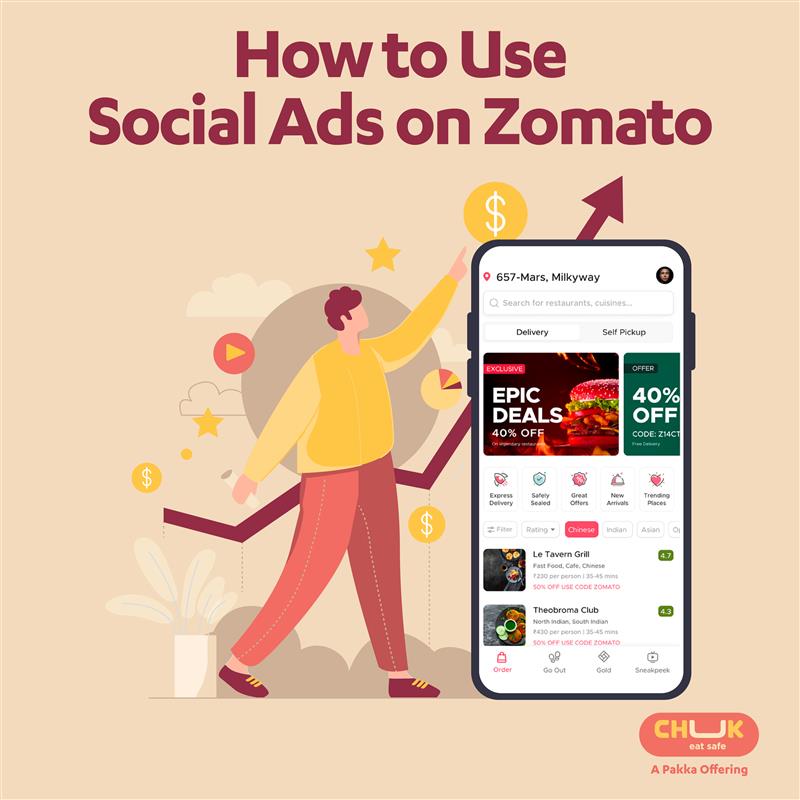
How to use social ads on Zomato to fill more tables and get more orders
You have a solid menu. Your kitchen delivers consistently. The reviews from regulars are genuine. But the phone doesn’t ring enough at 11 AM, and the delivery orders flatline after the lunch rush. The honest truth? Good food alone is no longer a discovery mechanism. Your next customer isn’t walking past your signboard. They’re scrolling Zomato during a boring meeting, double-tapping food reels at midnight, and clicking on a sponsored post at 6 PM that leads them straight to your restaurant page.
Zomato’s social ads put your restaurant directly in front of those people. Not through a generic banner tucked away in a corner, but through targeted content served on Facebook and Instagram to diners who are already looking for exactly what you cook.
This is not a feature reserved for chain restaurants with marketing teams. If you run a single-outlet restaurant or a cloud kitchen and you know how to post on Instagram, you can run social ads through Zomato. What follows is a practical, step-by-step breakdown with Indian restaurant economics in mind.
Key Takeaways
- Zomato social ads push your restaurant to targeted diners on Facebook and Instagram, not just within the Zomato app
- You do not need a big budget to start. Rs. 500 to Rs. 1,000 per day is enough to test and learn what works
- The three main ad formats (promoted listings, sponsored social posts, deals/offers) serve different goals. Pick the one that matches what you actually need
- Your ad performance depends heavily on what diners see when they land on your Zomato page, so fix your profile before you spend money
- Tracking impressions and click-through rates weekly (not monthly) lets you cut waste fast
- What diners see in your food photos, including the plates and containers, shapes their perception before they read a single word
Why social ads on Zomato matter for your restaurant
Indian food delivery and dining discovery have concentrated into a handful of apps. More than 50 million active users engage with Zomato every month. That is not a number you can reach through word of mouth, a flex banner outside your restaurant, or even a solid Instagram page.
Here is the part most restaurant owners miss: the majority of Zomato users discover new restaurants through the app, not by searching for a specific name they already know. They search by cuisine, by location, by rating. And increasingly, they discover through social feeds where Zomato-powered ads surface your restaurant between a friend’s vacation photos and a cricket highlights reel.
Social ads change the game for three reasons:
- Reach beyond the app. Your restaurant appears on Facebook and Instagram, where diners spend hours daily. Zomato handles the targeting. You just set the parameters.
- Intent-based audience. Unlike a generic Facebook boost, Zomato’s ad platform targets users based on dining behaviour, location, and food preferences. These are not random impressions. These are people who order food online in your area.
- Measurable ROI. Every rupee you put in gives you impression counts, click-through rates, and (if you connect tracking) actual order attribution. You know what worked.
The majority of people who see a food ad on social media are likely to take action, whether that means visiting the restaurant page, saving it for later, or placing an order. For a restaurant operating on tight margins, that conversion potential matters far more than any billboard.
Before you spend a single rupee: Fix your Zomato profile
Running ads to a weak Zomato page is like inviting guests to a restaurant with no signboard, dim lighting, and an outdated menu card. You will pay for clicks that don’t convert.
Before launching any social ad campaign, treat your Zomato profile as a landing page:
- Menu with prices. Indian diners are price conscious. If your menu isn’t updated, they bounce. List every active item with accurate pricing.
- High-quality food photos. Not stock images. Actual dishes from your kitchen, shot in decent light. Overhead shots work well for thalis and platters. Close-ups work for burgers, momos, and biryanis. Shoot on a clean, uncluttered surface.
- Operating hours. If you say you close at 11 PM but stop taking orders at 10:30, you’ll collect negative reviews. Be honest.
- Contact details and location pin. Double check that your Google Maps pin matches. Delivery riders and walk-in diners both rely on it.
- Respond to reviews. Every single one. Within 24 hours if possible. A profile with unanswered negative reviews looks abandoned. Active owners earn trust.
Your profile is the conversion point. The ad gets people there. The profile closes the deal.
Step 1: Understand who you are trying to reach
This is where most restaurant owners make the first mistake. They launch an ad targeting “everyone in Delhi who likes food.” That is too broad. You burn budget fast and learn nothing.
Narrow your audience using three filters:
Location radius
Start tight. If you’re a dine-in restaurant, target a 3-5 km radius. If you run delivery, go up to 7-8 km but no further unless your delivery partner coverage extends that far. There is no point showing your ad to someone 15 km away who will never order because delivery time would exceed 50 minutes.
Interest categories
Zomato lets you target based on dining preferences:
- Cuisine enthusiasts. Target people who frequently order or review the cuisine you serve (North Indian, South Indian, Chinese, Italian, etc.)
- Diet-specific audiences. Vegans, vegetarians, health-conscious eaters. If you have a strong veg menu or a dedicated Jain section, use this.
- Fine dining vs. casual vs. QSR. Match your restaurant’s positioning. A casual biryani joint shouldn’t target fine dining searchers, and vice versa.
Demographics
- Age. College-area restaurants should target 18-25. Family restaurants do better with 28-45. Know your core diner.
- Income bracket. If your average order value is Rs. 800+, targeting budget-conscious students wastes money.
- Day-part behaviour. Some audiences respond better to lunch-hour ads (office crowds). Others convert better at dinner (families, couples).
Write down your ideal customer before you touch the ad dashboard. “Office workers aged 25-35 within 5 km who order North Indian food for lunch” is a usable target. “Food lovers in Mumbai” is not.
Step 2: Choose the right ad format
Zomato offers three primary social ad formats. Each serves a different business goal. Picking the wrong one is the most common waste of budget.
Zomato social ad formats comparison
| Ad Format | Best For | Where It Shows | Typical Budget | Expected Outcome |
|---|---|---|---|---|
| Promoted Restaurant Listings | Visibility on Zomato search results | Zomato app (top of search, category pages) | Rs. 500-2,000/day | Higher ranking in Zomato search, more profile visits |
| Sponsored Social Media Ads | Brand awareness and new customer acquisition | Facebook and Instagram feeds | Rs. 500-3,000/day | Social engagement, profile clicks, first-time orders |
| Deals and Offers Ads | Driving immediate orders and walk-ins | Zomato app + social feeds | Rs. 300-1,500/day + discount cost | Spike in orders during promotion period |
When to use each format
Promoted Listings work when you are already getting some traffic but losing out to competitors ranked above you. If you are on page 2 of “biryani in Koramangala,” promoted listings bump you to the top. Think of this as buying shelf space in a supermarket.
Sponsored Social Media Ads are your best tool for reaching people who have never heard of you. The ad appears as a native post on Facebook or Instagram, complete with your restaurant name, a food image, rating, and a direct link to your Zomato page. Use this when you are launching, entering a new delivery zone, or trying to build awareness beyond your immediate neighbourhood.
Deals and Offers Ads combine a discount or bundle with paid promotion. “Flat 20% off on orders above Rs. 500” or “Free dessert with any main course” paired with ad spend creates urgency. Use this during slow weekdays, to clear a new menu launch, or during festival periods when competition for eyeballs is fierce.
For most single-outlet restaurants, start with Sponsored Social Media Ads. They give you the broadest reach for learning what messaging works before you invest in promoted listings or discount-driven campaigns.
Step 3: Set your budget without burning cash
Here is the mistake: restaurant owners either spend nothing or blow their monthly marketing budget in the first week. Neither approach teaches you anything useful.
The test-and-learn framework
- Week 1-2: Start with Rs. 500 per day. Run one ad format (start with sponsored social). Target your narrowest, highest-intent audience. Track impressions, clicks, and click-through rate.
- Week 3-4: If CTR is above 1.5%, increase budget to Rs. 1,000-1,500 per day. If it is below 1%, change the creative or tighten the audience before spending more.
- Month 2 onwards: Scale what works. Drop what doesn’t. Shift budget to the days and times that deliver the highest conversion.
Budget allocation by restaurant type
| Restaurant Type | Suggested Daily Start | Monthly Ceiling (testing phase) | Notes |
|---|---|---|---|
| Single-outlet dine-in | Rs. 500 | Rs. 15,000 | Focus on 3-5 km radius, dinner hours |
| Cloud kitchen / delivery only | Rs. 700 | Rs. 20,000 | Broader radius, lunch + dinner targeting |
| QSR / fast casual chain (2-5 outlets) | Rs. 1,500 | Rs. 40,000 | Split budget across locations |
| Cafe / bakery | Rs. 400 | Rs. 12,000 | Weekend-heavy budget allocation |
The key rule: never set a daily budget you cannot sustain for at least 14 days. Algorithms need time to optimize. Turning ads on and off daily teaches the system nothing and wastes your initial spend.
Step 4: Create ads that actually stop the scroll
Your ad competes with wedding photos, baby videos, and cricket memes. If it looks like an ad, people scroll past it. The winning approach is to make it look like something a friend posted.
What works in restaurant social ads
- Actual food, not styled stock photos. Shoot the dish the way a customer would photograph it. On the table, maybe a hand reaching for it, natural light preferred. Overly produced images feel corporate and get ignored.
- Show the setting. A bustling kitchen, a plated dish on a beautiful table with good lighting, a takeaway bag packed neatly. Context sells more than the food alone.
- Clear, short text. “Craving butter chicken? 4.3-rated and 12 minutes from you.” That is it. No paragraphs. No corporate language.
- Call to action that matches intent. “Order now,” “Book a table,” or “See the full menu” all work. “Learn more” does not.
What your packaging says in the ad
Here is something most restaurants overlook. When you shoot photos for ads, everything in the frame communicates. The plate, the container, the bowl, the napkin. If your delivery photo shows food in a flimsy plastic container with oil leaking through, that image works against you regardless of how good the food tastes.
Restaurants using compostable disposables from Chuk often find their food photos perform better simply because the tableware looks clean, consistent, and premium. A sturdy sugarcane bagasse container holding biryani photographs differently than a thin plastic box. It signals quality before the customer reads the restaurant name.
This matters even more for social ads where the image does 80% of the selling. Your packaging is part of your visual brand, whether you think about it that way or not.
Step 5: Launch and monitor like a professional
Setting up the ad is 20% of the work. The other 80% is monitoring, adjusting, and not panicking.
Your first 48 hours
- Don’t change anything. The algorithm is learning who responds to your ad. Let it collect data. Changing the creative or budget in the first two days resets the learning phase.
- Check impressions, not orders. In the first 48 hours, you want to know if the ad is being shown. If impressions are very low, your targeting might be too narrow or your bid too low.
Weekly check-in (every Monday)
Track these four numbers:
- Impressions: How many times your ad was shown. This tells you if your budget is competitive.
- Click-through rate (CTR): Clicks divided by impressions. Above 1.5% is decent. Above 2.5% is strong. Below 1% means the creative or targeting needs work.
- Cost per click (CPC): How much you pay for each person who clicks to your Zomato page. In most Indian cities, Rs. 5-15 per click is a reasonable range. Above Rs. 25 means you are overpaying.
- Conversion actions: Orders placed, table bookings made, or phone calls generated from the ad. This is your true ROI metric.
When to change your ad
| Signal | What It Means | What to Do |
|---|---|---|
| High impressions, low CTR | People see the ad but don’t click | Change the image or headline |
| High CTR, low conversions | People click but don’t order | Fix your Zomato profile (menu, photos, reviews) |
| Low impressions | Budget too low or audience too narrow | Increase daily spend by Rs. 200-300 or widen radius by 1-2 km |
| High CPC | Heavy competition in your area | Shift to a less competitive time slot or niche cuisine targeting |
| Strong performance | Everything is working | Increase budget gradually (20% per week max) |
Step 6: Use Zomato analytics to make smarter decisions
Zomato provides a restaurant dashboard with data that most owners never open. This is a mistake because the dashboard tells you exactly what your customers are doing.
Key metrics to track monthly
- Total impressions and reach. How many unique users saw your restaurant listing or ad.
- Engagement rate. How many interacted with your page (viewed menu, read reviews, clicked photos). A low engagement rate with high traffic means your profile is not compelling enough.
- Order trends. Daily and weekly order patterns reveal your peak and valley hours. Run ads during valleys, not peaks. You don’t need to advertise during Friday dinner rush when you’re already at capacity.
- Review sentiment. Track not just star ratings but what people mention. If 5 reviews in a week mention slow delivery, fix the process before spending more on ads.
- Photo performance. Zomato shows which photos get the most views. Use your top-performing food photos in your next ad creative.
Connecting the dots
The restaurants that get the highest return from social ads are the ones that use analytics to create a feedback loop:
- Run ad with food photo A targeting office workers within 4 km
- Check: CTR is 2.1%, CPC is Rs. 9, 14 orders attributed
- Next week: Run same audience but test food photo B
- Check: CTR drops to 1.3%. Photo A was better.
- Scale photo A ad, increase budget by 20%
This is not rocket science. It is disciplined testing. Most restaurants skip it because they set an ad, check it once after a week, and either declare it a success or a failure without understanding why.
Step 7: Pair your ads with a presentation that delivers
Social ads bring traffic. Your food, service, and presentation convert that traffic into repeat customers. This is where many restaurants break the chain.
A customer sees a beautiful ad, orders from your Zomato page, and receives food in a leaky container that has warped from the heat. The food might be excellent, but the experience starts with disappointment. That customer will not reorder, and they certainly will not leave a positive review that helps your organic ranking.
The packaging-experience connection
As a restaurant owner, every delivery order is a branding moment. The container is the first physical touchpoint. It sets the tone before the first bite.
Restaurants that switch to compostable disposables find an unexpected benefit: fewer complaints about packaging-related issues. Sturdy containers that hold hot food without warping, plates that don’t buckle under the weight of a loaded thali, bowls that don’t leak gravy through the seams. These are functional advantages that directly impact your Zomato rating.
Chuk’s sugarcane bagasse containers handle temperatures up to 120 degrees Celsius without deformation. They are microwave safe, leak resistant, and stackable for efficient delivery packing. When your delivery consistently arrives looking presentable, customers photograph it and post on social media. That is free advertising that no budget can buy.
And here is the business case that matters: a single negative review about leaky packaging can cost you 10-15 potential orders over the next month. At an average order value of Rs. 400, that is Rs. 4,000-6,000 in lost revenue. The cost difference between compostable disposables and cheap plastic is a fraction of that loss.
Step 8: Scale what works and cut what doesn’t
After 30 days of testing, you should have clear data on what performs. Now it is time to scale strategically.
Scaling checklist
- Double down on your best-performing audience segment. If office workers aged 28-35 within 4 km convert best, increase your budget for that segment by 30-50% and reduce spend on underperforming segments.
- Rotate creatives every 2-3 weeks. Even the best ad gets stale. Swap images regularly. Keep the winning copy structure but change the dish featured.
- Align ads with your calendar. Festival weeks, IPL match days, long weekends, monsoon comfort food season. Plan your highest-budget weeks around these moments.
- Layer in deals strategically. Once you know which audience converts, add a time-limited offer for that segment. “25% off your first order this week” to a proven audience is far more efficient than a blanket discount.
- Track cost per acquired customer, not just cost per click. If a customer who costs Rs. 80 to acquire through ads orders 4 times in the next 3 months with an average order of Rs. 450, your actual customer acquisition cost is Rs. 80 against Rs. 1,800 in revenue. That is a 22x return.
Common mistakes that waste your Zomato ad budget
Even experienced restaurant owners fall into these traps. Avoid them and you will outperform 80% of competitors running ads in your area.
- Running ads with an incomplete Zomato profile. You pay for clicks that hit a page with no photos, outdated menu, and unanswered reviews. Fix the profile first.
- Targeting too broadly. “All of Bangalore” is not a target audience. Narrow by area, cuisine preference, and demographics.
- Using the same creative for months. Ad fatigue is real. Audiences stop noticing after 2-3 weeks of the same image.
- Ignoring negative reviews while running ads. New visitors check your reviews before ordering. If the last 3 reviews are negative and unanswered, your ad spend brings people to a page that pushes them away.
- Not tracking ROI. If you cannot tell whether your Rs. 15,000 monthly ad spend generated Rs. 50,000 or Rs. 5,000 in revenue, you are guessing, not marketing.
- Stopping ads after 3 days because nothing happened. Social ad algorithms need 7-14 days to optimize. Cutting too early means you paid for the learning phase but left before the results phase.
- Competing on discounts alone. Deep discounts attract price-sensitive customers who will never return at full price. Use offers strategically, not as your default.
How your physical experience reinforces your digital ads
There is a cycle that the smartest restaurant operators understand: your social ads bring in first-time customers, your food and service create a positive experience, and that experience generates organic reviews and social posts that reduce your future ad spend.
Every element of the dining or delivery experience feeds back into this cycle. The taste, obviously. The speed. The temperature. But also the presentation. When a customer opens a delivery bag and finds food in clean, premium-looking compostable containers, they are more likely to photograph it, post it, and tag your restaurant.
That user-generated content is marketing gold. It costs you nothing and carries more trust than any ad you could create. Compostable disposables from Chuk give your food a clean, consistent backdrop that photographs well and signals to customers that you care about quality beyond just the recipe.
Sustainability becomes a silent brand differentiator. You don’t need to shout about it. When a customer notices the container says “100% compostable” and their food arrived in perfect condition, that registers. It shows up in reviews. It gets mentioned in Instagram stories. And every mention reduces the cost of your next ad by building organic reach.
In a Nutshell
Social ads on Zomato are not a luxury reserved for large restaurant chains. They are a practical, measurable tool for any restaurant owner who wants to reach more diners and fill more delivery slots.
Here is what matters:
- Fix your Zomato profile before spending on ads. Your profile is your landing page.
- Start small. Rs. 500-1,000 per day is enough to test and learn.
- Target narrowly. Location, cuisine interest, and demographics. Not “everyone.”
- Choose the right ad format. Sponsored social ads for awareness. Promoted listings for search visibility. Deals for urgency.
- Create ads with real food photos. Skip the stock images.
- Monitor weekly. Track CTR, CPC, and actual orders. Cut what doesn’t work within 2 weeks.
- Use analytics. Zomato’s dashboard tells you what’s working. Read it.
- Let your physical presentation reinforce your digital brand. What customers see when they open the delivery package matters as much as what they saw in the ad.
- Scale what works. Drop what doesn’t. Repeat every month.
The restaurant that wins on Zomato is not always the one with the best food. It is the one that is most visible, most trusted, and most consistent. Social ads give you the visibility. Your food, service, and presentation build the trust and consistency.
Frequently Asked Questions
How much does it cost to run social ads on Zomato?
You can start with as little as Rs. 500 per day. Most single-outlet restaurants see meaningful data with Rs. 10,000-15,000 per month. The cost depends on your city (Mumbai and Delhi are more competitive than tier-2 cities), your cuisine category, and how narrowly you target. Start low, track performance for 14 days, and scale only what shows a clear return.
Do I need a Zomato Pro or Gold membership to run social ads?
No. Social ads are available through the Zomato for Restaurants dashboard, which is separate from consumer-facing plans. Any restaurant listed on Zomato can access the ad platform. You just need an active listing with complete menu, photos, and contact details.
How long does it take to see results from Zomato social ads?
Expect 7-14 days before the algorithm optimizes delivery. You should see impression and click data within 24-48 hours, but actual order conversions typically stabilize by day 10-14. Do not judge a campaign based on the first 3 days. The learning phase is real and necessary.
Can I run social ads if my restaurant has a low Zomato rating?
You can, but you probably shouldn’t. If your rating is below 3.5, ads will drive traffic to a page that discourages ordering. Focus on improving your rating first by addressing review complaints, updating your menu, and improving delivery packaging. Once you cross 3.8-4.0, your ad spend will convert much more efficiently.
What type of food photos work best in Zomato social ads?
Real photos from your kitchen outperform stock images and overly styled shoots. Shoot in natural light, use a clean background, and show the food as a customer would actually receive it. Include the serving container in the frame because it communicates quality. Overhead shots work well for platters and thalis. Close-ups work for individual dishes like burgers, momos, or desserts.
Should I run promoted listings or social media ads first?
If you are new to Zomato advertising, start with sponsored social media ads. They give you reach beyond the Zomato app and help build awareness among people who have never searched for your restaurant. Promoted listings are better as a second step once you have some organic traffic and want to rank higher within Zomato search results.
How do I know if my Zomato ads are actually generating orders?
Track three things: clicks on your Zomato profile from the ad, order volume during and after the ad period compared to before, and any new reviews that mention discovering you online. Zomato’s analytics dashboard shows impression and click data directly. For order attribution, compare your weekly order count for the 2 weeks before the ad launched versus the 2 weeks after.
Can I target specific areas or neighbourhoods with Zomato social ads?
Yes. Location targeting is one of the strongest features. You can set a radius (as tight as 2-3 km) around your restaurant. For delivery-focused restaurants, match your targeting radius to your actual delivery coverage. There is no point paying for visibility in areas where you cannot deliver within a reasonable time.
What is the difference between Zomato social ads and boosting my own Instagram posts?
Zomato social ads use dining behaviour data to target people with demonstrated food ordering intent. When you boost an Instagram post directly, you target based on general interests and demographics. Zomato’s targeting is more precise for restaurant discovery because it use data from millions of actual food orders and searches. Both have a role, but Zomato social ads typically convert better for restaurant-specific goals.
How does my delivery packaging affect my Zomato ad performance?
Indirectly but significantly. Ads drive first-time orders. The delivery experience determines whether that customer returns and leaves a positive review. If food arrives in leaky, flimsy containers, the customer is unlikely to reorder or recommend you, which means your ad spend acquired a one-time customer instead of a repeat one. Restaurants using sturdy compostable disposables from Chuk report fewer packaging-related complaints and better repeat order rates, which compounds the value of every rupee spent on advertising.
More on restaurant marketing
- get featured on Zomato home page
- optimize your Zomato listing
- Zomato vs Swiggy
- restaurant advertising guide
- restaurant operations glossary
The container decides whether the customer orders again
Once the order leaves the kitchen the container is the only thing protecting it. CHUK’s compostable bagasse delivery containers hold heat, resist leaks and keep you clear of single-use plastic rules.
Browse delivery containers | Order a sample box | Get pricing on WhatsApp