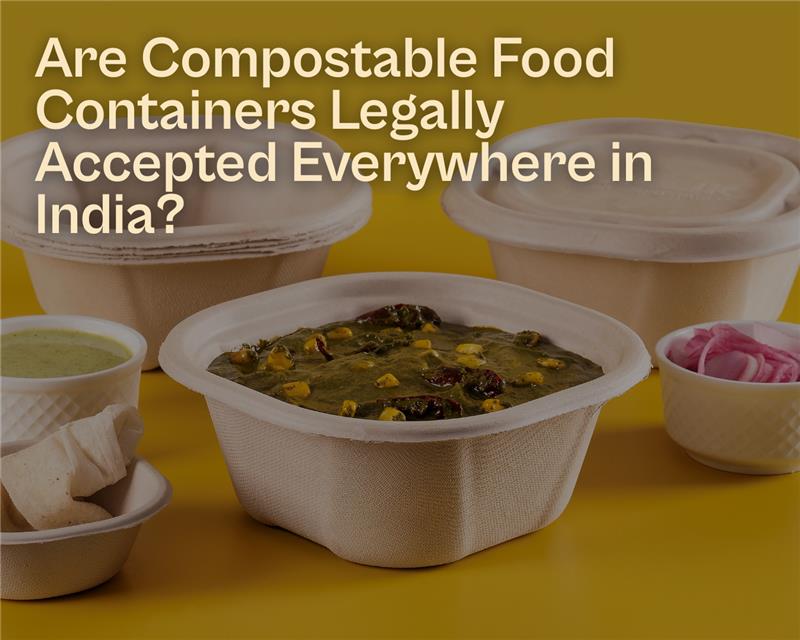
Are compostable food containers legally accepted everywhere in India?
You switched to compostable disposables. You feel good about it. Your customers notice the “eco-friendly” packaging and nod in approval. Then an FSSAI inspector walks in, asks for your packaging compliance certificate, and you have no idea what they are talking about.
This is the honest truth that most restaurant owners, QSR operators, and franchise decision-makers do not hear: switching to compostable food containers is not just a sustainability choice. It is a regulatory decision. And if you get it wrong, it can cost you your inspection score, your licence, or worse.
What they don’t tell you is that Indian law does not care whether your container is compostable, plastic, or made from banana leaves. It cares whether it is certified, food-grade, and documented. Full stop.
This guide breaks down the legal space of compostable food containers across India. No vague claims. No greenwashing. Just what you need to know as a food business operator to stay compliant and avoid nasty surprises during your next health inspection.
Key Takeaways
- Compostable food containers are legally accepted in India, but only when they meet FSSAI food-grade certification requirements
- The Food Safety and Standards (Packaging) Regulations, 2018 mandate that all materials in direct contact with food must carry a Certificate of Conformity from an NABL-accredited lab
- Different states enforce single-use plastic bans with varying strictness, creating a patchwork of rules across the country
- Packaging non-compliance is now treated as a critical food safety parameter in FSSAI inspections
- Working with certified compostable disposable suppliers is the simplest way to stay ahead of regulations
What Indian law actually says about food packaging
Let us start with the foundation. The Food Safety and Standards (Packaging) Regulations, 2018 are the rules that govern what touches your customer’s food. Under these regulations, every material in direct contact with food must be food-grade and demonstrably safe.
Here is what that means in practice:
- All packaging materials must comply with Indian Standards (IS) or equivalent international standards
- You need a Certificate of Conformity from an NABL-accredited laboratory
- The certificate must cover migration testing, ensuring nothing harmful leaches from the container into the food
- Documentation must be available on-site for inspection at any time
FSSAI updated its inspection checklists in recent years and packaging compliance is now categorised as critical to food safety. That is the same category as food temperature control and personal hygiene. Not a minor checkbox. A make-or-break parameter.
As a restaurant owner, you cannot afford to treat packaging as an afterthought. The inspector checking your kitchen is also checking your containers.
So, are compostable food containers legal in India?
Yes. But with conditions.
Indian law does not ban compostable food containers. It does not even treat them differently from any other packaging material. What it requires is that they meet the same food-grade standards as everything else.
For a compostable container to be legally compliant, it must be:
- Food-grade certified — tested and approved for direct food contact
- Compliant with relevant Indian Standards — IS/ISO 17088 for compostability, plus applicable BIS standards
- Backed by lab documentation — Certificate of Conformity from an NABL-accredited lab
- Free from harmful substances — migration limits for heavy metals and other contaminants must be within prescribed thresholds
Materials like bagasse (sugarcane fibre), PLA (polylactic acid), and other plant-based materials are widely used in compostable disposables. All of them can meet Indian food-grade standards. The question is never “can compostable containers be legal?” It is “does your specific supplier have the right certifications?”
This is where most food business operators slip up. They assume that because a product is marketed as compostable, it is automatically compliant. That is not how it works. A compostable container without food-grade certification is just as much of a compliance risk as an untested plastic one.
The state-wise picture: where regulations bite harder
Here is what they don’t tell you about India’s regulatory space. While FSSAI rules apply nationally, enforcement varies dramatically from state to state. On top of that, many states have their own single-use plastic bans and packaging regulations that layer on additional requirements.
| State / Territory | Single-Use Plastic Ban Status | Compostable Disposable Stance | Enforcement Level |
|---|---|---|---|
| Maharashtra | Strict ban since 2018 | Compostable alternatives actively encouraged | High — regular raids and fines |
| Tamil Nadu | Comprehensive ban | Compostable disposables accepted with certification | High |
| Karnataka | Ban with exemptions | Compostable packaging permitted | Moderate to High |
| Delhi NCT | Ban under national PWM Rules | Compostable alternatives accepted | Moderate |
| Himachal Pradesh | Early adopter of plastic ban | Compostable packaging encouraged | Moderate |
| Goa | Ban on select items | Compostable alternatives accepted | Moderate |
| Kerala | Progressive ban since 2020 | Compostable disposables accepted | Moderate to High |
| Uttar Pradesh | Ban announced, partial enforcement | Compostable packaging accepted | Low to Moderate |
| Rajasthan | Ban in place | Compostable alternatives accepted | Low to Moderate |
| Gujarat | Selective ban | Compostable packaging permitted | Moderate |
The bottom line? If you operate in Maharashtra, Tamil Nadu, or Karnataka, enforcement is not theoretical. Inspectors actively check. In states like Uttar Pradesh or Rajasthan, enforcement is lighter but tightening every year.
The national Plastic Waste Management Rules, 2016 (amended in 2021 and 2022) banned identified single-use plastic items across India from July 2022. This has pushed restaurants and QSRs toward compostable alternatives. But the push creates a trap for the unprepared: switching to compostable disposables without verifying certifications puts you at risk from a different angle.
As a food business operator, you need to track both sets of rules — the national FSSAI packaging regulations and your state’s specific plastic and packaging mandates.
Why packaging compliance matters during health inspections
If you think health inspections only cover kitchen hygiene and food temperatures, you are in for a rude awakening. FSSAI inspectors now assess packaging as part of their standard checklist. And failure here triggers the same consequences as any other critical non-compliance.
Here is what inspectors look for regarding packaging:
- Certificate of Conformity for all food-contact materials on the premises
- Supplier documentation showing food-grade status of containers and serviceware
- Proper storage of packaging materials, away from contaminants
- Labelling compliance on packaging, where applicable
- No reuse of single-use items — yes, this gets checked
Non-compliance with packaging requirements can contribute to the same inspection failures as:
- Serving food at incorrect temperatures
- Improper food storage practices
- Pest infestations or unsanitary conditions
- Lack of staff training records
- Missing or expired FSSAI licence
These are the core reasons restaurants fail health inspections. And packaging is now firmly in that list.
Real consequences of getting this wrong
Let us talk about what actually happens when restaurants ignore compliance. These are not hypothetical scenarios.
Licence suspensions and closures
Across Indian cities, the FDA and FSSAI have suspended licences of restaurants for combined violations including poor hygiene, inadequate pest control, and unsafe packaging practices. In many cases, the restaurant only learns about the packaging requirement after the inspection has already gone badly.
Financial penalties
Under the Food Safety and Standards Act, penalties for non-compliance range from INR 25,000 to INR 10 lakh depending on severity. Packaging violations might not carry the heaviest fines on their own, but they contribute to overall non-compliance scores that determine your inspection grade.
Reputation damage
In the age of Zomato and Swiggy, your FSSAI rating is public. A poor inspection grade tanks your visibility on delivery platforms. One food safety incident linked to packaging contamination and your Google reviews take a hit you cannot recover from quickly.
Supply chain disruption
If your packaging supplier cannot produce certifications on demand, you are vulnerable. An inspector asking for documentation you do not have is an immediate red flag. Some operators have had to halt operations while scrambling to source certified alternatives.
The honest truth? Most of these consequences are entirely avoidable. They happen because food business operators treat packaging as a procurement decision rather than a compliance one.
How to make compostable disposables your compliance advantage
Here is the flip side that smart restaurant owners and QSR operators are figuring out: if you do this right, compostable disposables become a competitive edge, not a liability.
1. Work with certified suppliers
The single most important step is sourcing from suppliers who can provide:
- Food-grade certification for every product
- Certificates of Conformity from NABL-accredited labs
- BIS certification where applicable
- Compostability certification (IS/ISO 17088 or equivalent)
When your supplier hands you a complete documentation folder, you have already solved 80% of your compliance headaches. Chuk, for instance, provides full certification documentation across its range of compostable disposables — from delivery containers to plates and bowls.
2. Build a packaging compliance file
Create a dedicated folder (physical and digital) with:
- Copies of all supplier certifications
- Purchase orders and invoices showing certified products
- Internal training records showing staff know which containers to use for what
- Any correspondence with suppliers regarding compliance queries
This file should be as accessible as your FSSAI licence. When the inspector asks, you hand it over immediately. No searching. No delays.
3. Train your team
Your kitchen staff and service team need to know:
- Which containers are approved for which food types (hot vs. cold, oily vs. dry)
- Proper storage of compostable disposables to maintain food-grade integrity
- What to do if a container looks damaged or compromised
- Where the compliance documentation is kept
Training is not optional. FSSAI checks for training records as part of inspections.
4. Integrate packaging into your internal audit
If you run internal hygiene audits (and you should), add packaging compliance to the checklist. Check that:
- All containers on the floor are from approved, certified suppliers
- No uncertified alternatives have crept in through back channels
- Documentation is current and complete
- Storage conditions meet requirements
5. Stay updated on state regulations
Regulations evolve. What was acceptable last year might not be today. Assign someone on your team to track:
- FSSAI circulars and advisories
- State-level plastic ban updates
- Changes to BIS standards for compostable materials
- New enforcement drives in your operating area
The business case for certified compostable disposables
Let us frame this the way it matters to your bottom line. Sustainability is not just about saving the planet. For a food business, it is about staying open, staying listed, and staying profitable.
Regulatory readiness. Certified compostable disposables keep you on the right side of both FSSAI packaging rules and state plastic bans simultaneously. One switch addresses two compliance requirements.
Customer preference. Consumer surveys consistently show that Indian diners, especially in metros and Tier-1 cities, prefer restaurants that use sustainable packaging. This translates to higher delivery platform ratings and repeat orders.
Delivery platform alignment. Zomato and Swiggy have both signalled interest in promoting sustainable restaurants. Being ahead of the curve positions you favourably when these platforms introduce green badges or sustainability filters.
Reduced inspection risk. When your packaging documentation is complete and your containers are certified, that is one less area where an inspector can find fault. It shifts the inspection conversation from “prove you are compliant” to “clearly this operator has their act together.”
Brand differentiation. In a market where most QSRs and restaurants use generic, uncertified containers, switching to branded compostable disposables signals quality. It tells your customers you care about what their food touches, not just what is on the plate.
Common mistakes to avoid
Based on what we see across the industry, here are the pitfalls that trip up food business operators:
- Assuming “compostable” means “compliant.” It does not. Certification is what makes it compliant.
- Not keeping documentation on-site. Having certifications at your head office while the inspector is at your branch is useless.
- Buying from uncertified suppliers to save costs. The fine for non-compliance is always more expensive than the price difference on certified products.
- Ignoring state-specific rules. National compliance is necessary but might not be sufficient in states with stricter local bans.
- Failing to update certifications. Certifications expire. Supplier certifications need to be current at the time of inspection.
- Using the wrong container for the application. A compostable container rated for cold food being used for hot, oily dishes can fail migration tests. Match the container to the use case.
In a Nutshell
Compostable food containers are legally accepted in India — but legality comes with conditions that every restaurant owner, QSR chain, and franchise operator must understand.
- Indian law requires all food-contact packaging to be food-grade certified, tested, and documented. Compostable disposables are no exception.
- FSSAI now treats packaging compliance as a critical food safety parameter. Non-compliance affects your inspection score the same way poor hygiene does.
- State-wise enforcement varies. Maharashtra, Tamil Nadu, and Karnataka enforce most aggressively. But regulations are tightening everywhere.
- The smart move is to source from certified suppliers who provide complete documentation, and to build a packaging compliance file that is ready for inspection at any time.
- When done right, compostable disposables are not just a compliance checkbox. They are a business advantage — improving your inspection readiness, customer perception, and platform visibility.
Stop treating packaging as an afterthought. Start treating it as the compliance and branding opportunity it actually is.
Frequently Asked Questions
Are compostable food containers legal in all Indian states?
Yes, compostable food containers are legal across India as long as they meet FSSAI food-grade certification requirements. However, enforcement intensity varies by state. States like Maharashtra and Tamil Nadu have strict single-use plastic bans and actively encourage compostable alternatives, while others have lighter enforcement. Regardless of your state, you need food-grade certification and a Certificate of Conformity from an NABL-accredited lab for any packaging that touches food.
What certifications do compostable containers need in India?
At minimum, compostable food containers need food-grade certification confirming they are safe for direct food contact, a Certificate of Conformity from an NABL-accredited laboratory covering migration testing, and compliance with applicable IS/BIS standards. For compostability claims specifically, IS/ISO 17088 certification is the benchmark. If the product carries a BIS mark for marketing in India, that certification needs to be current as well.
Can FSSAI penalise my restaurant for using non-certified compostable containers?
Absolutely. FSSAI does not distinguish between compostable and non-compostable containers when it comes to food-grade compliance. If your packaging lacks a Certificate of Conformity or fails to meet food-grade standards, it is a compliance violation. This can lower your inspection score, trigger penalties ranging from INR 25,000 to INR 10 lakh, and in severe cases contribute to licence suspension.
How do I verify if my compostable container supplier is compliant?
Ask your supplier for three things: a Certificate of Conformity from an NABL-accredited lab, food-grade test reports showing migration limits within prescribed thresholds, and BIS or IS/ISO 17088 certification for compostability claims. Reputable suppliers like Chuk make these documents readily available. If a supplier hesitates or cannot produce documentation, that is a red flag you should not ignore.
Do health inspectors actually check food packaging during restaurant inspections?
Yes. FSSAI inspection checklists now include packaging compliance as a critical parameter. Inspectors check for Certificates of Conformity, supplier documentation, proper storage of packaging materials, and labelling compliance. Packaging failures are treated with the same seriousness as improper food storage or hygiene violations. Keeping your documentation accessible and current is essential.
What happens if my state bans single-use plastic but I am already using compostable containers?
If your state has a single-use plastic ban and you are using certified compostable containers, you are generally in a strong position. Most state bans either exempt or actively encourage compostable alternatives. However, you still need to ensure your containers meet the definition of “compostable” under the relevant state rules and carry appropriate certifications. Some states require specific markings or labelling on compostable products. Check your state pollution control board’s guidelines for the exact requirements.
Is bagasse (sugarcane fibre) packaging accepted as food-grade in India?
Yes. Bagasse-based packaging, such as Chuk’s compostable tableware, can meet all Indian food-grade standards when properly manufactured and tested. Bagasse is a natural plant fibre and is widely recognised as a safe food-contact material. The key is that the specific product must have been tested and certified — the raw material being natural does not automatically confer food-grade status. Always verify with your supplier’s certification documents.
Internal Link Suggestions:
– How Bagasse Plates Are Made — contextual link when discussing bagasse as a material
– Chuk Certificates — link when discussing certification requirements
– Food Safety and Standards Act Guide — link when referencing FSSAI regulations
– Guide to Choosing the Right Delivery Container — link when discussing container selection
– Benefits of Switching to Compostable Delivery Containers — link in the business case section
– Chuk Products — link when mentioning product range