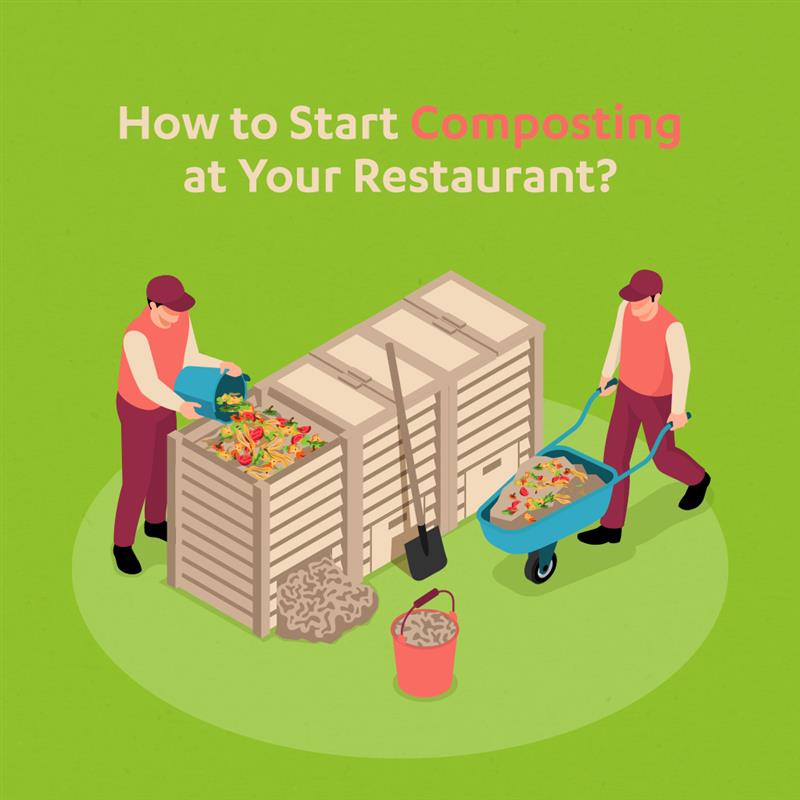
How to start composting at your restaurant: a step-by-step guide that actually works
Your kitchen generates waste. That is not a character flaw. It is the nature of running a food business.
The question is what happens to that waste after it leaves your prep station. For most restaurants in India, the answer is the same: it gets bagged, it gets picked up, it goes to a landfill. And every kilogram that ends up there costs you twice. Once in the disposal fee. Again in the lost opportunity to turn organic waste into something that saves money or generates goodwill.
The honest truth? Composting at a restaurant is not the complicated, science-heavy process most articles make it out to be. It is a system. And like every other system in your kitchen, from inventory to prep to service, it works when the steps are clear and the team knows their role.
This guide walks you through the practical steps. No hand-waving about saving the planet. Just the mechanics of setting up composting at your restaurant so it runs, stays running, and pays for itself.
Key Takeaways
- Restaurant composting reduces waste disposal costs by 30-40% within the first quarter
- Three composting methods to choose from based on your space, budget, and volume
- Proper waste segregation at source is the single step that determines whether the entire system works or fails
- Compostable disposables simplify the sorting process because they go straight into the organic waste stream
- Staff training takes one session to start and 15 minutes monthly to maintain
- CPCB bulk waste generator norms already require composting for restaurants generating over 100 kg of waste daily
Restaurant composting at a glance
| Step | What to do | Time investment | Cost | Payback period |
|---|---|---|---|---|
| 1. Understand why it matters | Review waste volumes and disposal costs | 1-2 hours | Free | Immediate clarity |
| 2. Choose your composting method | Select on-site, service-based, or community model | 2-3 hours research | Varies by method | N/A |
| 3. Set up kitchen waste segregation | Install labelled bins, create sorting protocol | Half a day | INR 2,000-5,000 | 2-4 weeks |
| 4. Select the right bins and equipment | Purchase countertop, collection, and outdoor bins | 1-2 hours | INR 5,000-25,000 | 2-3 months |
| 5. Train your kitchen staff | Run initial training + create visual guides | 2 hours initial | Free | Immediate |
| 6. Communicate with customers | Menu notes, social media, signage | 1-2 hours | Minimal | Ongoing brand value |
| 7. Monitor, troubleshoot, improve | Weekly tracking + monthly reviews | 30 min/week | Free | Compounds over time |
Step 1: Understand why composting matters for your restaurant
Before buying a single bin, look at your own numbers. Most restaurant owners skip this step and jump straight into composting without knowing what their waste actually looks like. That is how composting programmes die within two months.
Here is what the data says at an industry level:
- Restaurants generate 25,000-75,000 kg of food waste per year depending on size and covers
- Food waste accounts for 45-65% of total restaurant waste by weight
- Organic waste in landfills produces methane, which is roughly 80 times more potent than CO2 over a 20-year window
- The Central Pollution Control Board (CPCB) classifies restaurants generating more than 100 kg of waste daily as bulk waste generators, with mandatory on-site processing requirements
That last point matters. This is not optional for high-volume operations. It is regulatory compliance.
The business case in plain numbers
As a restaurant owner, you are already paying for waste disposal. Composting does not add a new cost line. It restructures how the existing one works.
- Disposal cost reduction: Diverting organic waste from general pickup reduces your waste hauling charges by 30-40%. Municipal corporations in cities like Bangalore, Pune, and Chennai already charge differential rates based on wet versus dry waste segregation quality.
- Potential revenue: Finished compost sells at INR 5-10 per kg. A mid-sized restaurant producing 200 kg of organic waste weekly can generate 40-60 kg of compost. That is INR 200-600 weekly, or you donate it locally and get brand visibility in return.
- Regulatory compliance: Avoiding penalties for non-compliance with Solid Waste Management Rules saves you the cost of fines and the headache of notices.
- Customer perception: Diners who see composting happening at a restaurant trust that restaurant more with food safety and quality. The two are linked in consumer psychology.
Step 2: Choose the composting method that fits your operation
Not every restaurant needs the same setup. Your choice depends on three things: how much space you have, how much waste you generate, and how much you want to manage in-house.
Option A: On-site composting
You handle composting at your own premises. Best for restaurants with outdoor space or a backyard area.
- How it works: Organic waste goes into a composting unit on your property. Aerobic decomposition breaks it down over 45-90 days.
- Best for: Standalone restaurants, highway dhabas, resorts, banquet halls with garden space
- Effort: Moderate. Requires turning the pile weekly and monitoring moisture levels.
- Cost: INR 10,000-50,000 for a manual setup. INR 1-3 lakh for an automated composter that processes 50-100 kg daily.
- Output: Usable compost for your own herb garden or local donation
Option B: Partner with a composting service
A waste management company picks up your segregated organic waste on a fixed schedule. They handle the composting. You handle the sorting.
- How it works: You segregate organic waste on-site. The service provider collects it 3-6 times per week.
- Best for: Urban restaurants with limited space, cloud kitchens, food courts
- Effort: Low. Your only job is proper segregation.
- Cost: INR 2,000-8,000 per month depending on volume and city. Some municipalities offer subsidised collection for compliant businesses.
- Output: Many services provide monthly reports showing your diversion volume, which is useful for marketing and compliance documentation.
Option C: Community composting partnership
You partner with local urban farms, community gardens, residential welfare associations, or schools to channel your food waste into their composting operations.
- How it works: You deliver segregated organic waste to a nearby composting site, or they collect it from you.
- Best for: Small restaurants, cafes, bakeries with low daily waste volumes (under 20 kg)
- Effort: Low to moderate depending on logistics
- Cost: Often free or nominal. Some partnerships involve a barter arrangement where you receive finished compost in return.
- Output: Community goodwill, local press coverage, and a genuine sustainability story to tell
Which method should you choose?
| Factor | On-site | Service partner | Community |
|---|---|---|---|
| Daily waste volume | 50+ kg | 20-100+ kg | Under 20 kg |
| Available space | Outdoor area required | No space needed | No space needed |
| Budget | Higher upfront, lower recurring | Lower upfront, steady recurring | Minimal |
| Control | Full | Partial | Limited |
| Compliance documentation | Self-managed | Provider supplies reports | May need additional tracking |
Step 3: Set up waste segregation in your kitchen
This is where composting either works or falls apart. The composting method you chose does not matter if your kitchen is not separating waste correctly at the source.
The three-bin system
Set up three clearly labelled bins at every waste generation point in your kitchen:
- Green bin (organic/compostable): Vegetable and fruit scraps, peels, trimmings, coffee grounds, tea leaves, eggshells, stale bread, cooked food waste (rice, dal, roti, curry), paper napkins, and compostable disposables
- Blue bin (dry recyclable): Clean plastic, glass, metal cans, cardboard, paper
- Black bin (reject/landfill): Contaminated materials, mixed waste, sanitary waste, non-recyclable plastic
What goes into the compost bin
Knowing exactly what qualifies as compostable waste eliminates the guesswork for your staff:
Compost these (organic waste stream):
- Vegetable and fruit peels, trimmings, and scraps
- Cooked food waste including rice, roti, dal, sabzi, and gravies
- Coffee grounds and loose tea leaves
- Eggshells (crushed)
- Stale bread, biscuits, and baked goods
- Paper napkins and uncoated paper
- Compostable plates, bowls, and containers (bagasse-based)
- Flowers and garlands (common after puja days)
Do not compost these:
- Meat bones and large animal bones (small amounts of cooked meat are fine for industrial composting)
- Cooking oil in large quantities (small residues on food are acceptable)
- Plastic of any kind, including bags labelled “biodegradable” that are not certified compostable
- Styrofoam, thermocol, and laminated packaging
- Glass, metal, or ceramics
- Chemical-contaminated waste (cleaning agents, pesticide containers)
Why compostable disposables simplify this step
Here is where your packaging choices directly affect composting efficiency. When your takeaway containers, plates, and bowls are made from compostable materials like sugarcane bagasse, they go straight into the green bin alongside food scraps. No sorting required. No second-guessing by your staff about which bin a food-stained container belongs in.
With conventional plastic or foam packaging, a plate with leftover food becomes a problem. The food is compostable but the plate is not. Your staff either has to scrape every container clean (which nobody does consistently) or the whole thing goes to landfill.
Compostable tableware removes that friction entirely. The plate and the food waste travel through the same waste stream, which means higher diversion rates and less contamination in your compost bin.
Step 4: Select the right bins and equipment
The right bins make compliance easy. The wrong bins make it a daily struggle for your team.
Kitchen counter bins (5-10 litre)
- Place one at each prep station and the dishwashing area
- Tight-fitting lids to control odour
- Empty into the main collection bin at the end of each shift or when full
- Stainless steel or food-grade plastic with clear colour coding
Main collection bins (60-120 litre)
- Located near the kitchen exit or back-of-house area
- One green (organic), one blue (recyclable), one black (reject)
- Foot-pedal operated lids for hygiene
- Lined with compostable bin liners, not plastic bags. This is a common mistake. Plastic liners contaminate the entire batch.
Outdoor composting setup (if on-site)
- Manual option: Tumbler composter or a three-bin rotation system. First bin for fresh waste, second for partially decomposed material, third for mature compost. Total footprint: roughly 6×3 feet.
- Automated option: Compact composting machines from manufacturers like Excel Industries, GreenTech Life, or GPS Renewables. These process 25-100 kg daily, require electricity, and produce compost in 24-48 hours instead of 45-90 days.
- Biogas digester: For very high-volume operations (hotels, banquet halls), a small biogas unit converts food waste into cooking gas and liquid fertiliser. Upfront cost is INR 2-5 lakh, but it offsets LPG expenses directly.
Step 5: Train your kitchen staff
Your composting system is only as good as the people using it. The good news is that kitchen staff pick this up fast because it mirrors the kind of systematic thinking they already use in food prep.
The initial training session (2 hours)
Cover these in a single session:
- Why the restaurant is composting. Lead with the business reason, not the environmental one. When your team understands that proper segregation saves the restaurant INR 15,000-30,000 monthly in disposal costs, they take it seriously.
- What goes where. Walk through the three-bin system with actual examples from your kitchen. Hold up a banana peel, a plastic wrapper, a compostable container. Show them which bin each goes in.
- What happens if waste is mixed. One plastic bag in the compost bin contaminates the entire batch. Make this visible. Show what contamination looks like.
- Who is responsible. Assign bin-emptying to specific roles and shifts. If everyone is responsible, nobody is.
Visual aids that work
- Laminated posters above each bin with photos of items that belong in that bin. Not clip art. Actual photos of the waste your kitchen generates.
- Colour-coded stickers on bin lids matching the poster colours
- A simple checklist at the kitchen exit for the closing shift: bins emptied, lids secured, collection area clean
Ongoing reinforcement
- 15-minute refresher during monthly staff meetings
- Track contamination incidents (plastic in the green bin) and discuss them without blame
- Recognise the shift or station that maintains the cleanest segregation. Small incentives work. A monthly award of INR 500 or an extra day off builds habits faster than any poster.
Step 6: Tell your customers about it
Composting is a genuine story worth sharing. Not as greenwashing, but as a visible operational choice your customers can see and verify.
How to communicate composting authentically
- Menu note: A single line on your menu or table tent. Something like: “Food waste from this kitchen is composted, not landfilled. Our tableware is 100% compostable.”
- Visible bins in the dining area. If you have a counter-service or QSR setup, place clearly labelled bins where customers bus their own trays. Make it easy for them to participate.
- Social media with real numbers. Share your monthly diversion data. “This month, we composted 1,200 kg of food waste instead of sending it to landfill.” Specific numbers build trust. Vague claims do not.
- Delivery packaging message. If you use compostable delivery containers, a small sticker or printed line on the container itself tells the story. Something like: “This container is compostable. So is the food waste inside it.”
- Zomato and Swiggy profiles. Both platforms now support sustainability tags and descriptions. Update your restaurant profile to mention composting and compostable packaging. It influences ordering decisions, especially among 25-40 year old urban diners.
What not to do
- Do not exaggerate your impact. If you are composting 60% of your waste, say 60%. Not “nearly zero waste.”
- Do not use composting as a reason to raise prices. It is a cost-saving measure, not a premium add-on.
- Do not make it the centrepiece of your brand unless your entire concept is built around sustainability. For most restaurants, it is one of several good operational practices. Let it speak for itself.
Step 7: Monitor, troubleshoot, and improve
Composting is a living process. It needs attention, especially in the first three months while your team builds the habit and your system finds its rhythm.
Weekly tracking
Keep a simple log (spreadsheet or even a notebook) with these data points:
- Total organic waste collected (kg)
- Contamination incidents (number of times non-compostable items were found in the green bin)
- Compost output (if on-site) or pickup volume (if using a service)
- Any odour or pest issues
Common problems and fixes
| Problem | Likely cause | Fix |
|---|---|---|
| Foul smell from compost bin | Too much moisture, not enough aeration | Add dry material (shredded paper, sawdust), turn pile more frequently |
| Fruit flies around bins | Bins not sealed, waste exposed | Use bins with tight lids, empty countertop bins more frequently |
| Staff not segregating properly | Unclear labelling, no reinforcement | Update visual guides, discuss in next staff meeting |
| Compost service rejecting pickup | High contamination rate | Audit bins before pickup, retrain on what qualifies as compostable |
| Slow decomposition (on-site) | Too dry, pieces too large | Add water, chop waste into smaller pieces before adding to compost |
| Rodents or pests near outdoor unit | Meat/dairy waste in compost, open bins | Remove meat/dairy, secure bin lids, elevate unit off ground |
Month-over-month improvement targets
- Month 1: Establish the system. Target 50% of organic waste properly segregated.
- Month 2: Reduce contamination to under 5%. Begin tracking disposal cost changes.
- Month 3: Reach 80%+ segregation rate. Compare waste disposal costs to pre-composting baseline.
- Month 6: Evaluate whether to scale up (larger composter, more frequent service pickups) based on data.
The real cost of not composting
If the business case alone is not enough, consider what non-compliance looks like going forward.
The Solid Waste Management Rules (2016, amended 2024) mandate source segregation and on-site processing for bulk waste generators. Municipal corporations in Bangalore, Pune, Hyderabad, Chennai, and Delhi are already enforcing these rules with fines ranging from INR 5,000 to INR 25,000 per violation.
Several states are tightening single-use plastic bans simultaneously. Restaurants using conventional plastic or foam packaging face an additional compliance risk. Switching to compostable disposables addresses both the packaging regulation and the waste management regulation in one move.
The restaurants that set up composting now are building muscle memory and staff habits before enforcement gets stricter. The ones that wait will be scrambling to comply under deadline pressure, which always costs more.
In a Nutshell
Composting at your restaurant is a seven-step system, not a seven-year journey.
Start by understanding your waste volumes and choosing the composting method that fits your space and budget. Set up a three-bin segregation system in your kitchen. Invest in the right bins with proper lids and liners. Train your staff once, reinforce monthly, and make the business case visible so they stay invested. Tell your customers what you are doing with real numbers, not slogans. Track progress weekly and fix issues as they surface.
The financial return is clear: 30-40% reduction in waste disposal costs within the first quarter. The operational return is equally real: a cleaner kitchen, simpler waste handling, and a genuine sustainability story that customers and delivery platforms value.
If your current disposables are creating a sorting headache at the bin, that is worth examining too. When your takeaway packaging is compostable, it goes into the same green bin as food scraps. One stream. No confusion. No contamination.
Set up the bins. Train the team. Start this week.
Frequently asked questions
How much does it cost to start composting at a restaurant?
For a service-based model where a composting company picks up your segregated waste, the monthly cost runs INR 2,000-8,000 depending on your city and waste volume. On-site manual composting starts at INR 10,000-15,000 for bins, tools, and setup. Automated composters range from INR 1-3 lakh but process waste faster and require less manual effort. Most restaurants recover these costs within 2-3 months through reduced disposal fees.
Is composting mandatory for restaurants in India?
Under the Solid Waste Management Rules (2016, amended 2024), establishments generating more than 100 kg of waste daily are classified as bulk waste generators and must process organic waste on-site or through authorised channels. Even below that threshold, municipal corporations in several cities require source segregation. Non-compliance attracts fines of INR 5,000-25,000 per incident. It is increasingly a legal requirement, not just a choice.
What can I do with the finished compost?
You have several options. Use it in a kitchen herb garden or rooftop garden if you have one. Donate it to local urban farms, community gardens, or municipal plantation drives. Sell it to landscapers or nurseries at INR 5-10 per kg. Or offer it to customers in small branded bags as a takeaway gesture. Each option either saves money, generates modest revenue, or builds community goodwill.
How do compostable disposables make restaurant composting easier?
Compostable disposables like bagasse plates, bowls, and containers are designed to break down in the same composting conditions as food waste. This means your staff does not have to separate food from packaging before binning it. A used compostable plate with leftover food goes directly into the green bin. With conventional plastic or foam packaging, food-stained containers contaminate recycling streams and end up in landfill regardless. The sorting simplification alone reduces contamination errors by 40-60% based on waste management industry benchmarks.
How long does restaurant composting take to produce usable compost?
It depends on your method. Manual composting (tumbler or bin system) takes 45-90 days to produce finished compost. Automated composting machines process waste in 24-48 hours. Service-based models handle the timeline for you. In all cases, the waste starts decomposing immediately once it is properly mixed and aerated. You do not need to wait for finished compost to start seeing disposal cost savings. Those begin the moment you start diverting organic waste from your general waste stream.
Will composting attract pests or create odour problems in my restaurant?
Not if the system is managed correctly. Kitchen counter bins with tight-fitting lids and daily emptying prevent indoor odour. Outdoor composting units should be covered, elevated off the ground, and located away from the dining area. Avoid adding large quantities of meat, dairy, or oily food to a manual compost pile because those attract rodents and flies. An aerobic composting process that is properly turned and balanced with dry material (shredded paper, dried leaves, sawdust) does not smell. The smell comes from anaerobic decomposition, which means too much moisture and not enough air.
Can I compost if my restaurant has no outdoor space?
Absolutely. A service-based composting model requires zero outdoor space. You segregate organic waste into bins inside your kitchen, and the service provider picks it up on a fixed schedule. For cloud kitchens and food courts, this is the most practical option. If you want some on-site processing, compact indoor composters (electric units that fit in a 2×2 foot space) can handle 5-25 kg of waste daily. Community composting partnerships are another space-free option for smaller operations.