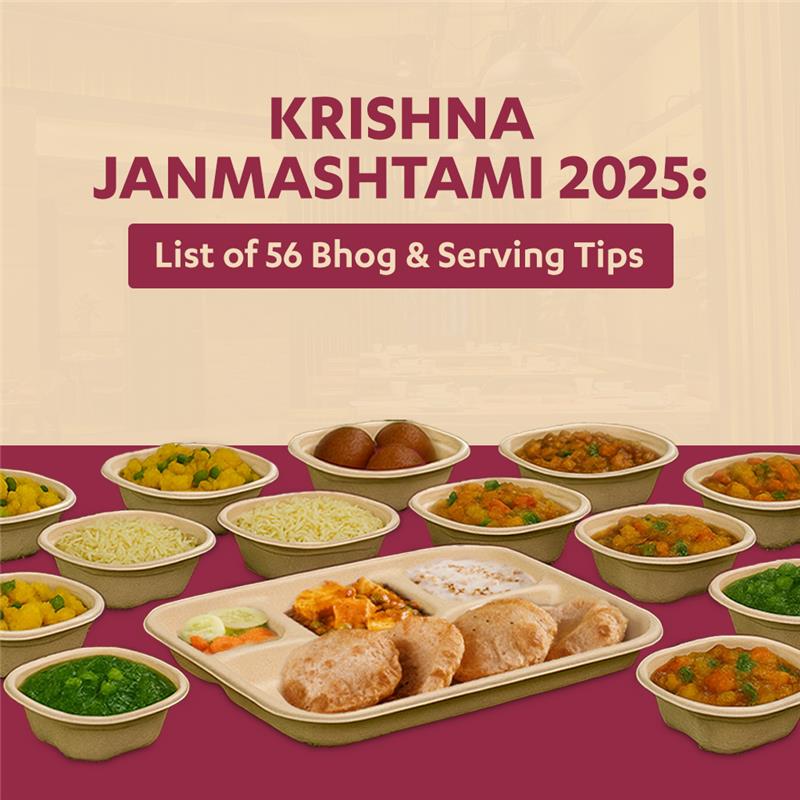
Krishna Janmashtami: Complete Chhappan Bhog List with 56 Items & Serving Tips
Every year, millions of devotees across India celebrate Krishna Janmashtami with midnight pujas, devotional songs, and vibrant decorations. But the heart of this festival beats in the kitchen. The preparation of Chhappan Bhog — a grand offering of 56 food items to Lord Krishna — is the most treasured tradition of the celebration.
Whether you are a temple organizer planning for hundreds, a devotee preparing bhog at home, or a caterer serving a community event, this guide covers everything you need. You will find the complete Chhappan Bhog list, the story behind it, vrat-friendly options, and practical serving tips that keep things clean and sustainable.
The Story Behind Chhappan Bhog: Why 56 Items?
The tradition of offering 56 items to Lord Krishna traces back to a beloved story from Vrindavan.
When Krishna was a young child, the people of his village faced devastating rains and floods. To protect them, little Krishna lifted the mighty Govardhan Parvat on his little finger. He held it up like a giant umbrella, shielding the villagers, their animals, and their homes.
He did not hold it for a few hours. He stood there for seven full days and seven nights — smiling, comforting, protecting.
During those seven days, Krishna did not eat a single morsel. Once the rains finally stopped, the villagers were overwhelmed with love and gratitude. They decided to make up for every meal he had missed.
In those times, people ate eight small meals a day. Seven days without food meant 56 missed meals (8 x 7 = 56). The villagers lovingly prepared 56 dishes and presented them to Krishna as a feast of gratitude.
That grand offering became the tradition of Chhappan Bhog — a devotional act that continues every Janmashtami across temples, homes, and community gatherings.
The Complete List of 56 Bhog Items for Krishna Janmashtami
While regional variations exist, here is a widely followed Chhappan Bhog list organized by category. As a devotee or organizer, you can adapt this based on local traditions and available ingredients.
Sweets (Mithai) — 18 Items
| No. | Item | Notes |
|---|---|---|
| 1 | Makhan Mishri | Krishna’s absolute favourite — fresh butter with rock sugar |
| 2 | Kheer | Rice pudding, a staple bhog offering |
| 3 | Gulab Jamun | Deep-fried milk dumplings soaked in sugar syrup |
| 4 | Jalebi | Crispy, syrup-soaked spirals |
| 5 | Peda | Milk-based sweet, classic Mathura offering |
| 6 | Boondi Laddu | Round sweets made from chickpea flour droplets |
| 7 | Coconut Barfi | Shredded coconut and sugar fudge |
| 8 | Sooji Halwa | Semolina pudding cooked in ghee |
| 9 | Rasgulla | Spongy cottage cheese balls in light syrup |
| 10 | Malpua | Sweet pancakes, traditional in Eastern India |
| 11 | Kalakand | Grainy milk cake with cardamom |
| 12 | Moong Dal Halwa | Rich lentil-based sweet |
| 13 | Rabri | Thick, reduced sweetened milk |
| 14 | Anjeer Barfi | Fig-based fudge with nuts |
| 15 | Milk Cake | Caramelized milk sweet |
| 16 | Sandesh | Bengali cottage cheese delicacy |
| 17 | Khoya Modak | Stuffed sweet dumplings |
| 18 | Rava Laddu | Semolina and ghee laddus |
Savouries and Snacks — 12 Items
| No. | Item | Notes |
|---|---|---|
| 19 | Kachori | Stuffed deep-fried pastry |
| 20 | Samosa | Filled with spiced potato or dry fruits for vrat |
| 21 | Dhokla | Steamed chickpea flour cake |
| 22 | Namak Para | Crispy salted diamond biscuits |
| 23 | Mathri | Flaky fried crackers |
| 24 | Murukku | Spiral-shaped rice flour snack |
| 25 | Sev | Thin chickpea flour noodles |
| 26 | Papdi | Flat, crispy wafers |
| 27 | Poori | Deep-fried puffed bread |
| 28 | Pakora | Batter-fried vegetable fritters |
| 29 | Besan Chilla | Savoury chickpea flour pancake |
| 30 | Masala Idli | Steamed rice cakes with spice tempering |
Fruits and Dry Fruits — 9 Items
| No. | Item | Notes |
|---|---|---|
| 31 | Banana | Commonly offered in all pujas |
| 32 | Apple | Symbol of health and devotion |
| 33 | Pomegranate | Auspicious fruit, rich red colour |
| 34 | Guava | Seasonal and fragrant |
| 35 | Coconut | Sacred offering in Hindu worship |
| 36 | Dates (Khajoor) | Natural sweetness, vrat-friendly |
| 37 | Cashews (Kaju) | Premium dry fruit offering |
| 38 | Almonds (Badam) | Soaked or whole, both traditional |
| 39 | Raisins (Kishmish) | Sweet dried grapes |
Dairy-Based Items — 6 Items
| No. | Item | Notes |
|---|---|---|
| 40 | Dahi (Curd) | Central to dahi handi celebrations |
| 41 | Paneer Cubes | Fresh cottage cheese |
| 42 | Buttermilk (Chaas) | Light, cooling drink offering |
| 43 | White Butter (Makhan) | Krishna’s most iconic offering |
| 44 | Milk (Doodh) | Pure, full-fat milk |
| 45 | Lassi | Sweet or salted yogurt drink |
Rice and Grains — 6 Items
| No. | Item | Notes |
|---|---|---|
| 46 | Jeera Rice | Cumin-tempered basmati rice |
| 47 | Khichdi | Comfort food — rice and lentils |
| 48 | Pulao | Fragrant spiced rice |
| 49 | Sabudana Khichdi | Tapioca pearls — a vrat staple |
| 50 | Samak Rice | Barnyard millet — fasting-friendly |
| 51 | Dalia | Broken wheat porridge |
Miscellaneous Sacred Offerings — 5 Items
| No. | Item | Notes |
|---|---|---|
| 52 | Panchamrit | Five-ingredient sacred nectar (milk, curd, ghee, honey, sugar) |
| 53 | Tulsi Leaf | Holy basil — placed on every offering |
| 54 | Honey (Shahad) | Raw, unprocessed — symbolizes purity |
| 55 | Ghee (Clarified Butter) | Essential in every puja and cooking ritual |
| 56 | Rock Sugar (Mishri) | Crystal sugar — used in Panchamrit and bhog garnishing |
How to Organize Chhappan Bhog for Large Gatherings
If you are a temple committee member or a caterer managing Janmashtami bhog for dozens or even hundreds of devotees, preparation can feel overwhelming. Here is a practical approach to break it down.
Plan by Category, Not by Number
Instead of thinking about “56 individual dishes,” organize your preparation by the six categories above:
- Sweets: Prepare 5-6 hero items (Kheer, Laddu, Peda, Halwa, Gulab Jamun) in larger quantities. The rest can be symbolic or in smaller bowls.
- Savouries: Kachori, Poori, and Pakora are crowd favourites. Prepare these fresh and in bulk.
- Fruits and Dry Fruits: These require zero cooking. Wash, plate, and arrange.
- Dairy: Dahi, Milk, and Lassi can be portioned into small cups or matki-shaped containers.
- Rice and Grains: One main rice dish (Pulao or Jeera Rice) plus one vrat-friendly option (Sabudana Khichdi) covers this category well.
- Sacred Offerings: Panchamrit, Tulsi, Ghee, Honey, and Mishri are small-portion ritual items. Keep them ready on the puja thali.
Prepare a Vrat-Friendly Version
Many devotees observe a strict fast (vrat or upvaas) on Janmashtami. As a host, having falahar-friendly options is essential.
Vrat-safe items from the Chhappan Bhog list include:
- Sabudana Khichdi and Samak Rice (grain alternatives)
- All fruits and dry fruits
- Makhan Mishri, Kheer (made with Samak flour or Singhara flour)
- Panchamrit and Milk
- Kuttu (buckwheat) Poori as a substitute for regular Poori
- Rock sugar-based sweets instead of refined sugar
This way, fasting devotees can participate fully without breaking their vrat.
Serving Tips That Keep Bhog Clean and Sacred
Bhog is a sacred offering first. The way you serve it matters as much as what you prepare. Here is where thoughtful choices make a real difference, especially at scale.
Use Compartment Plates for Multi-Item Serving
When you are serving 10-15 bhog items per plate, mixing flavours is a real problem. Ghee-soaked halwa bleeding into savoury kachori ruins both the taste and the presentation.
Compartment plates solve this cleanly. Chuk’s 4-compartment Chausar plates, for instance, separate sweets, savouries, fruits, and wet items into distinct sections. They are sturdy enough to hold heavy items like kheer without bending or leaking.
For temples and large events, this means:
- No taste contamination across bhog items
- Clean, organized presentation worthy of an offering
- Less food waste from devotees discarding mixed-flavour plates
Choose Compostable Disposables Over Plastic or Thermocol
Here is the honest truth about large-scale Janmashtami events: the post-event waste is staggering. Hundreds of plastic plates and thermocol cups end up in landfills every single year after temple celebrations.
Compostable disposables made from sugarcane bagasse offer a practical alternative. They are:
- Leak-proof and oil-resistant — handles ghee, kheer, and syrup-heavy mithai
- Sturdy under weight — does not bend or collapse with heavy bhog items
- Toxin-free — no plastic coatings, no chemical leaching into hot food
- Fully compostable — breaks down naturally in 90 days
As a temple organizer, switching to compostable disposables is not just an environmental choice. It is a practical one. You eliminate the need for washing steel thalis after the event, reduce cleanup time dramatically, and align the celebration with Krishna’s own love for nature and cows.
Set Up a Simple Post-Event Composting Station
You can go one step further. Place clearly marked composting bins near the serving area. After the bhog, devotees simply drop their used plates into these bins instead of garbage bags.
This works especially well for:
- Temple trusts looking to set a sustainability example
- Housing societies organizing community Janmashtami events
- Caterers who want to offer a zero-waste event package
It is also a wonderful way to teach children about caring for the earth — a value that Lord Krishna himself embodied.
Decor Ideas for Your Janmashtami Bhog Table
The bhog table is the visual centrepiece of any Janmashtami celebration. Here are ideas to make it look divine without spending too much.
- Banana leaves or palm leaf mats as base layers under the plates — traditional and compostable
- Brass diyas placed around the edges for a warm, golden glow during the midnight puja
- Lotus flowers (real or fabric) scattered around the thali for an authentic temple aesthetic
- Peacock feathers — Krishna’s signature adornment — tucked into flower arrangements
- A small Krishna idol with flute at the centre of the bhog spread
- Marigold garlands draped along the table edges for colour and fragrance
- Matki (clay pots) filled with buttermilk or lassi — a nod to the dahi handi tradition
Keep the decor natural and compostable wherever possible. Avoid plastic flowers, glitter, and synthetic table covers. The beauty of Janmashtami lies in its simplicity and devotion.
Common Mistakes to Avoid When Preparing Chhappan Bhog
Even experienced organizers sometimes slip up. Watch out for these:
- Skipping the Tulsi leaf. Every bhog offering must include Tulsi. Without it, the offering is considered incomplete in many traditions.
- Using onion or garlic. Chhappan Bhog is strictly sattvic. Onion, garlic, and non-vegetarian items are never included.
- Serving bhog before the offering. The food must be offered to Lord Krishna first during the puja. Only after the deity has “accepted” it does it become prasad for distribution.
- Ignoring vrat-friendly options. If devotees are fasting, they cannot eat regular grains. Always have falahar alternatives ready.
- Overcomplicating quantities. You do not need industrial quantities of all 56 items. Symbolic portions of less common items work perfectly. Focus cooking effort on 10-12 hero dishes.
Where to Find Compostable Disposables for Your Janmashtami Event
If you are planning a Janmashtami bhog for your temple, society, or home, Chuk compostable disposables are available on quick-commerce platforms for fast delivery:
- Blinkit — search for “Chuk plates” for same-day delivery
- Swiggy Instamart — available in most metro cities
- BigBasket — for bulk orders and advance planning
For large temple or event orders, you can also reach out to Chuk directly for bulk pricing and custom compartment plate configurations.
In a Nutshell
Krishna Janmashtami is one of India’s most food-centric festivals. The tradition of Chhappan Bhog — 56 lovingly prepared items offered to Lord Krishna — is the heart of the celebration. Here is what to remember:
- The story: Krishna held up Govardhan Parvat for 7 days without eating. The villagers prepared 8 meals x 7 days = 56 items as gratitude.
- The items: 18 sweets, 12 savouries, 9 fruits and dry fruits, 6 dairy items, 6 rice and grain dishes, and 5 sacred offerings.
- Serving smart: Compartment plates keep flavours separated. Compostable disposables eliminate post-event cleanup headaches and plastic waste.
- Vrat-friendly: Include Sabudana Khichdi, Samak Rice, fruits, and Singhara flour-based items for fasting devotees.
- Stay sattvic: No onion, no garlic, no non-vegetarian items. Tulsi leaf on every offering.
- Decor: Banana leaves, brass diyas, peacock feathers, marigold garlands, and a central Krishna idol.
Let your devotion to Krishna show not just in the food you prepare but in how thoughtfully you serve it. When bhog is offered with care for your guests and care for the earth, it becomes something truly divine.
Frequently Asked Questions
What is Chhappan Bhog in Krishna Janmashtami?
Chhappan Bhog is a grand offering of 56 food items presented to Lord Krishna during Janmashtami celebrations. It includes sweets, savouries, fruits, dry fruits, dairy items, rice dishes, and sacred offerings like Panchamrit and Tulsi. The tradition commemorates the Govardhan Parvat story from Krishna’s childhood.
Why are exactly 56 items offered to Lord Krishna?
The number 56 comes from the Govardhan story. When young Krishna lifted Govardhan Parvat to protect his village, he went without food for seven days. Since people ate eight meals a day in that era, the villagers prepared 8 x 7 = 56 dishes to make up for every missed meal. This became the tradition of Chhappan Bhog.
Can I prepare Chhappan Bhog at home with a small family?
Yes, absolutely. You do not need to prepare large quantities of all 56 items. Many families make symbolic portions — a small bowl of each item, or even a spoonful placed on a thali. The devotion behind the offering matters more than the quantity. Focus on 10-12 hero dishes and keep the rest in smaller amounts.
What food items are vrat-friendly in the Chhappan Bhog list?
Several items on the list are naturally vrat-friendly: Sabudana Khichdi, Samak Rice, all fruits and dry fruits, Makhan Mishri, milk-based sweets made with Singhara or Kuttu flour, Panchamrit, plain milk, and rock sugar (Mishri). Avoid regular grains, regular salt, and refined sugar if you are observing a strict Janmashtami fast.
Is fasting compulsory on Krishna Janmashtami?
No, fasting is not compulsory. It is a personal choice rooted in devotion. Many devotees observe nirjala vrat (no food or water) until midnight, while others keep a fruit-and-milk-based fast. Some families skip the fast entirely and focus on the bhog preparation and puja instead. There is no single rule that applies to everyone.
What are the best plates for serving Chhappan Bhog at temples?
For temple events with large crowds, compartment plates work best because they separate multiple bhog items on a single plate. Compostable disposables made from sugarcane bagasse are ideal — they handle oily and wet foods without leaking, are sturdy enough for heavy items, and can be composted after the event instead of adding to landfill waste.
What items should never be included in Chhappan Bhog?
Chhappan Bhog is strictly sattvic. Onion, garlic, non-vegetarian items, eggs, and alcohol-based ingredients must never be included. Stale or leftover food is also not offered. Every item should be freshly prepared with clean hands and pure ingredients. Tulsi leaf is considered essential and should accompany the offering.
How do I set up a Janmashtami bhog table for a community event?
Start with a clean surface covered in banana leaves or natural fabric. Place a Krishna idol with flute at the centre. Arrange the 56 items in small bowls or compartment plates around the idol. Add brass diyas, marigold garlands, lotus flowers, and peacock feathers for decoration. Keep the arrangement symmetrical and avoid synthetic decor. Serve prasad only after the midnight puja and offering are complete.