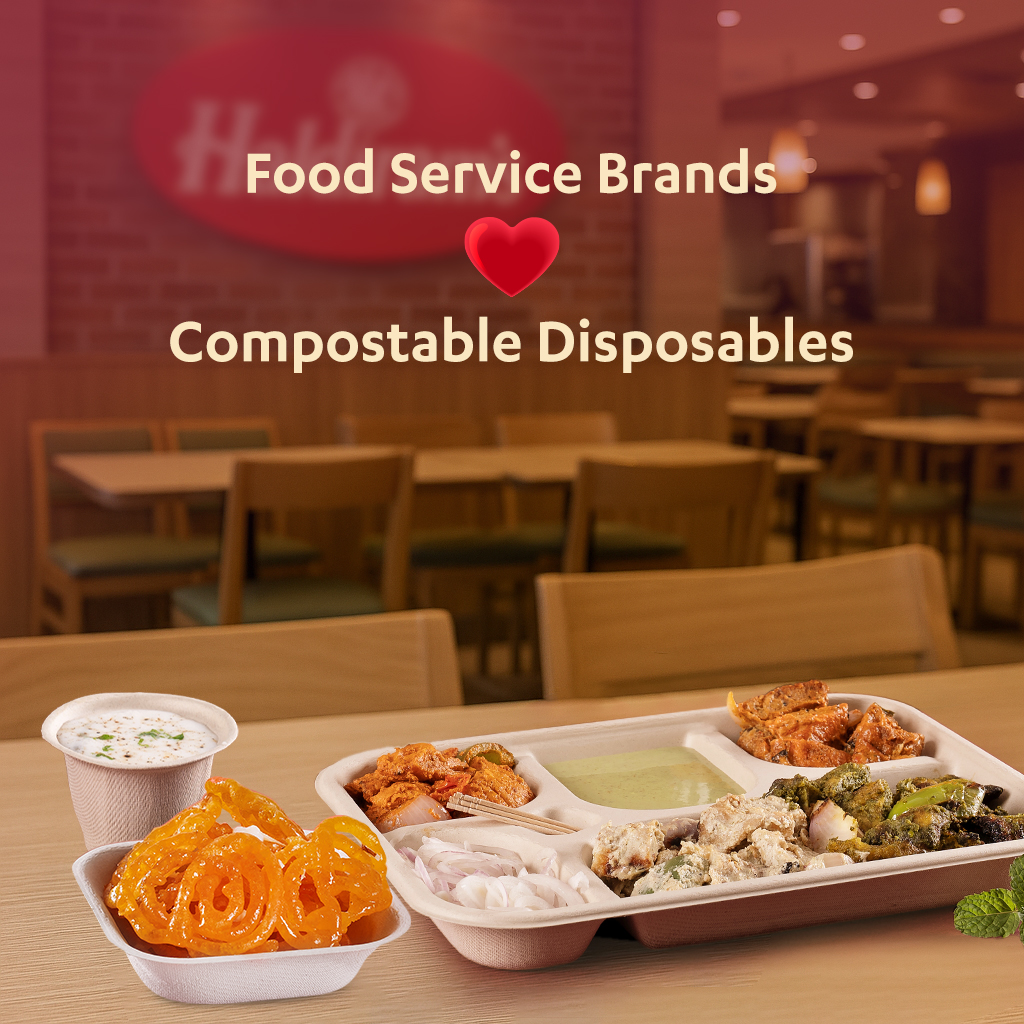
Why More Food Brands Are Switching to Compostable Disposables
Here is the honest truth. The packaging sitting on your food service counter right now is probably costing you more than you think. Not just in rupees per unit, but in customer trust, regulatory risk, and long-term brand value.
If you run a QSR chain, manage a cloud kitchen, or own a restaurant brand, you have likely noticed something shifting across the industry. Compostable disposables are showing up everywhere — from fast-food counters to specialty cafes to delivery-only kitchens. And this is not a passing trend.
This is a structural shift in how food businesses think about packaging. Let us walk through exactly why it is happening, what the numbers say, and what it means for your operations.
The Real Problem with Traditional Food Packaging
As a food brand owner, you already know that single-use plastic, polystyrene clamshells, and plastic-lined paper plates dominate the market. What you may not fully appreciate is the scale of the liability they carry.
Consider what the data shows:
- 36% of all plastics produced globally go into packaging, most of it single-use (UNEP, 2021)
- 79% of all plastic waste ends up in landfills or the natural environment — only 9% has ever been recycled (Science Advances, 2020)
- Plastic-coated paper plates and polystyrene can take up to 500 years to decompose, leaching toxic chemicals into soil and groundwater along the way (National Geographic, 2019)
- Many plates marketed as “biodegradable” contain hidden wax or plastic linings that make them incompatible with industrial composting (Environmental Working Group, 2023)
That last point matters more than most operators realise. You might think you have already made the switch, only to find out your current “eco” packaging does not actually compost. This is the gap compostable disposables are designed to close.
Your Customers Are Already Making This Decision for You
You do not need a research firm to tell you that consumer expectations have changed. But let us look at the numbers anyway, because they are striking.
- 57% of consumers are willing to change their shopping habits to reduce environmental impact (IBM Institute for Business Value, 2022)
- Over 70% say they would pay more for sustainable packaging
- 79% of consumers are altering purchase preferences based on sustainability credentials (Capgemini Research Institute, 2022)
- Searches for “eco-friendly disposable plates” and “compostable tableware” have risen by over 35% since 2023 across Google and Instagram
As a QSR operator, this means the packaging your food arrives in is part of the customer experience. It is not just a container — it is a signal. It tells your customer whether you care about what they care about.
Brands that serve food on compostable plates and bowls are not just doing the right thing environmentally. They are making a calculated brand decision.
Regulations Are Not Waiting for You to Catch Up
If consumer pressure alone did not convince you, the regulatory space should. Here is what is already in effect:
| Region | Regulation | Status |
|---|---|---|
| India | Nationwide single-use plastics ban | In effect since July 2022 (MoEFCC) |
| European Union | Single-Use Plastics Directive — bans non-compostable cutlery, plates, straws | In effect since 2021 (European Commission) |
| United States | State-level laws in California, New York, Maine promoting compostable materials | Active and expanding |
The global compostable packaging market is projected to grow at a CAGR of 13.5% from 2023 to 2028 (ResearchAndMarkets, 2023). That growth is being driven almost entirely by government mandates and public pressure.
As a food brand owner, the question is not whether you will need to switch. It is whether you switch now on your own terms — or later, under compliance pressure.
What Exactly Are Compostable Disposables?
Let us be specific, because the terminology can be confusing.
Compostable disposables — plates, bowls, trays, clamshells — are designed to break down completely into CO2, water, and biomass within 180 days under industrial composting conditions. No microplastics. No toxic residue. Just organic matter that returns to the soil.
Common raw materials include:
- Sugarcane bagasse — the fibrous residue left after juice extraction from sugarcane
- Molasses-based fibres — derived from sugar refining waste, adding binding strength
- PLA (polylactic acid from cornstarch)
- Palm leaves, wheat bran, bamboo
According to the Ellen MacArthur Foundation (2023), properly composted materials can divert up to 60% of packaging waste from landfills. And a 2022 University of Florida study found that sugarcane bagasse breaks down 70% faster than PLA under controlled composting conditions.
Why Sugarcane Bagasse and Molasses Lead the Pack
Not all compostable materials are equal. Here is why bagasse and molasses have emerged as the preferred raw materials for food-grade compostable disposables.
Sugarcane Bagasse
- A byproduct of sugar production — no additional farming or deforestation required
- Naturally strong, durable, and fully compostable
- Requires no plastic lining, unlike conventional paper plates
- Tree-free, which means zero contribution to deforestation
Molasses-Based Fibres
- Derived from sugar refining waste — another agricultural byproduct
- When combined with plant fibres, molasses adds binding strength and biodegradability
- Research from the Journal of Polymers and the Environment (2022) confirms molasses can produce high-performance, food-safe packaging when reinforced with cellulose fibres
The eco-friendly disposables market using bagasse and molasses is growing at CAGR 6.6% and projected to reach USD 370 million by 2027 (Allied Market Research, 2024).
Unlike traditional wood-pulp paper, neither bagasse nor molasses requires cutting down trees. This considerably lowers deforestation rates in regions where agri-waste packaging is widely adopted.
Compostable Disposables vs. Traditional Packaging: A Side-by-Side Comparison
Here is the honest comparison, because as a food brand owner, you need facts — not marketing fluff.
| Feature | Compostable Disposables (Bagasse/Molasses) | Plastic/Polystyrene | Paper (Plastic-Lined) |
|---|---|---|---|
| Decomposition time | Under 180 days | 400-500 years | 20-50 years (liner persists) |
| Microplastic risk | None | High | Moderate (36% contain microplastics — University of Leeds, 2023) |
| Composting compatible | Yes (industrial & home) | No | No (plastic liner) |
| Heat resistance | Strong — no sagging | Moderate | Poor in humid conditions |
| Oil/grease resistance | High | High | Low to moderate |
| Carbon footprint | 70% lower than polystyrene (Carbon Trust, 2023) | Baseline (high) | Moderate |
| Deforestation impact | Zero (agri-waste) | None (petroleum) | High (wood pulp) |
| Regulatory compliance | Fully compliant | Increasingly banned | Partially compliant |
| Cost trend | Declining (18% drop in 2 years) | Stable | Stable |
The data speaks clearly. Compostable disposables are not a compromise — they outperform traditional options on almost every metric that matters to your business.
Six Ways Food Brands Benefit from the Switch
This is where it gets practical. As a QSR operator or food brand owner, here is what switching to compostable disposables actually does for your business.
1. Stronger Brand Perception
NielsenIQ (2023) found that 73% of global consumers would change their habits to reduce environmental impact. Serving food on compostable plates sends an immediate, visible sustainability message.
A 2023 Harvard Business Review analysis showed food firms using sustainable packaging see a 10% increase in repeat business and a 12-20% boost in brand loyalty.
2. Simpler Waste Management
Compostable disposables can be discarded with food waste — no sorting required. This cuts labour costs and simplifies back-of-house operations, especially for high-volume kitchens.
3. Regulatory Compliance Without Scrambling
Early adoption means you are already ahead of future mandates. Instead of reacting to bans, you are operating from a position of readiness.
4. Declining Unit Costs
The price gap between compostable disposables and conventional foam or paper packaging has shrunk by nearly 18% in the last two years (Statista Packaging Index, 2024). As manufacturing scales up, costs will keep falling.
5. A Healthier Eating Experience
No hidden toxins, no plastic linings, no microplastic contamination. A 2023 University of Leeds study found microplastics in 36% of paper-based food containers. With bagasse-based compostable disposables, that risk drops to zero.
6. Measurable Environmental Impact
Switching to sugarcane-residue-based compostable disposables delivers:
- 70% fewer carbon emissions than polystyrene (Carbon Trust, 2023)
- 100% compostability in under 180 days
- ~60% reduction in solid waste sent to landfill
- Zero microplastic residue post-degradation
These are not aspirational targets. These are measured outcomes that directly improve your ESG scores and operational hygiene.
The Operational Side: Sturdy, Stackable, Kitchen-Ready
Let us talk about what matters in a busy kitchen. Because sustainability means nothing if the product fails during a Friday dinner rush.
- 30% less storage space required compared to polystyrene (Supply Chain Quarterly, 2023) — a real advantage for space-constrained cloud kitchens
- No sagging under heat or moisture — unlike paper or foam, molasses-based disposables hold up in hot, humid kitchen environments
- 22% fewer returns on defective packaging reported by brands that switched to compostable plate alternatives
- Faster packing times and fewer staff complaints due to sturdier materials — reported by brands like Chai Point and Haldiram India after switching to compostable bowls and lids
As a cloud kitchen operator, you know that every minute of packing time and every defective container adds up. Compostable disposables are not just the sustainable choice — they are the operationally superior one.
What Customers Actually Think About Your Packaging
Here is something most food brand owners underestimate. Your packaging is not invisible to your customer.
- 68% of urban Indian consumers believe food served on eco-friendly disposables is healthier and more premium (Mintel India, 2023)
- In a 2024 study across eight cloud kitchens in Bengaluru and Delhi, 83% of customers said packaging was critical to how they perceived food quality
- Brands using compostable bowls and plates see a 10-15% increase in return business, particularly in metro areas
- Social media posts with hashtags like #CompostablePlates and #EcoFriendlyTableware generate 40% higher engagement (Sprinklr and Brandwatch analysis)
Your packaging tells a story. Compostable disposables tell the right one.
The Composting Infrastructure Is Already Here
One concern you might have: “Even if I switch, will the packaging actually get composted?”
Fair question. Here is the reality.
- Over 150 new composting facilities were added across India in 2024 alone, as part of the Smart Cities Waste Program (Compost Coalition India Report)
- Cities like Pune, Chennai, Bengaluru, and Gurugram now support wet + compostable packaging waste collection
- Effective composting of sugarcane bagasse plates and molasses-based containers can reduce landfill dependency by 45% for the average fast-food outlet (World Bank Clean Cities Report, 2023)
The infrastructure gap that once made composting impractical is closing fast. Your switch to compostable disposables will not end up as a greenwashing exercise — the systems to process these materials are already operational and expanding.
The Supply Chain Is Ready and Costs Are Dropping
If you tried sourcing compostable disposables a few years ago and found limited options or high prices, the space has changed dramatically.
- Global sugarcane bagasse output grew by over 25% between 2021 and 2023 (GreenTech Insights, 2024)
- The price difference between molasses-based disposables and conventional foam has narrowed by 18% in two years (Statista Packaging Index, 2024)
- Compostable plates, bowls, and meal trays are now available at scale — even for large restaurant chains and delivery-only kitchens
In India specifically, 42% of restaurant owners plan to switch to sustainable packaging within the next two years (Mintel Packaging Trends, 2023). The supply chain is ready. The pricing makes sense. The only remaining variable is your decision.
In a Nutshell
The switch to compostable disposables is not about saving the planet at the expense of your business. It is about recognising that your business does better when your packaging does better.
Here is what you should take away:
- Consumer demand for sustainable packaging is real, measurable, and growing — 70%+ will pay more for it
- Regulations are tightening globally, and India’s single-use plastics ban is just the beginning
- Sugarcane bagasse and molasses produce compostable disposables that are stronger, safer, and increasingly cheaper than plastic or lined-paper alternatives
- Operational benefits are concrete: less storage, fewer defects, simpler waste management
- Brand perception improves measurably — 10-15% more repeat business, higher social engagement
- Composting infrastructure in India is expanding rapidly, so your compostable packaging will actually get composted
- The cost gap is closing — unit prices have dropped 18% in two years and continue to fall
The food brands making this switch today are not just checking a compliance box. They are building a competitive edge that compounds over time.
Frequently Asked Questions
What are compostable disposables made from?
Most compostable disposables are made from sugarcane bagasse, which is the fibrous residue left after juice is extracted from sugarcane. Some products also use molasses-based fibres, PLA (from cornstarch), palm leaves, or bamboo. Bagasse-based products are especially popular because they are tree-free, require no plastic lining, and decompose fully within 180 days under industrial composting conditions.
How long do compostable disposables take to decompose?
Under industrial composting conditions, compostable disposables made from sugarcane bagasse typically decompose within 90 to 180 days. This is dramatically faster than plastic (400-500 years) or plastic-lined paper (20-50 years). A University of Florida study found that bagasse decomposes 70% faster than PLA, another common compostable material.
Are compostable disposables more expensive than plastic or foam?
The price gap has narrowed significantly. According to the Statista Packaging Index (2024), the difference between molasses-based compostable disposables and conventional foam packaging has dropped by nearly 18% in the last two years. When you factor in reduced waste management costs, fewer defective packaging returns, and the brand loyalty boost, many food businesses find the total cost of ownership is lower.
Can compostable disposables handle hot and oily food?
Yes. Bagasse and molasses-based compostable disposables are heat-resistant and oil-proof. Unlike paper plates, they do not sag in hot or humid conditions. This makes them well suited for Indian cuisines, fried foods, and curries. Brands like Chai Point and Haldiram India have switched to compostable containers and reported fewer packaging failures.
Is composting infrastructure actually available in India?
It is expanding rapidly. Over 150 new composting facilities were added across India in 2024 under the Smart Cities Waste Program. Cities like Pune, Chennai, Bengaluru, and Gurugram now support wet and compostable packaging waste collection. The World Bank estimates that composting sugarcane bagasse containers can reduce landfill dependency by 45% for the average fast-food outlet.
How do compostable disposables affect brand perception?
Significantly. A Mintel India (2023) survey found that 68% of urban consumers perceive food served on eco-friendly disposables as healthier and more premium. Brands using compostable packaging see 10-15% higher return business in metro areas. Social media content featuring compostable packaging also generates 40% higher engagement.
Are compostable disposables safe for food contact?
Compostable disposables made from sugarcane bagasse are certified food-grade safe. They contain no plastic linings, wax coatings, or chemical additives. A University of Leeds (2023) study found microplastics in 36% of paper-based food containers — a risk that does not exist with pure bagasse-based products.
What is the difference between biodegradable and compostable disposables?
This is an important distinction. “Biodegradable” simply means a material will break down eventually — even plastic is technically biodegradable over hundreds of years. “Compostable” means a material breaks down into non-toxic organic matter within a defined timeframe (usually 180 days) under composting conditions. Many products labelled “biodegradable” contain hidden plastic or wax linings and are not suitable for composting. Always look for products that are certified compostable.
Moving off plastic usually starts with the plate
The plate is where most kitchens start when they move off plastic. CHUK’s compostable bagasse plates take hot, oily and wet food without going limp, and they compost after use.
Browse compostable plates | Order a sample box | Get pricing on WhatsApp