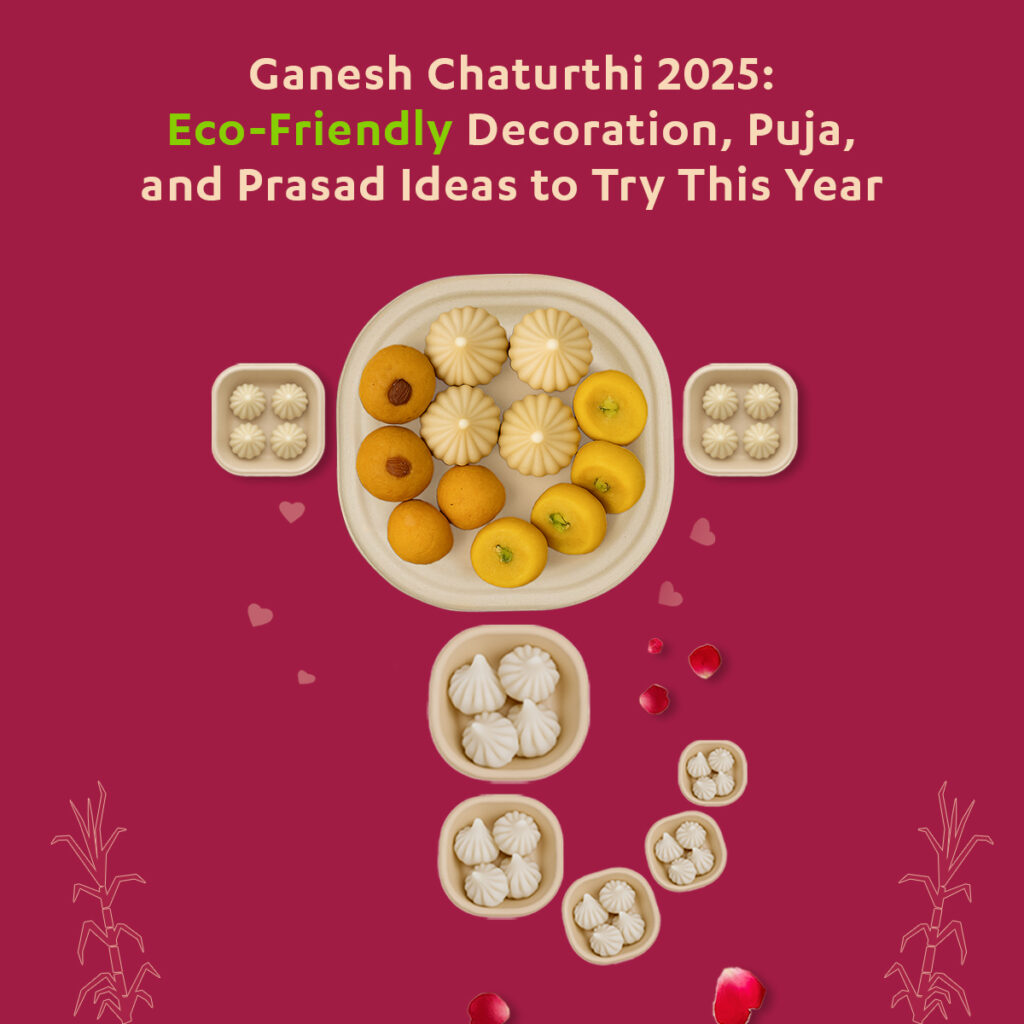
Green Ganpati: the honest guide to puja, prasad & visarjan without the waste
The modaks are steaming. The mandaps are going up. Bappa is on his way. And somewhere, a mountain of plastic plates, thermocol decorations, and chemical-painted idols is waiting to end up in a river or a landfill.
Here is the honest truth. Ganesh Chaturthi is one of the most joyful, community-driven festivals in India. It is also one of the most waste-heavy. Every year, cities like Mumbai, Pune, Hyderabad, and Bangalore deal with tonnes of non-biodegradable waste from just a few days of celebration.
But what if your Ganpati Utsav could be just as grand, just as devotional, and generate almost zero waste? Whether you are bringing Bappa home as a devotee, managing a pandal as a mandal organiser, or coordinating a housing society celebration as a community leader, this guide walks you through every step — from decoration to prasad to visarjan — the cleaner way.
Key Takeaways
- A green Ganpati celebration does not mean a smaller celebration — it means a smarter one that aligns with what Ganpati Bappa actually stands for
- Compostable disposables made from sugarcane bagasse handle hot modaks, oily prasad, and wet sundal without bending, leaking, or adding to landfill waste
- Swapping plastic plates and thermocol decorations for natural alternatives can cut celebration waste by 80% or more
- Eco visarjan at home using a bucket or artificial tank is now the norm in most housing societies — and it keeps rivers clean
- Every choice you make — from the idol material to the plate you serve prasad on — is a reflection of the devotion you bring to the festival
Why green Ganpati celebrations are not a trend — they are the tradition
What they do not tell you is that Ganesh Chaturthi was always a green festival. Go back a few generations. The idols were made of natural clay, not Plaster of Paris. Decorations came from banana leaves, mango leaves, and marigold garlands. Prasad was served on patravali (leaf plates) and dona. Nothing went to waste.
Somewhere along the way, plastic took over. Thermocol mandaps replaced jute and cloth. Chemical-painted idols replaced clay. Styrofoam plates replaced leaf plates. And the very festival that celebrates the remover of obstacles started creating one of the biggest environmental obstacles our cities face every monsoon season.
Here is why the shift back to green is gaining ground:
- Water pollution awareness. Plaster of Paris idols with chemical paints raise water toxicity levels during visarjan. Municipal bodies across India now actively promote clay idols
- Waste reduction pressure. Housing societies and mandals face increasing scrutiny from municipal authorities about post-celebration waste
- Community pride. Mandals that go green get recognition, media coverage, and community respect — it has become a competitive advantage
- Spiritual alignment. As a devotee, you already know this: Ganpati Bappa is Pratham Pujya, the lord of beginnings. Starting with respect for the earth is the most fitting way to honour him
Ganesh Chaturthi decoration ideas that go back to the earth
The decor mantra for a green Ganpati? If it cannot return to the earth, it should not be part of the celebration.
Eco-friendly mandap decoration ideas
Swap glittery thermocol and plastic flowers for materials that look stunning and compost naturally.
- Banana leaves and mango leaves backdrop. The traditional toran made from mango leaves is not just beautiful — it is considered auspicious in Hindu tradition
- Jute fabric mandap draping. Durable, reusable across years, and gives the mandap an earthy, grounded look
- Marigold flower garlands. Fresh marigold and jasmine strings are the gold standard for Ganpati decoration. They smell incredible, photograph well, and compost completely
- DIY recycled paper torans and buntings. Seed paper buntings are a brilliant idea — after the festival, plant them and watch them grow
- Potted plants as mandap decor. Tulsi, money plant, or even small fruit-bearing plants work beautifully as mandap accents. They stay with you long after visarjan
Small-space decoration ideas for home Ganpati
Not everyone has a full mandap setup. If you are celebrating at home in a flat or apartment, here are practical swaps.
- Use natural rangoli colours made from turmeric, beetroot powder, rice flour, and indigo. They are safe for children and pets too
- Hang seed paper bunting — it doubles as a post-festival garden project
- Place potted plants around the murti instead of plastic flowers
- Use brass or copper diyas instead of electric LED lights for the aarti area
- Create a backdrop with a simple cotton cloth in a rich colour — saffron, green, or red
These choices make your home Ganpati look peaceful, earthy, and genuinely beautiful. No thermocol required.
Ganesh Chaturthi puja vidhi and items: the zero-waste setup
No need to compromise on rituals. Not a single one. The honest truth is that every traditional puja item is already natural. It is only the modern additions — plastic wrapping, synthetic flowers, styrofoam packaging — that cause the problem.
Step-by-step Ganesh Chaturthi puja vidhi (the cleaner way)
Step 1: Ganpati Sthapana (installation)
Place your clay or seed Ganpati murti on a bamboo or wooden base. Use natural fabrics for draping. Decorate with fresh flowers, banana leaves, or jute cloth. Avoid thermocol bases entirely.
Step 2: Kalash Sthapana
Fill a copper or brass pot with clean water. Place mango leaves and a coconut on top. This is already a zero-waste ritual by design.
Step 3: Shodashopachara Puja (16 ritual offerings)
The sixteen offerings include:
- Akshata (unbroken rice grains)
- Haldi-kumkum
- Fresh flowers
- Fruits and modaks
- Diya with ghee or sesame oil
- Natural incense sticks (avoid synthetic agarbatti with chemical fragrance)
Step 4: Aarti and Naivedyam
Sing your Ganesh aartis with full devotion. Offer naivedyam (prasad) to Bappa. And here is where the practical choice matters: serve that prasad in compostable bowls and thalis instead of plastic or styrofoam.
No washing up. No plastic waste. No guilt. Just clean devotion.
Eco-friendly puja samagri checklist
| Puja Item | Green Choice | What to Avoid |
|---|---|---|
| Ganpati idol | Natural clay or seed idol | Plaster of Paris, chemical paint |
| Mandap base | Bamboo or wooden chowki | Thermocol base |
| Thali for puja | Brass or steel thali | Plastic or melamine |
| Haldi-kumkum | Organic, chemical-free | Synthetic powders |
| Flowers | Fresh, locally sourced | Plastic or silk flowers |
| Rangoli | Turmeric, rice flour, petals | Chemical rangoli powder |
| Incense | Natural dhoop, cow dung | Synthetic agarbatti |
| Prasad plates | Compostable plates and bowls | Plastic plates, styrofoam |
| Napkins | Cloth napkins (reusable) | Paper napkins (bleached) |
| Visarjan setup | Bucket or artificial tank | Open river immersion of POP idol |
Ganpati prasad ideas: bhog recipes that Bappa loves
What is Ganesh Chaturthi without prasad? Bappa loves food — especially when it is homemade and heartfelt. As a devotee or a mandal organiser, the prasad you serve is central to the celebration.
Here are classic recipes that work for everything from a small home puja to a society-level gathering.
1. Ukadiche modak (steamed modak)
Bappa’s absolute favourite. The prasad that defines Ganesh Chaturthi.
Made with rice flour outer shell, filled with grated coconut, jaggery, and ghee. Steamed to perfection. The texture is delicate, the flavour is warm, and the aroma fills the entire house.
Serve hot modaks in compostable bowls so they stay warm, hold their shape, and do not stick.
2. Coconut laddoos
Zero fuss, maximum flavour. Mix grated coconut, condensed milk, and cardamom powder. Roll into balls. Done.
This is a brilliant option for large gatherings because you can make them in bulk. Children love helping with this one — bonus family bonding during the festival.
3. Sundal (chana or moong sundal)
For those who prefer savoury prasad. Boiled lentils or chickpeas sauteed with mustard seeds, curry leaves, grated coconut, and green chillies.
Sundal is popular across South Indian Ganpati celebrations. It is protein-rich, easy to distribute, and travels well. Use compostable bowls for distribution — they are sturdy, bleach-free, and chlorine-free.
4. Sheera (sooji halwa)
A warm comfort classic. Easy to prepare with rava (semolina), sugar, ghee, and saffron. Garnish with dry fruits. This is the prasad that works for every age group and every gathering size.
Serve in compostable plates — no washing, no waste, no fuss.
5. Puran poli
A Maharashtrian staple for Ganesh Chaturthi. Stuffed with a sweet chana dal filling, cooked on a tawa with ghee. It is rich, satisfying, and deeply traditional.
Puran poli is best served hot. Wrap portions in compostable meal trays if you are distributing prasad across floors in a housing society or across homes in a neighbourhood.
Hosting a Ganpati function? Here is the honest math on serving prasad
Whether you are serving 10 guests or 500, as a mandal organiser or a housing society committee member, the serving logistics matter.
Here is what they do not tell you about festival waste:
- A single large community Ganpati celebration can generate 50-100 kg of plastic waste from plates, cups, and cutlery alone
- Most of that waste ends up in municipal landfills because mixed food-contaminated plastic cannot be recycled
- The cost difference between plastic and compostable disposables for a 200-person prasad distribution is roughly INR 2,000-3,000 more — less than what most mandals spend on a single decoration element
Compostable disposables from sugarcane bagasse handle every type of prasad:
- Hot modaks and sheera — heat resistant up to 120 degrees Celsius
- Oily sundal and puran poli — oil and grease resistant without any chemical coating
- Wet items like shrikhand or basundi — leak-proof construction holds liquids without soggy bottoms
The practical benefits for mandal organisers:
- No dishwashing logistics to manage
- No plastic waste complaints from municipal authorities
- Post-event cleanup takes a fraction of the time
- All used tableware goes into wet waste or compost bins
- Community members notice and appreciate the effort
Check out Chuk’s full range of compostable plates and bowls for your Ganpati celebration needs.
Eco visarjan: how to do Ganpati visarjan the responsible way
Visarjan is the most emotional moment of Ganesh Chaturthi. The procession, the chanting, the final farewell to Bappa. But the honest truth? Traditional river visarjan with Plaster of Paris idols causes serious damage to aquatic ecosystems.
Here is what actually happens when a POP idol enters a water body:
- Plaster of Paris takes months to fully dissolve, raising water alkalinity
- Chemical paints release lead, mercury, and cadmium into the water
- Decorative materials like thermocol, plastic, and synthetic cloth float and choke aquatic life
- Fish populations in visarjan-heavy water bodies show measurable decline during and after the festival season
You do not have to choose between devotion and responsibility. Here is how families and communities are making visarjan cleaner.
Eco visarjan methods that work
- Artificial immersion tank. Most housing societies and municipal bodies now provide these. The clay idol dissolves, the water is treated, and the clay is often reused for next year’s idols
- Home visarjan in a bucket or tub. Immerse your clay Ganpati in a bucket of water at home. Once dissolved, use the water for your garden plants. It is nutrient-rich and completely safe
- Community visarjan drives. Many cities organise designated eco-visarjan points with proper waste management infrastructure
- Seed Ganpati visarjan. Seed idols are designed to be planted after immersion. The idol dissolves and a plant grows in its place. Bappa’s blessing, literally growing from the earth
Post-visarjan waste management
After visarjan, the celebration waste needs proper handling.
- Compost all flowers, garlands, and food waste using your society’s compost bin or a community garden
- Place all used compostable tableware into the wet waste stream — it breaks down alongside organic matter
- Collect any reusable items (brass thali, cloth draping, copper kalash) and store for next year
- Avoid burning any celebration waste — it defeats the purpose entirely
Green Ganpati celebration: a complete planning checklist
Whether you are planning for a home Ganpati or a mandal-level celebration, here is your planning checklist.
For home Ganpati (as a devotee)
- [ ] Source a natural clay or seed Ganpati idol from a verified local artisan
- [ ] Set up the mandap with banana leaves, marigold, and cloth draping
- [ ] Prepare organic puja samagri (haldi, kumkum, akshata, fresh flowers)
- [ ] Make prasad at home — modaks, laddoos, sundal
- [ ] Serve prasad in compostable plates and bowls
- [ ] Arrange home visarjan setup (bucket or artificial tank)
- [ ] Compost all flowers and food waste post-visarjan
For mandal and society-level celebrations (as an organiser)
- [ ] Choose a clay idol from a registered idol maker
- [ ] Design mandap with natural, compostable materials only
- [ ] Order compostable disposables in bulk for prasad distribution
- [ ] Set up waste segregation bins at the venue (wet waste, dry waste, compost)
- [ ] Coordinate with the local municipal body for artificial visarjan tank access
- [ ] Plan a post-visarjan cleanup drive with volunteers
- [ ] Document the green celebration for social media and community recognition
What makes a Ganpati celebration truly green? It is the details
The big-ticket items — clay idol, natural decorations, eco visarjan — get all the attention. But the details add up.
The plates you serve prasad on. If 200 people eat modak and sundal on plastic plates, that is 200 plates heading to a landfill. If those same plates are compostable, they go into the wet waste bin and decompose within 90 days.
The packaging you use. If you distribute take-home prasad, use compostable meal trays or paper bags instead of plastic pouches.
The decorations you choose. Every piece of thermocol, every plastic flower, every synthetic ribbon will outlast you, your children, and your grandchildren in a landfill. Marigold, banana leaves, and jute will return to the earth within weeks.
The clean-up approach. A green celebration is not complete without green waste management. Segregate. Compost. Reuse. That is the full circle.
Explore more about sustainable festival celebrations on Chuk’s blog.
In a Nutshell
Ganpati Bappa Morya. That chant carries weight. It carries love, devotion, community, and a centuries-old tradition that was always in harmony with nature.
A green Ganpati celebration is not a compromise. It is a return to what the festival was always meant to be. Clay idols instead of POP. Banana leaves instead of thermocol. Compostable plates instead of plastic. Home visarjan instead of river pollution.
Here is what to remember:
- Start with the idol. Natural clay or seed Ganpati. This is the single biggest impact choice you make
- Decorate with what the earth gives. Marigold, mango leaves, jute, potted plants. It looks better and costs less than plastic
- Serve prasad in compostable disposables. They handle hot modaks, oily sundal, and wet sweets without any issues. And they decompose instead of landfilling
- Do visarjan responsibly. Bucket at home, artificial tank in the society, or a designated eco-visarjan point. Keep the rivers clean
- Manage post-celebration waste. Compost flowers and food waste. Segregate the rest. Close the loop
As a devotee, as a mandal organiser, as a community leader — the choices you make during Ganesh Chaturthi ripple outward. Make them count.
Ganpati Bappa Morya.
Frequently Asked Questions
Can compostable plates and bowls handle hot and oily Ganpati prasad like modaks, sheera, and sundal?
Yes. Compostable tableware made from sugarcane bagasse withstands temperatures up to 120 degrees Celsius. It is oil-resistant and grease-resistant without any chemical coating. Hot steamed modaks, oily sundal, ghee-rich sheera, and even wet sweets like basundi hold perfectly without leaking or making the plate soggy. The structural integrity stays intact throughout the meal.
How much does it cost to switch from plastic to compostable disposables for a Ganpati celebration?
The per-piece cost of compostable disposables is approximately 15-25% higher than equivalent plastic items. For a society-level celebration serving 200-300 people, the additional cost works out to roughly INR 2,000-4,000 total. That is less than what most mandals spend on a single decoration banner. When you factor in reduced waste disposal costs and community goodwill, the value far exceeds the marginal difference.
What is the difference between compostable and biodegradable tableware?
Biodegradable is a loosely used marketing term. Almost anything technically biodegrades given enough time, including plastic over centuries. Compostable means the product breaks down within 90 to 180 days in a composting environment, leaving no toxic residue. Always look for certified compostable products with clear certification marks rather than vague biodegradable claims. The honest truth is that many products labelled biodegradable are not meaningfully different from regular plastic in practical terms.
How do I do Ganpati visarjan at home without a river or lake?
Home visarjan is simple and deeply meaningful. Fill a large bucket or tub with clean water. Immerse your clay Ganpati murti in it with full devotion — the aarti, the chanting, the emotional farewell all remain the same. The clay dissolves over a day or two. Use the resulting water to nourish your garden plants. It is safe, nutrient-rich, and completes the cycle beautifully. Many families find home visarjan more intimate and personal than a public procession.
Are Plaster of Paris Ganpati idols really that harmful to water bodies?
Yes, and the data is clear. POP idols take months to dissolve in water, during which they raise alkalinity and disrupt aquatic pH levels. The chemical paints used on these idols contain heavy metals like lead, mercury, and cadmium that are toxic to fish and other aquatic organisms. Studies by the Central Pollution Control Board have documented measurable water quality degradation in visarjan-heavy lakes and rivers. Natural clay idols, by contrast, dissolve within hours and add no toxicity to the water.
What should I do with leftover flowers and garlands after Ganesh Chaturthi?
Compost them. Flower waste from puja is excellent composting material. If your housing society has a community compost bin, add all flowers, garlands, and food waste there. If not, you can start a simple home composting setup with a terracotta pot. Never throw puja flowers into the regular trash or into water bodies. The organic matter returns to soil within weeks and can nourish your garden.
How can a mandal organiser make the entire Ganesh Chaturthi celebration zero-waste?
Start with three decisions: a natural clay idol, compostable tableware for all prasad distribution, and a waste segregation plan. Source decorations from natural materials only. Set up clearly labelled bins for wet waste, dry waste, and compostable items at the venue. Coordinate with a local composting facility or community garden for post-event waste processing. Document the entire effort on social media — it inspires other mandals and builds community recognition. The investment in going green is minimal compared to the reputational and environmental returns.