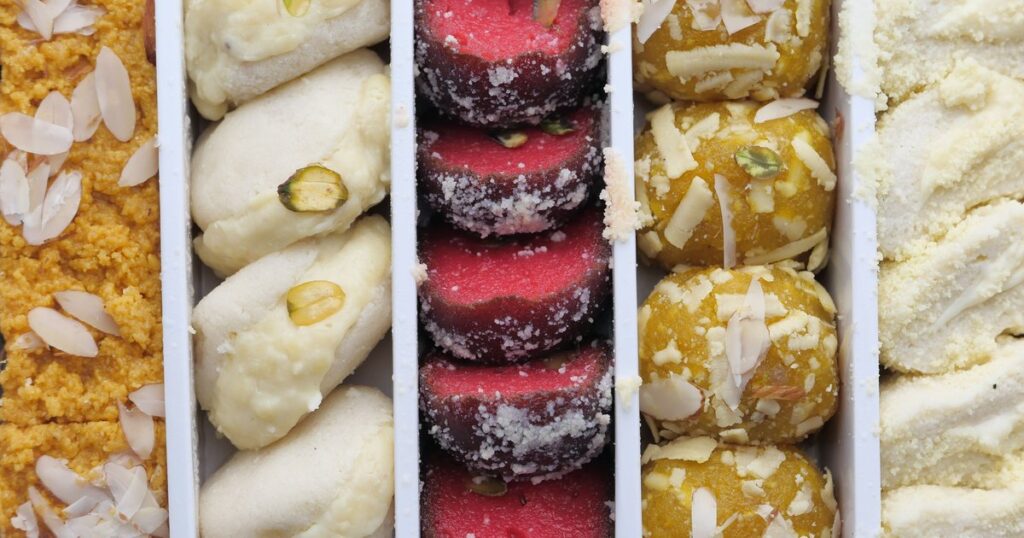
Diwali 2026 falls on Sunday, 8 November. The classic Diwali sweets list starts with kaju katli, besan and motichoor ladoo, soan papdi and gulab jamun, then turns regional: rasgulla and sandesh in the east, anarse and karanji in the west, Mysore pak and adhirasam in the south. All 40 are below, with the five days of Diwali and sweet box pricing.
What are the most popular Diwali sweets? The complete list by region
Every family’s Diwali tray looks a little different. Still, a few dozen mithai turn up across most of India in the festival week. Here are 40, grouped by the region where each one is most at home, with what it is made from. Plenty of them, kaju katli and gulab jamun above all, are now eaten everywhere.
| # | Sweet | Region | Made from |
|---|---|---|---|
| 1 | Kaju katli | North, now all-India | Cashew paste and sugar, rolled thin with silver varq |
| 2 | Besan ladoo | North and West | Roasted gram flour, ghee and sugar |
| 3 | Motichoor ladoo | North | Tiny fried gram-flour pearls in sugar syrup |
| 4 | Boondi ladoo | All-India | Larger fried gram-flour drops, bound in syrup |
| 5 | Soan papdi | North, now all-India | Flaky strands of gram flour, ghee and sugar |
| 6 | Khoya barfi | North | Reduced milk (khoya) and sugar, set and cut |
| 7 | Kalakand | North | Grainy set milk cake of paneer and reduced milk |
| 8 | Milk cake | Rajasthan (Alwar) | Slow-cooked caramelised milk |
| 9 | Peda | Uttar Pradesh (Mathura) | Browned khoya, sugar and cardamom |
| 10 | Gulab jamun | All-India | Fried khoya dumplings in rose-cardamom syrup |
| 11 | Jalebi | All-India | Fermented batter spirals, fried and soaked in syrup |
| 12 | Imarti | North | Urad dal batter, fried in flower shapes, in syrup |
| 13 | Balushahi | North | Flaky fried maida rounds glazed in syrup |
| 14 | Petha | Uttar Pradesh (Agra) | Ash gourd candied in sugar |
| 15 | Gujiya | North | Fried pastry filled with khoya and dry fruit |
| 16 | Dry fruit barfi | North | Dates, figs and nuts, no added sugar in many versions |
| 17 | Gajar halwa | North | Grated carrot cooked in milk and ghee |
| 18 | Rasgulla | East (Bengal, Odisha) | Chhena balls cooked in light sugar syrup |
| 19 | Sandesh | East (Bengal) | Pressed chhena with sugar or nolen gur |
| 20 | Cham cham | East | Oval chhena sweets, often coated in khoya |
| 21 | Rasmalai | East, now all-India | Chhena discs in saffron-cardamom milk |
| 22 | Narkel naru | East (Bengal) | Coconut and jaggery balls, a Kali Puja staple |
| 23 | Pantua | East (Bengal) | Bengal’s darker, firmer cousin of gulab jamun |
| 24 | Khaja | East (Bihar, Odisha) | Layered fried pastry dipped in syrup |
| 25 | Anarse | West (Maharashtra) | Fermented rice flour and jaggery, fried with poppy seeds |
| 26 | Karanji | West (Maharashtra) | Fried crescent pastry filled with coconut and sugar |
| 27 | Shankarpali | West (Maharashtra) | Sweet fried diamonds of maida, ghee and sugar |
| 28 | Rava ladoo | West and South | Semolina, coconut, ghee and sugar |
| 29 | Mohanthal | West (Gujarat, Rajasthan) | Coarse gram flour fudge with ghee and khoya |
| 30 | Ghughra | West (Gujarat) | Gujarat’s fried pastry with semolina and dry fruit |
| 31 | Basundi | West | Milk reduced until thick and sweet |
| 32 | Shrikhand | West | Strained yoghurt with sugar, saffron and cardamom |
| 33 | Mysore pak | South (Karnataka) | Gram flour cooked in a lot of ghee and sugar |
| 34 | Adhirasam | South (Tamil Nadu) | Rice flour and jaggery discs, fried; essential for Deepavali |
| 35 | Ariselu | South (Andhra, Telangana) | The Telugu version of adhirasam, with sesame |
| 36 | Badusha | South | The southern balushahi, crisp outside, soft inside |
| 37 | Jangiri | South (Tamil Nadu) | Tamil Nadu’s imarti, made from urad dal |
| 38 | Coconut barfi | South and West | Fresh coconut, sugar and milk |
| 39 | Paal kova | South (Tamil Nadu) | Milk reduced to a soft, grainy sweet |
| 40 | Badam halwa | South | Ground almonds, ghee, sugar and saffron |
If you only stock ten, the national bestsellers are kaju katli, besan ladoo, motichoor ladoo, soan papdi, gulab jamun, rasgulla, khoya barfi, milk cake, peda and dry fruit barfi. Diwali is not the only festival people search for this way. The 56 bhog list for Janmashtami, the Durga Puja bhog list and the sargi thali list for Karwa Chauth are searched the same way: people want the whole list, in one place.
What are the 5 days of Diwali in 2026, and which sweets go with each?
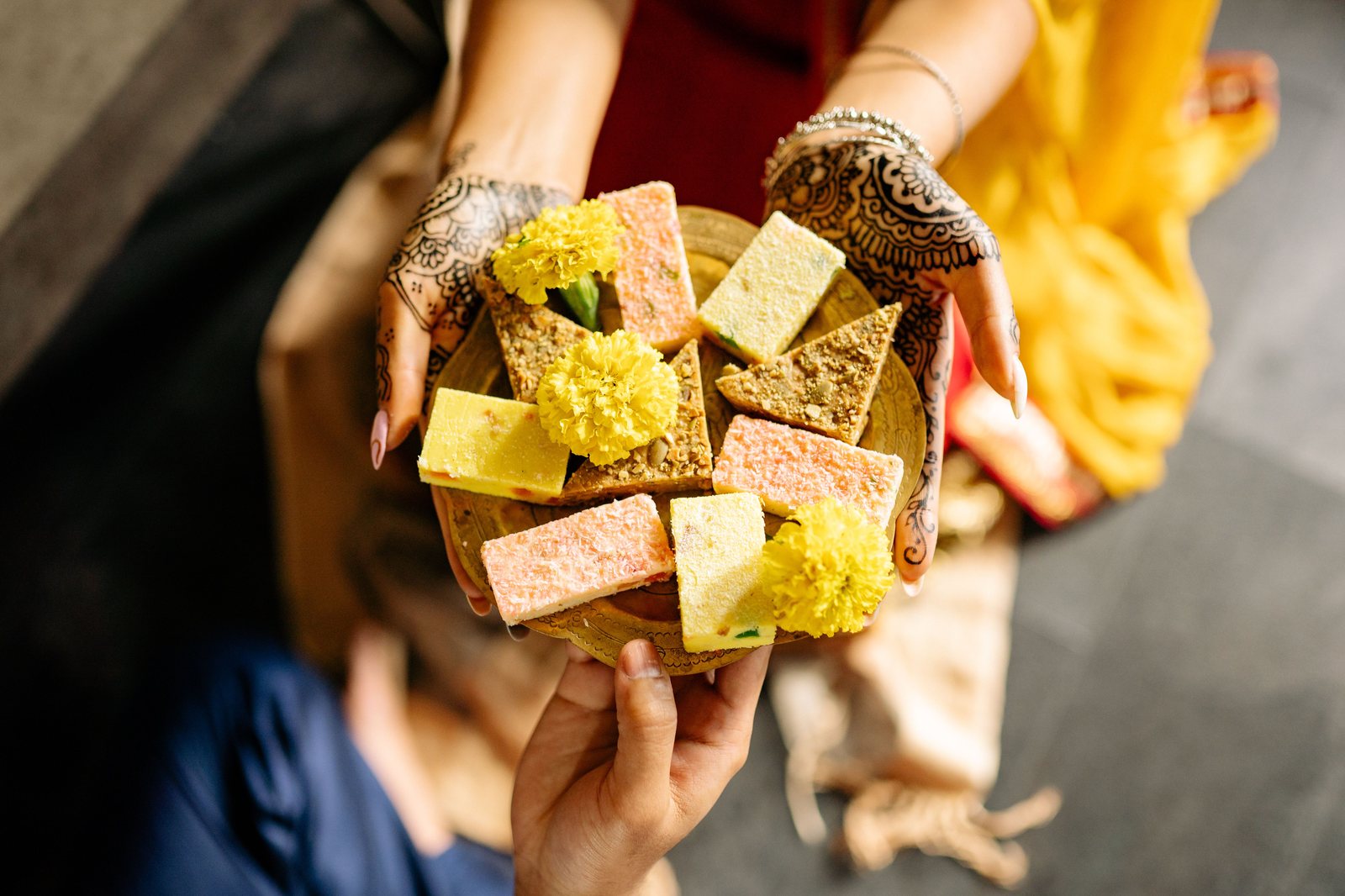
Diwali is a five-day festival that starts on Dhanteras and ends on Bhai Dooj, and in 2026 it runs from Friday, 6 November to Wednesday, 11 November. That is six calendar days for five festival days, because the Amavasya tithi this year begins at 11:27 AM on 8 November and ends at 12:31 PM on 9 November. Govardhan Puja therefore moves to Tuesday, 10 November, and Monday, 9 November, is a quiet day in between. These are the New Delhi dates from Drik Panchang, and some regional calendars place Govardhan Puja a day earlier, so check yours. For a sweet shop, the dates decide when the rushes come. Gifting boxes sell hardest in the days before Dhanteras. Loose mithai for the puja sells on Saturday and Sunday morning. Then a second, smaller rush comes for Bhai Dooj on the Wednesday.
| Day | Date (2026) | What happens | Sweets and bhog |
|---|---|---|---|
| 1. Dhanteras | Fri, 6 Nov | Puja of Lakshmi, Kuber and Dhanvantari; people buy gold, silver and utensils | Dhaniya panjiri (coriander seed with jaggery or sugar), boondi ladoo, khoya sweets |
| 2. Naraka Chaturdashi (Chhoti Diwali) | Sat, 7 Nov (Kali Chaudas) and the morning of Sun, 8 Nov | Kali Chaudas puja on the Saturday; abhyang snan (oil bath) before sunrise on Sunday; Tamil Deepavali is on 8 Nov | Maharashtra’s Diwali faral (anarse, karanji, shankarpali, besan ladoo) after the bath; adhirasam and laddu in Tamil homes |
| 3. Lakshmi Puja (Diwali) | Sun, 8 Nov | Lakshmi-Ganesh puja in the evening; Kali Puja in Bengal the same night | Kheel-batashe, ladoo, kheer, sugar toys; narkel naru in Bengal |
| 4. Govardhan Puja (Annakut) | Tue, 10 Nov | A “mountain” of cooked food offered to Krishna; Gujarati New Year | Annakut with dozens of dishes and sweets, often a 56 bhog spread |
| 5. Bhai Dooj | Wed, 11 Nov | Sisters put a tilak on their brothers and feed them a sweet | Kaju katli, peda, barfi, gift boxes |
What is offered as bhog in Lakshmi Puja?
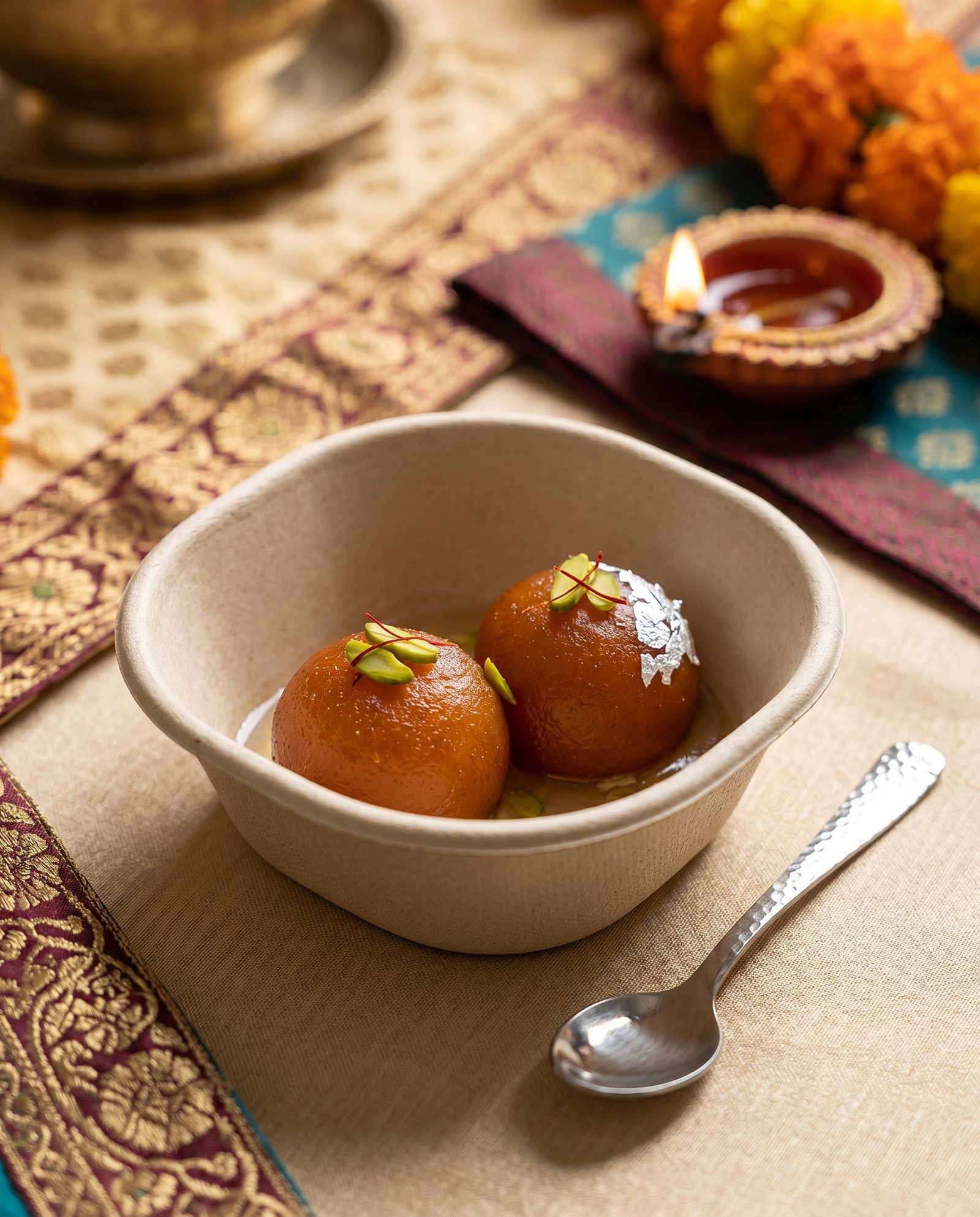
The Lakshmi Puja bhog is simple, and most of it is white or golden: sugar, rice, milk and ghee. In 2026 the Pradosh Kaal muhurat for Lakshmi Puja in New Delhi is 5:54 PM to 7:50 PM on Sunday, 8 November, and the offering usually includes these eight things:
- Kheel and batashe: puffed rice and sugar drops, the most common Diwali prasad in north India.
- Chini ke khilone: sugar toys shaped like animals, temples and houses.
- Boondi or motichoor ladoo, offered to Ganesh, who is worshipped alongside Lakshmi.
- Kheer, or makhana kheer in some homes.
- Panchamrit: milk, curd, ghee, honey and sugar.
- Fresh fruit, often sugarcane, singhara (water chestnut) and pomegranate.
- Paan and supari.
- One or two pieces from the family’s sweet box, usually barfi or peda.
Annakut, two days later, is the big food offering of the week, and temples and families often build it around a 56 bhog spread. If you take temple or society orders, the Annakut list overlaps heavily with Janmashtami, so the same recipes and the same packing plan can run twice in a year.
What should a Diwali sweet box cost you?
A Diwali sweet box price is the cost of the sweets plus the box, the labour and your margin, and the sweets decide most of it. Work from your own buying prices, not a competitor’s shelf. For a 500 g assorted box, weigh out the mix (for example 150 g kaju katli, 150 g besan ladoo, 100 g khoya barfi and 100 g soan papdi), cost each one per kilo from your recipe sheet, and add them up. Then add the box itself, the tray or liners, the ribbon and the label, which together often add more than people expect on a decorated box. Add direct labour for packing, then your margin. Cashew and ghee move the number more than anything else, so a kaju-heavy box needs its own price rather than a single “assorted” rate. Fix the price and the weights before the rush, print them, and do not change the mix mid-week. Corporate buyers often order in October and check that the box they receive matches the sample they approved.
Most shops sell three tiers: a 250 g box for neighbours and staff, a 500 g box as the standard gift, and a 1 kg box or dry-fruit hamper for clients. Keep syrup sweets out of the gift boxes or pack them separately, since a single leaking gulab jamun can ruin an entire carton of kaju katli. Our mithai takeaway guide covers batching and the pre-order book in more detail.
How should sweet shops and restaurants plan Diwali week?
The week before Diwali is the heaviest sweet-selling week of the year for most mithai shops, and the mistakes repeat every year. Lock the menu and box sizes by late October and stop taking bulk corporate orders a few days before Dhanteras, so the kitchen is not still making kaju katli on Saturday night. Make dry sweets with a longer life first (kaju katli, soan papdi, besan ladoo, dry fruit barfi) and milk sweets last, since khoya and chhena sweets keep only a day or two out of the fridge. Since 1 October 2020, FSSAI has required shops selling loose sweets to display a best before date on the tray or container at the counter. FSSAI announced the rule in early 2020 and moved the start date twice, as its May 2020 newsletter records. Festival weeks are a common window for food safety checks, so make sure your FSSAI licence is current before the rush starts.
Delivery is where Diwali orders go wrong. Rasgulla, rasmalai and gulab jamun travel in syrup, and a gift box is only as good as its weakest container. Pack wet sweets in lidded bowls that hold liquid, and keep them away from dry mithai. Plenty of sweet shops still use thin plastic tubs, but more of them now put syrup sweets in compostable bagasse bowls and donas (Chuk is one of the options), which take hot syrup and look cleaner in the box. Our takeaway food packaging guide goes through leak-proof choices in detail, and if your counter staff are new to terms like khoya, chhena or bhog, the restaurant operations glossary has quick definitions.
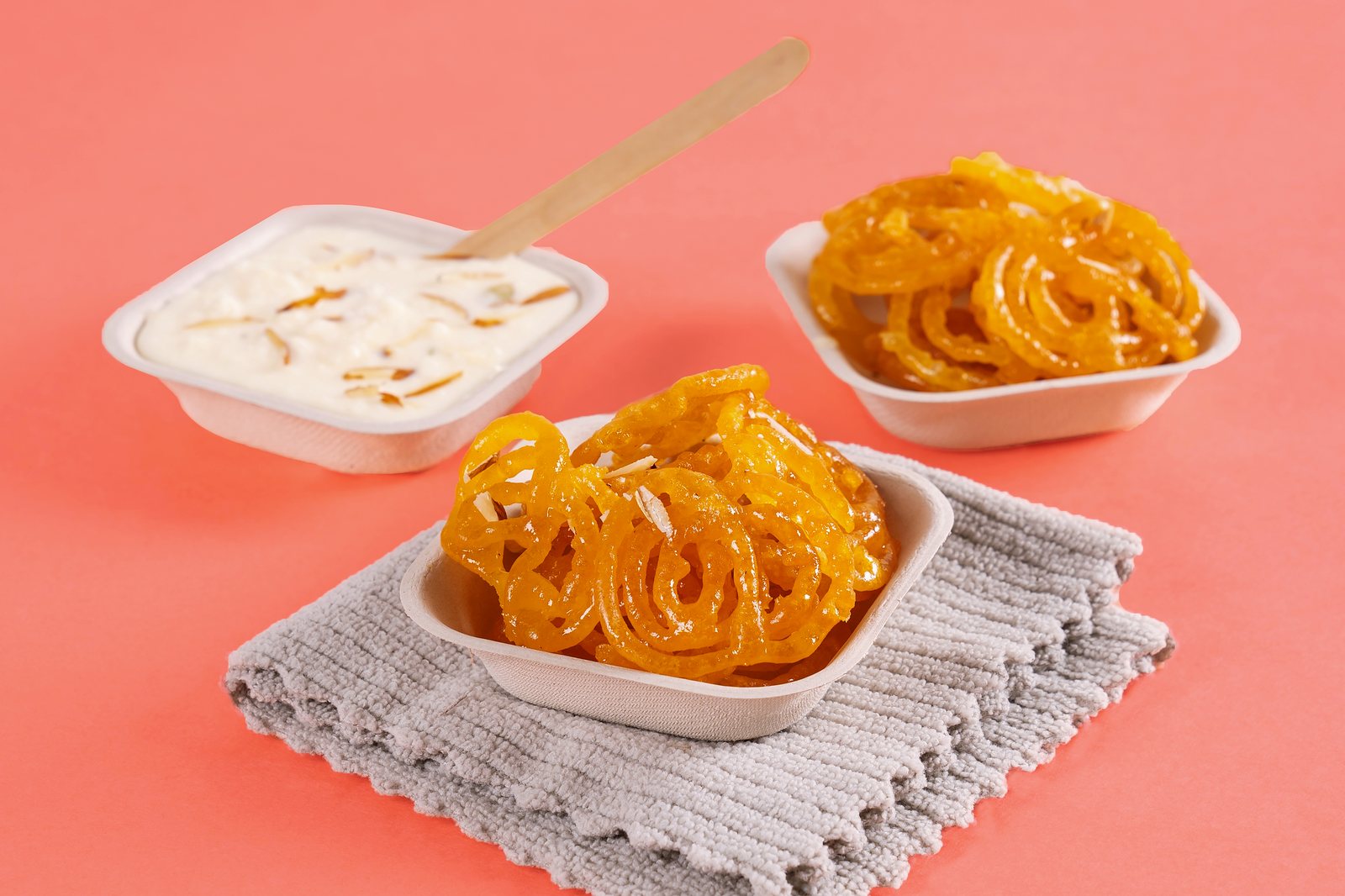
Restaurants have a smaller opening of their own. Many families eat out or order in on Bhai Dooj and on the quiet Monday after Lakshmi Puja, and a fixed festive thali with one or two sweets (jalebi with rabri, or gulab jamun) is easy to prep in bulk. If you are hosting rather than selling, our Diwali party menu guide covers that side.
In a Nutshell
Diwali 2026 runs from Dhanteras on Friday, 6 November to Bhai Dooj on Wednesday, 11 November, with Lakshmi Puja on Sunday, 8 November (muhurat 5:54 PM to 7:50 PM in New Delhi). The most popular Diwali sweets are kaju katli, besan and motichoor ladoo, soan papdi, gulab jamun, rasgulla, barfi, milk cake and peda, with regional favourites like anarse, sandesh, Mysore pak and adhirasam. Price your sweet box from your own per-kilo costs, keep syrup sweets in separate leak-proof containers, and finish bulk orders before Dhanteras.
FAQ
Which sweets are made on Diwali?
The most common Diwali sweets are kaju katli, besan ladoo, motichoor ladoo, soan papdi, gulab jamun, khoya barfi, peda, milk cake, rasgulla and dry fruit barfi. Regional favourites include anarse and karanji in Maharashtra, sandesh and narkel naru in Bengal, and Mysore pak and adhirasam in the south.
What are the 5 days of Diwali in 2026?
Dhanteras on Friday, 6 November; Naraka Chaturdashi (Chhoti Diwali) on Saturday, 7 November and the morning of 8 November; Lakshmi Puja on Sunday, 8 November; Govardhan Puja on Tuesday, 10 November; and Bhai Dooj on Wednesday, 11 November.
What is the Lakshmi Puja muhurat in 2026?
In New Delhi, the Lakshmi Puja muhurat on Sunday, 8 November 2026 is 5:54 PM to 7:50 PM, within the Pradosh Kaal of 5:31 PM to 8:09 PM. Timings change by city, so check a panchang for your location.
What is offered as prasad on Diwali?
Kheel and batashe are the most common Diwali prasad in north India, along with ladoo, kheer, sugar toys, fruit, panchamrit, paan and supari. In Bengal, Kali Puja on the same night is offered narkel naru and other sweets.
Do loose sweets need a best before date?
Yes. Since 1 October 2020, FSSAI has required sweet shops to display a best before date on the tray or container of sweets sold loose. Displaying the manufacturing date is optional.
Packing Diwali boxes or Bhai Dooj orders this year? Put the gulab jamun, rasgulla and rabri in compostable bagasse bowls and donas that hold syrup without leaking, and keep them away from the kaju katli. See CHUK disposable bowls, order a sample box to test before the rush, or WhatsApp us for festival pricing.