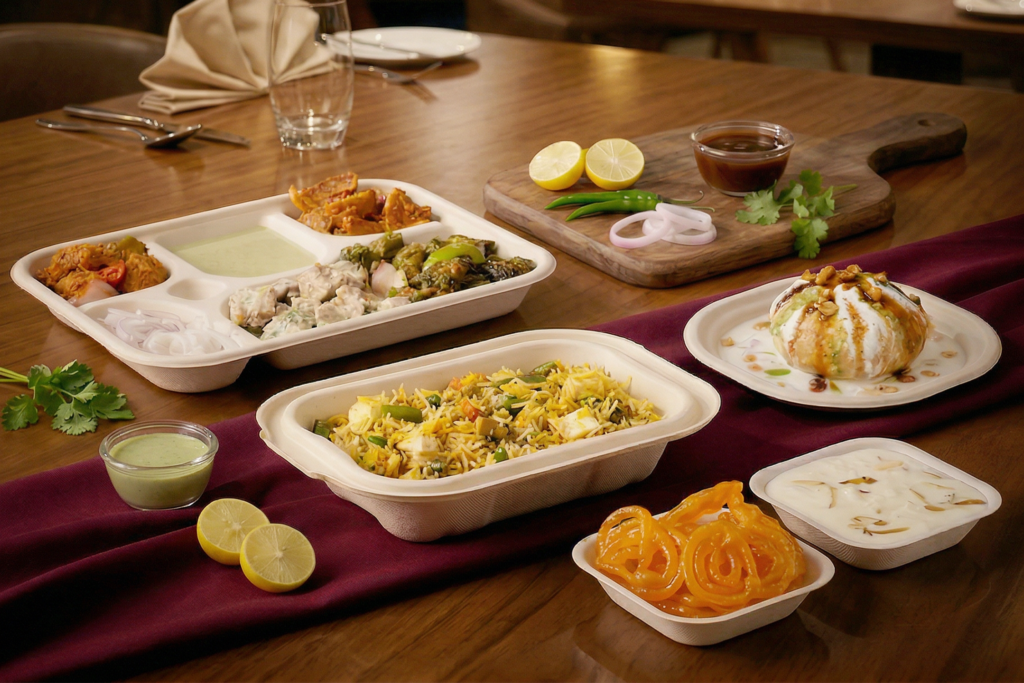
If you run a restaurant, cloud kitchen, or catering business in India, you already know where this is going. Packaging costs keep climbing. Plastic rules keep tightening. And your customers have started noticing what their food arrives in.
So the real question isn’t whether to switch to compostable packaging. It’s how to buy it in bulk without wrecking your margins.
This guide covers what compostable packaging actually costs at scale, the 2026 compliance rules that make switching less optional than you’d think, and the steps for placing your first bulk order.
Why compostable packaging for restaurants isn’t really optional anymore
On April 4, 2026, the Ministry of Environment, Forest and Climate Change (MoEFCC) notified the Plastic Waste Management (Amendment) Rules 2026. These expand Extended Producer Responsibility (EPR) mandates, bump recycled content requirements to 30% for rigid plastics, and tighten QR code traceability on all plastic packaging.
That’s on top of the single-use plastic ban in force since July 2022, where violators face fines up to Rs 1 lakh or imprisonment up to 5 years.
FSSAI hasn’t been sitting idle either. In April 2025, it reclassified food-grade packaging as “critical” in its inspection checklists. What that means in practice: when an FSSAI officer walks into your kitchen, the containers your food ships in now get scrutinized the same way your cooking oil and cold storage do.
If you’re a restaurant owner juggling a hundred things, the takeaway is simple. If your food safety inspection turns up non-compliant packaging, that’s a mark on your license. Not a suggestion. A mark.
What compostable packaging actually costs (the numbers might surprise you)
“Compostable sounds expensive” is the most common objection I hear. Let’s look at what the numbers actually say.
Per-unit cost comparison:
| Packaging type | Cost per unit (Rs) | Notes |
|---|---|---|
| Standard plastic clamshell | Rs 6-10 | Increasingly non-compliant |
| Sugarcane bagasse clamshell | Rs 12-18 | Food-safe, microwave-safe, freezer-safe |
| Premium bagasse (branded) | Rs 15-22 | Custom branding, restaurant-grade |
At first glance, bagasse costs 50-80% more per unit. That’s the number that scares people off.
But at 10,000+ pieces per month, compostable packaging pricing drops to within 10-15% of plastic. At 50,000+ units, the gap nearly disappears.
A typical cloud kitchen spends Rs 15,000-40,000 per month on packaging depending on order volume (per Restroworks industry benchmarks). The actual premium for switching to compostable at those volumes? Roughly Rs 2,000-5,000 per month.
Now factor in one fine — which starts at Rs 25,000 for a first offence under municipal rules and goes up steeply. The math gets very clear, very fast.
What to look for when buying compostable packaging in bulk
Not every compostable food container on the market will actually survive a busy restaurant kitchen. Here’s what separates the good stuff from the packaging that falls apart mid-delivery.
Material matters: sugarcane bagasse vs palm leaf vs paper
Sugarcane bagasse is what most restaurants end up going with, and for good reason. It’s made from the fibrous residue left after sugar extraction — agricultural waste turned into sturdy containers. Handles hot, oily, gravy-heavy food without leaking or warping. It’s what brands like Haldiram’s, Taco Bell, PVR INOX, and Chai Point already use for their takeaway and dine-in packaging.
Palm leaf (areca) plates look gorgeous for events and outdoor catering. But for daily restaurant use, they’re limiting — you can’t easily mould them into clamshells or deep containers.
Paper-based packaging is cheap but falls apart with moisture. Works for wrapping a sandwich. Not so much for a dal-chawal combo that’s been sitting 20 minutes.
Certifications you should ask for
Before you commit to a bulk order, get these from your supplier:
- Food-safe certification tested per FSSAI/BIS standards for migration limits
- Compostability certification (breaks down in 180 days in industrial composting)
- Microwave-safe and freezer-safe testing
- Oil and heat resistance testing — should withstand 100-degree oil for 30 minutes minimum
If a supplier can’t produce these documents, walk away. Your FSSAI compliance depends on paperwork, and “we told you it was compostable” won’t hold up during an inspection.
Range and variety
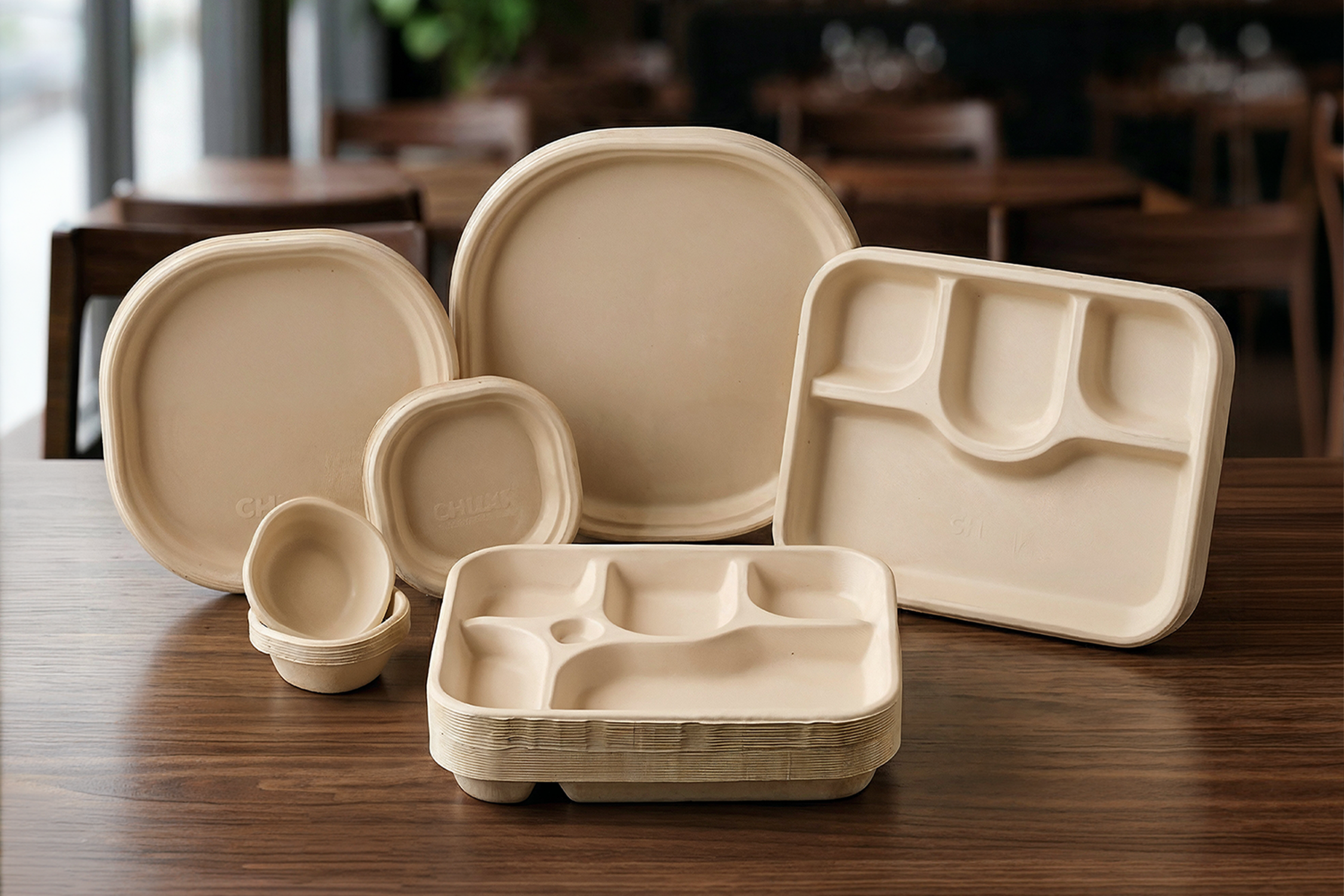
You don’t need just one container size. A working restaurant typically needs clamshells (500ml, 750ml, 1000ml) for main courses, compartment trays (3, 4, or 5 sections) for thalis and combos, bowls for curries, plates in at least two sizes for dine-in, wooden cutlery for delivery orders, and drinkware.
Getting all of this from one supplier is far more efficient than cobbling it together from five different vendors. To give you an idea of what a full range looks like, here’s what Chuk offers across delivery containers, clamshells, meal trays, bowls, plates, and cutlery. Ask any supplier upfront whether they can cover your full range.
How to place your first bulk order
Step 1: Audit what you’re currently spending
Before switching anything, know your baseline. Track every packaging item you buy for one month — what containers and sizes you use, how many of each per week, what you pay per unit, and which items leak, break, or get complaints.
Most restaurant owners are genuinely surprised to find they spend 8-10% of operating costs on takeout packaging. Knowing the exact number gives you real leverage when negotiating bulk rates.
Step 2: Figure out your monthly volume
Bulk pricing kicks in meaningfully at 5,000+ units per month. If you’re doing 50-100 delivery orders daily, you probably already cross that threshold once you count all container types.
Quick math for a mid-sized restaurant doing 80 delivery orders a day:
- 80 orders x 1.5 containers per order = 120 containers/day
- 120 x 30 days = 3,600 containers/month (just mains)
- Add bowls, cutlery, drinks: 5,000-7,000 units/month total
That puts you comfortably in the bulk pricing zone.
Step 3: Get samples before committing
Any credible supplier will send samples. Test them with your actual food, not water. (If you want to try sugarcane bagasse containers specifically, Chuk’s bulk order page is a good place to start — they ship samples before you commit to a large order.)
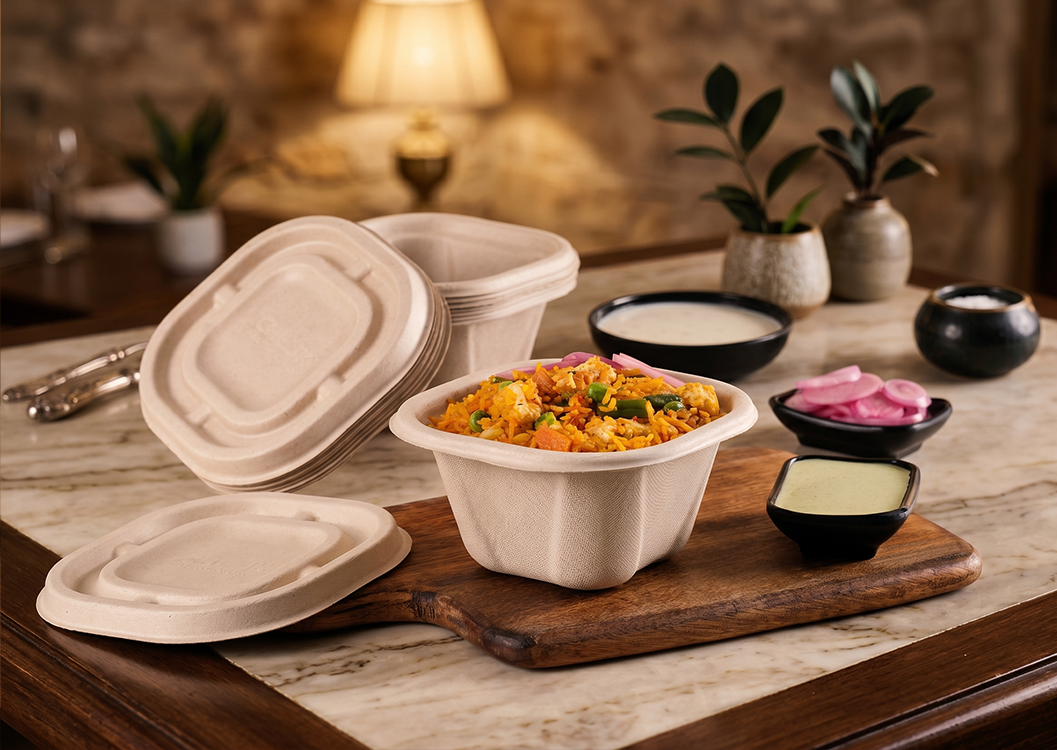
Does the biryani container hold gravy without leaking after 45 minutes? Can the clamshell survive a 20-minute delivery ride in a bike bag? Does the food still smell and taste right after 2 hours? (Some cheap alternatives leach a papery taste that’s hard to miss.) Is it sturdy enough for delivery platforms like Zomato and Swiggy?
Step 4: Negotiate pricing and terms
Ask for monthly contracts rather than per-order pricing. Request tiered pricing across slabs — 5K, 10K, 25K, 50K units/month. Push for NET 15 or NET 30 payment terms instead of advance payment. And check whether the supplier offers custom branding at higher volumes. Your logo on the container is free marketing every time someone opens a delivery.
Step 5: Set up reordering so you don’t run out
The biggest headache with switching is running out mid-week and scrambling for plastic as a backup. Set minimum stock alerts at 2 weeks of inventory, work out an auto-reorder agreement with your supplier, and keep a backup of 500-1,000 units for unexpected spikes. IPL match nights and festival rushes have a way of blowing through your stock faster than you’d expect.
The Zomato and Swiggy angle
Both platforms have been quietly nudging restaurants toward eco-friendly packaging for a while now.
Zomato runs an eco-packaging marketplace that gives compliant restaurants extra marketing visibility on the app. Swiggy has Packaging Assist, which connects partners with vendors of food-grade certified materials.
Neither has made compostable packaging mandatory. Yet. But restaurants that use it do get preferential visibility, and that translates directly to more orders showing up on your KOT printer.
If you’re already working on improving your aggregator listing, switching your packaging is one of the fastest ways to get a visibility bump without spending on ads.
What your customers actually think about packaging
McKinsey’s 2025 Global Packaging Survey (11,000+ respondents, 11 countries) found that 36% of Indian consumers said they’d pay “a lot more” for sustainable packaging — the highest percentage of any country surveyed. Another 49% said “a little more.”
That’s 85% of your customer base saying they won’t mind a few extra rupees per order if it means their food comes in something that doesn’t sit in a landfill for 500 years.
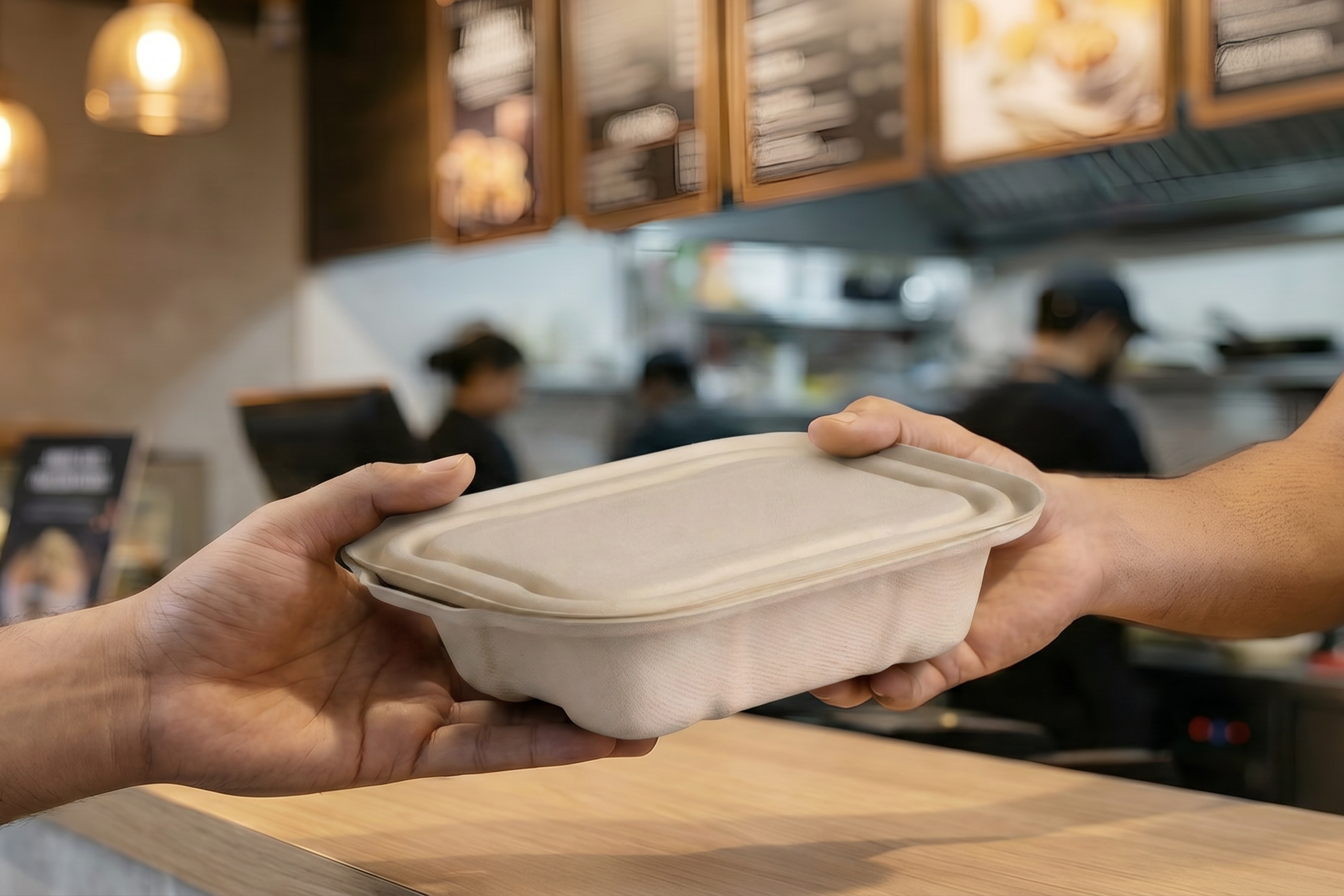
For restaurants, this is a competitive thing. A brown bagasse container with clean branding signals quality the moment someone opens the delivery bag. A flimsy plastic box does the opposite.
Quick comparison: plastic vs compostable
| Factor | Plastic (status quo) | Compostable (bulk) |
|---|---|---|
| Per-unit cost (retail) | Rs 6-10 | Rs 12-18 |
| Per-unit cost (bulk 10K+) | Rs 5-8 | Rs 9-12 |
| FSSAI compliance risk | Increasing | Fully compliant |
| Customer perception | Neutral to negative | Strongly positive |
| Zomato/Swiggy visibility | No benefit | Eco-badge + visibility boost |
| Penalty risk (SUP ban) | Rs 25,000 – Rs 1,00,000 | None |
| Environmental impact | 500+ years to degrade | 180 days to compost |
Mistakes people make when buying in bulk
Ordering only one container size. Your menu has 15 items. Your packaging needs at least 4-5 formats.
Going with the absolute cheapest supplier. Ultra-cheap compostable packaging usually means thin walls, poor oil resistance, and zero certifications. Your customers will notice the soggy bottom. Your FSSAI inspector will notice the missing paperwork.
Skipping the food test. A container that holds water might completely fail with hot sambar. Always test with your real dishes.
Forgetting about storage. Compostable packaging needs dry, cool storage. Unlike plastic, it absorbs moisture if stored carelessly. Plan your storage space before a 10,000-unit shipment shows up.
Switching overnight without telling the kitchen team. Bagasse clamshells close differently from plastic ones. Train your staff, or you’ll end up with half-open containers reaching customers on day one.
Ready to try compostable packaging for your restaurant?
Chuk supplies 200+ restaurant brands across India with sugarcane bagasse packaging — from delivery containers and meal trays to plates and cutlery. All products are food-safe certified, microwave-safe, and tested with hot oil.
Request bulk pricing and samples | WhatsApp: +91 7800056200 | Email: hello@chuk.in
FAQ
How much does compostable packaging cost for a restaurant buying in bulk?
At 10,000+ units per month, sugarcane bagasse packaging runs Rs 9-12 per unit — about 10-15% more than plastic. For a restaurant doing 80 delivery orders daily, the monthly premium works out to Rs 2,000-5,000 over plastic.
Is compostable packaging mandatory for restaurants in India?
Single-use plastic items like plates, cups, and cutlery have been banned since July 2022. The 2026 PWM Amendment Rules tighten things further. Compostable isn’t explicitly mandatory, but FSSAI now classifies packaging as “critical” in inspections. In practice, you need compliant alternatives.
Can compostable containers handle hot and oily Indian food?
Good quality sugarcane bagasse containers are tested to withstand 100-degree oil for 30 minutes without leaking. They’re microwave-safe and freezer-safe too. But not all suppliers meet these specs, so always ask for test reports before ordering.
What’s the minimum order for bulk compostable packaging?
Most suppliers start bulk pricing at 5,000 units per month. Real price breaks typically come at 10,000+, 25,000+, and 50,000+ units. Some will do a smaller trial run of 1,000-2,000 units first.
Do Zomato and Swiggy reward restaurants that use compostable packaging?
Both platforms offer visibility benefits through their eco-packaging programs. It can improve your ranking and order volume on the app, though neither has published exactly how much the boost is worth.
In a Nutshell
The regulatory pressure on plastic packaging isn’t going away. The 2026 PWM Amendment Rules, FSSAI’s “critical” packaging reclassification, and aggregator platform preferences all point one way. But honestly, the compliance angle isn’t even the most interesting reason to switch. At bulk prices, compostable barely costs more than plastic, most of your customers actively prefer it, and it makes your delivery presence look more professional.
Start by auditing what you spend now. Get samples from a bulk supplier. Test them with the greasiest, sauciest dishes on your menu. Then place a bulk order and pay attention to what happens with customer feedback.
And if you’re building a food business from scratch, bake compostable packaging into your setup costs from day one. It’s cheaper to start right than to switch later.