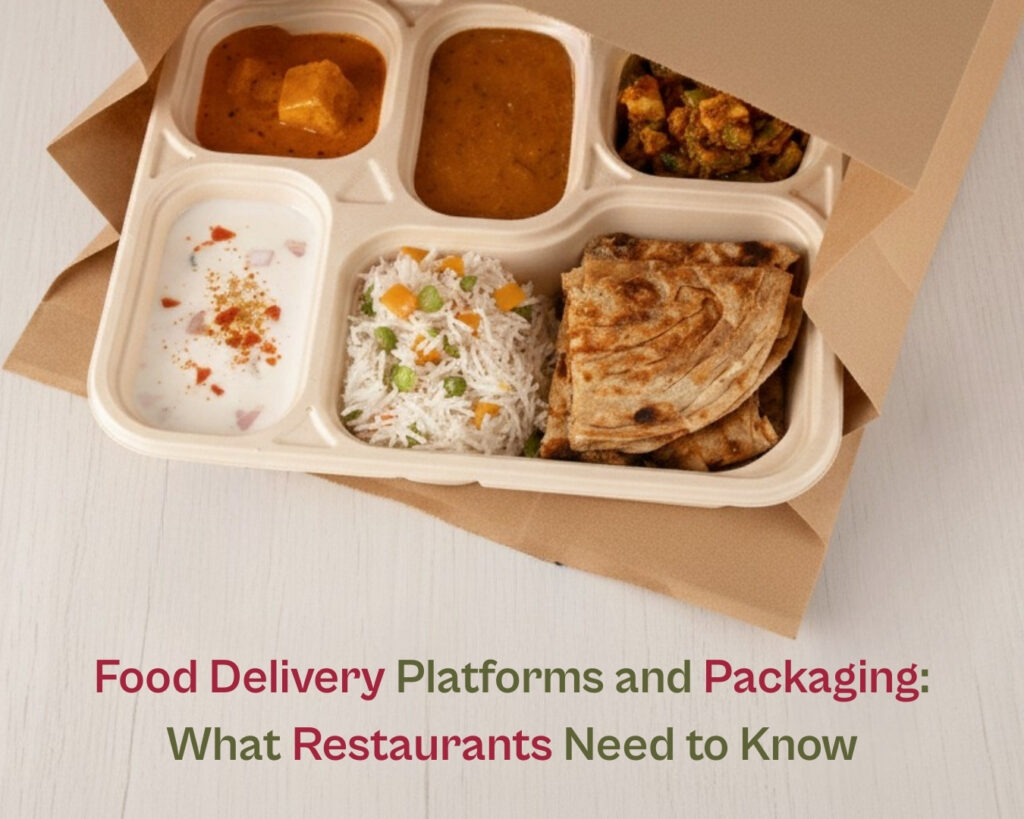
Food Delivery Platforms and Packaging: What Restaurants Need to Know
Here is the honest truth: as a restaurant owner, you could have the best biryani in your city, the crispiest dosa, or the most perfectly layered lasagna. But if it arrives at your customer’s door in a soggy, leaking, or crushed container, none of that matters.
Your Swiggy rating drops. Your Zomato visibility tanks. And the customer who waited 40 minutes for that order? They are not coming back.
Food delivery platforms have quietly become the biggest influence on how Indian restaurants package their food. And what they don’t tell you is that packaging decisions directly affect your revenue, your ratings, and your long-term survival on these platforms.
Let us break down exactly what is happening, what these platforms expect, and how you can turn packaging from a cost centre into a competitive advantage.
Why Delivery Platforms Care About Your Packaging
This is not about platforms being difficult. It is about money — theirs and yours.
Every leaked container, every crushed samosa box, every cold biryani that arrives lukewarm generates a customer complaint. That complaint costs the platform a refund. It costs you a negative review. And it costs both of you a repeat customer.
Here is what delivery aggregators are now actively monitoring:
- Food safety compliance — Your packaging must prevent contamination, leakage, and spoilage during transit
- Material standards — Only food-grade, non-toxic materials are acceptable
- Temperature retention — Hot food must stay hot, cold food must stay cold
- Sustainability credentials — Platforms are increasingly favouring restaurants that use compostable disposables over single-use plastic
- Proper labelling — Allergen warnings, reheating instructions, and clear branding
The days of stuffing food into any available container and handing it to a delivery rider are over.
What They Don’t Tell You: The Hidden Penalties
Most restaurant owners think packaging penalties are limited to the occasional customer complaint. The reality is far more systematic.
How Platforms Penalise Poor Packaging
| Violation | Consequence |
|---|---|
| Repeated leakage complaints | Lower search ranking on the platform |
| Non-food-grade materials flagged | Temporary listing suspension |
| Missing allergen labels | Regulatory warning + platform notice |
| Excessive customer refunds due to packaging | Reduced delivery radius or priority |
| Ignoring sustainability mandates | Loss of “green” or “eco” badges |
Platforms may audit your restaurant randomly or based on customer complaint patterns. And here is the part that stings — once your listing visibility drops, climbing back up is significantly harder than maintaining your position in the first place.
Think of it this way: you are essentially paying rent on these platforms through commissions. Poor packaging is like letting the roof leak in a shop you are paying premium rent for.
The 5 Packaging Mistakes Restaurants Keep Making
As a restaurant owner, you are already managing a hundred things. Packaging often falls to the bottom of the priority list. But these common mistakes are costing restaurants real money every single day.
1. Using Flimsy, Leak-Prone Containers
That thin plastic container might save you Rs 1-2 per order. But when gravy leaks through the bag and ruins a customer’s car seat, you have lost a customer worth thousands in lifetime value.
The fix: Use containers with proper sealing — tight-fitting lids, compartmented trays for gravy-heavy items, and leak-proof closures.
2. Choosing Non-Food-Grade Materials
Here is something alarming: many disposable containers sold in wholesale markets contain chemicals that leach into hot food. These are not just unsafe — they violate FSSAI standards and can get your listing pulled.
The fix: Always verify that your containers are food-grade certified. Look for BIS markings or compostable certifications.
3. Ignoring Temperature Control
Dal that arrives cold. Ice cream that arrives melted. These are not delivery rider problems — they are packaging problems.
The fix: Use insulated containers for temperature-sensitive items. Compartmented meal trays with proper lids help maintain temperature across longer delivery distances.
4. Skipping Labels and Instructions
A customer with a nut allergy receives your dish with no allergen information. A family reheats a container that was not microwave-safe. These situations create liability issues that go far beyond a bad review.
The fix: Include allergen warnings, reheating instructions, and storage guidance on your packaging. It takes minimal effort but protects both your customers and your business.
5. Treating Sustainability as Optional
This is the biggest shift happening right now. Platforms like Swiggy and Zomato are actively promoting restaurants that use compostable disposables and sustainable packaging. Some cities are already enforcing single-use plastic bans.
The fix: Switch to compostable disposables made from bagasse (sugarcane fibre) or similar plant-based materials. They perform just as well as plastic for most food types, and they send a clear message to eco-conscious customers.
What Swiggy, Zomato, and Other Platforms Actually Expect
Let us get specific. While each platform has its own guidelines, here is what the major Indian delivery aggregators consistently require:
Non-Negotiable Requirements
- Sealed packaging that prevents spillage during transit
- Food-grade certified materials that comply with FSSAI standards
- Tamper-evident seals or stickers — customers want to know their food was not opened during delivery
- Proper portion-to-container ratio — oversized containers lead to food movement and damage; undersized containers lead to leaks and spills
Strongly Encouraged Practices
- Using compostable disposables instead of single-use plastic
- Brand-consistent packaging that creates a professional impression
- Including reheating instructions for items that travel well when reheated
- Separate packaging for items at different temperatures (hot curry vs cold raita)
What Earns You Bonus Points
- Restaurants that adopt verified sustainable packaging often receive platform badges or “eco-friendly” tags
- Consistent positive packaging feedback from customers boosts your algorithmic ranking
- Some platforms are testing sustainability-based sorting filters — restaurants with compostable packaging appear higher
How to Build a Delivery Packaging System That Works
Stop thinking about packaging as a per-order decision. Build a system, and your kitchen staff will never have to guess.
Step 1: Audit Your Current Packaging
Walk through every item on your delivery menu. For each dish, ask:
- Does the current container hold this food without leaking for 30-45 minutes?
- Does it maintain temperature?
- Is it food-grade and certified?
- Is it appropriately sized?
- Does it look professional when the customer opens it?
If the answer to any of these is no, that dish needs a packaging upgrade.
Step 2: Match Containers to Food Types
Different dishes need different solutions. Here is a practical guide:
| Food Type | Packaging Need | Recommended Solution |
|---|---|---|
| Gravies and curries | Leak-proof, heat-retaining | Deep containers with tight lids and compartments |
| Dry items (rotis, parathas) | Ventilation to prevent sogginess | Clamshell containers with slight venting |
| Rice dishes (biryani, pulao) | Volume + heat retention | Round meal bowls with secure lids |
| Combo meals | Separation of wet and dry | Compartmented meal trays |
| Desserts and cold items | Insulation from hot items | Separate packaging, never stacked with hot containers |
| Beverages and soups | Absolute leak-proofing | Sealed cups with double-lid systems |
Step 3: Train Your Kitchen Staff
This is where most restaurants fail. You can buy the best containers in the world, but if your staff keeps overfilling them or using the wrong lid, you are back to square one.
- Assign a packaging lead for every shift
- Create a simple visual guide showing which container goes with which dish
- Run a 15-minute training session every month to reinforce standards
- Track packaging-related complaints and address patterns immediately
Step 4: Set Up a Review Cycle
Check your delivery platform dashboards weekly. Look for:
- Packaging-related complaints or refund requests
- Rating trends that might indicate container issues
- Customer comments mentioning spillage, temperature, or presentation
- Any platform notifications about compliance
Restaurants that review packaging performance monthly see measurably fewer complaints within a single quarter.
Why Compostable Disposables Are the Smart Business Move
Let us set aside the environmental argument for a moment. Purely from a business perspective, switching to compostable disposables makes sense right now.
The Business Case
- Platform preference: Delivery aggregators are actively promoting sustainable restaurants. This translates to better visibility and more orders.
- Customer preference: A growing segment of urban Indian consumers actively choose restaurants that use compostable packaging. They check. They notice. And they tip better.
- Regulatory trajectory: Single-use plastic bans are expanding across Indian states and municipalities. Switching now means you avoid a forced, rushed transition later.
- Cost parity: The price gap between compostable disposables and plastic containers has narrowed significantly. When you factor in the value of better ratings and increased orders, compostable often comes out ahead.
- Brand differentiation: In a market where every restaurant on Swiggy looks similar, sustainable packaging is a visible differentiator that customers remember.
What About Performance?
Here is the concern most restaurant owners have: “Will compostable containers hold up as well as plastic?”
The honest answer is yes — modern bagasse-based compostable disposables handle heat, oil, and moisture effectively. Chuk’s range of compostable containers is specifically designed for Indian food service, which means they handle gravy, oil, and high temperatures without compromising structural integrity.
They are microwave-safe, freezer-safe, and they hold their shape during delivery transit. The only thing they do differently from plastic is break down naturally in 90 days instead of sitting in a landfill for 500 years.
Integrating Packaging Into Your Food Safety Culture
Good packaging is not a separate checklist item. It is part of your overall food safety and hygiene practice.
Restaurants that treat packaging as integral to their food safety management system benefit from:
- Fewer complaints and higher ratings — consistency in packaging reduces variability in customer experience
- Smoother FSSAI inspections — proper food-grade packaging documentation makes compliance straightforward
- Stronger brand credibility — customers associate quality packaging with quality food
- Operational efficiency — a standardised packaging system reduces kitchen chaos during peak hours
If you already have a food safety supervisor, add packaging audits to their checklist. If you do not, consider designating someone. The investment in time pays for itself within weeks.
What Happens Next: The Future of Delivery Packaging in India
The trajectory is clear. Here is what you should prepare for:
- Mandatory compostable packaging in more Indian cities — what is currently encouraged will become required
- Platform-level sustainability scoring — aggregators will likely introduce visible sustainability ratings for restaurants
- Digital compliance certificates — expect platforms to require uploaded proof of packaging certifications
- Consumer-driven demand — the “eco-conscious consumer” segment is growing at double digits in metro cities
- Packaging as marketing — branded compostable packaging with your restaurant’s identity will become standard
The restaurants that move early do not just avoid penalties. They capture market share from competitors who are still scrambling to catch up.
Internal link suggestions:
– How to Choose the Right Compostable Delivery Container for Your Business
– Benefits of Switching to Compostable Delivery Containers
– Packaging Your Food for Delivery: Tips and Tricks
– A Simpler Way to Start Eco-Friendly Food Delivery
– 8 Tips to Reduce Food Waste as a Restaurant Owner
In a Nutshell
- Delivery platforms like Swiggy and Zomato are actively monitoring and penalising restaurants with poor packaging practices — this directly affects your visibility, ratings, and revenue.
- The five most common packaging mistakes are flimsy containers, non-food-grade materials, poor temperature control, missing labels, and ignoring sustainability requirements.
- Building a packaging system (audit, match containers to food types, train staff, review monthly) eliminates guesswork and reduces complaints.
- Compostable disposables are no longer just an environmental choice — they are a business advantage that improves platform ranking, customer loyalty, and regulatory readiness.
- The future of food delivery packaging in India is compostable, certified, and branded. Moving early gives you a competitive edge that late adopters cannot easily replicate.
Frequently Asked Questions
Can delivery platforms actually penalise my restaurant for poor packaging?
Yes. Platforms like Swiggy and Zomato can lower your search ranking, temporarily suspend your listing, reduce your delivery radius, or flag your restaurant based on packaging-related complaints. These are not theoretical penalties — they happen regularly to restaurants with consistent packaging issues.
What packaging materials do delivery platforms prefer?
Platforms require food-grade, non-toxic materials that comply with FSSAI standards. Increasingly, they prefer and promote restaurants using compostable disposables over single-use plastic. Some platforms offer eco-badges or improved visibility to restaurants that verify their sustainable packaging practices.
How much more do compostable disposables cost compared to plastic?
The price gap has narrowed considerably. Depending on the container type and order volume, compostable disposables from bagasse (sugarcane fibre) typically cost only marginally more than plastic equivalents. When you factor in better platform rankings, fewer complaint-driven refunds, and customer preference for sustainable packaging, the total cost of ownership often favours compostable options.
Do compostable containers handle Indian food well — gravies, oil, and high heat?
Modern bagasse-based compostable disposables are specifically engineered for food service applications. They handle oil, moisture, and temperatures up to 120 degrees Celsius without losing structural integrity. They are also microwave-safe and freezer-safe, making them suitable for virtually every Indian cuisine type.
What is the easiest first step to improve my restaurant’s delivery packaging?
Start with an audit. Go through every item on your delivery menu and test whether the current container keeps the food intact, warm, and presentable after a 30-45 minute delivery window. Replace the containers that fail this test first — typically gravy items and combo meals see the most improvement. Then standardise your packaging choices so kitchen staff do not have to decide on the fly during rush hours.
How do I train my kitchen staff on proper packaging practices?
Keep it simple and visual. Create a one-page chart showing which container goes with which dish category. Post it at the packing station. Run a 15-minute refresher each month. Assign one person per shift as the packaging lead who checks containers before they go out. Track packaging complaints weekly and address repeat issues immediately.
Will switching to compostable packaging really improve my ratings on Swiggy or Zomato?
It contributes meaningfully. Compostable containers from reputable manufacturers perform well during transit, which reduces spillage and temperature complaints. Also, many customers actively notice and appreciate sustainable packaging — some mention it in reviews. Platforms are also algorithmically boosting restaurants with sustainability credentials, so the combined effect on your ratings and visibility is real and measurable.