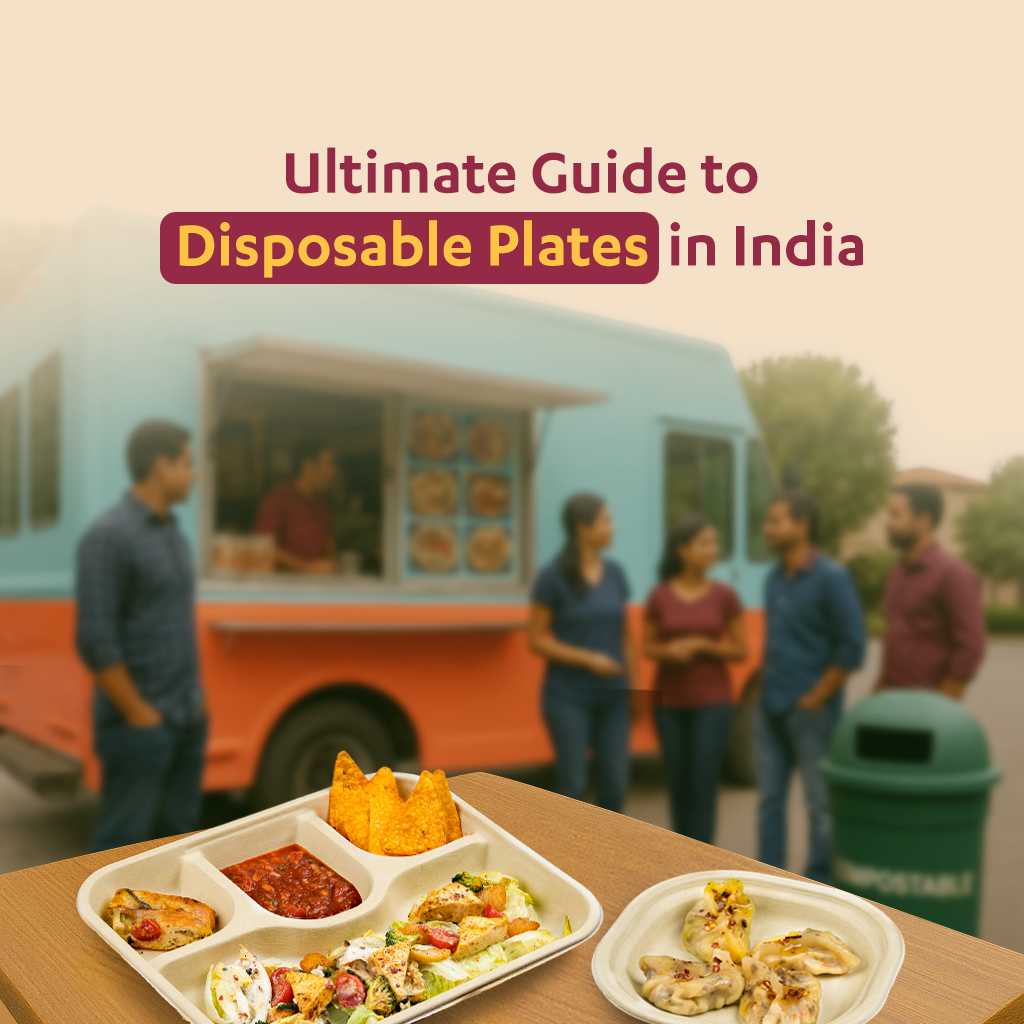
Last updated: 6 October 2026. Plastic-ban facts re-checked against the Plastic Waste Management (Amendment) Rules, 2021.
What are the types of disposable plates in India?
There are six main types of disposable plates sold in India, sorted by what they’re made of. Plastic plates have been banned nationwide since 1 July 2022 under the Plastic Waste Management (Amendment) Rules, 2021, so in practice a buyer today is choosing between the other five. For the full list of banned items and what the 2026 rule changes mean for a kitchen, see our guide to India’s single-use plastic ban for restaurants.
- Paper plates: cheapest, fine for dry snacks, but the ones that hold gravy almost always carry a plastic (PE) lining.
- Plastic plates: polypropylene or polystyrene (thermocol). Banned for sale and use across India since July 2022.
- Sugarcane bagasse plates: moulded from sugarcane fibre, no plastic lining, handle hot and oily food, compostable.
- Areca leaf plates: pressed from fallen areca palm leaves, chemical-free, popular for traditional and premium events.
- Bamboo and wooden plates: the premium end, good looking, expensive for daily volume.
- Corn starch (PLA) plates: plant-based, but soften with hot food and need industrial composting.
Shape matters too. The same materials come as quarter plates, round dinner plates, compartment thalis and snack plates, which we cover further down. If you already know what you need and just want to buy, go straight to Chuk’s compostable disposable plates or the compartment meal plates for thali-style service.
Key Takeaways
- Plastic plates, cups and cutlery are banned across India from 1 July 2022 (MoEFCC, PWM Amendment Rules 2021). It isn’t a state-by-state question any more.
- Bagasse is the only common type that handles hot, oily Indian food without a plastic lining.
- “Plant-based” and “biodegradable” on a label prove nothing. Ask for EN 13432, ASTM D6400 or IS/ISO 17088 test reports.
Why disposable plates are everywhere in India right now
Picture a Saturday wedding in Jaipur serving 3,000 guests, a cloud kitchen in Bengaluru pushing 400 deliveries before lunch, and a chaat stall in Delhi plating faster than the queue grows. All three run on disposable plates. Each of them is making a plate choice that shows up in the margin and the waste bill, whether anyone’s thinking about it or not.
Here’s what’s driving the demand:
- Speed of service. Nobody has to wash, dry or store anything. For a restaurant pushing 200 covers at lunch, that time goes straight back into service.
- Bulk affordability. For weddings, langars and institutional feeding, disposables cut the cost of buying, washing and replacing crockery.
- Hygiene. Single-use plates remove the shared-utensil worry. Customers notice, even if they never mention it.
- Food delivery. Swiggy and Zomato turned every restaurant into a packaging operation. A plate or tray that survives a 30-minute ride is infrastructure now.
- The plastic ban. Once plastic plates went off the legal menu in July 2022, every business still buying disposables had to pick a replacement material.
So disposable plates aren’t going anywhere. The only real question is which type you pick, and whether that pick is working for you or quietly costing you money.
Types of disposable plates by material: pros and cons
The material decides how a plate handles heat, whether it survives oily food, what it costs per piece and what happens after it’s thrown away. Here’s how each type on the Indian market holds up.
1. Paper plates
The most common disposable plate in India. You’ll find them at every kirana store and every household function.
- What they are: Made from cellulose pulp, usually with a polyethylene (PE) or wax coating so they don’t go soggy.
- Best for: Dry snacks and light items like sandwiches, samosas and dhokla.
- Where they fail: Hot, oily or gravy-based food. Without the coating they collapse. With the coating they stop being truly compostable.
About paper plates: most people assume paper means natural. But the coating that makes a paper plate usable with food is usually PE, which is plastic. An uncoated paper plate composts but gives up on anything heavier than a biscuit. A coated one holds the food and doesn’t break down in soil.
For a caterer, that’s a bind. You need performance and you need to meet sustainability expectations, and paper gives you neither fully.
2. Plastic plates
Once the default for bulk catering, canteens and mess halls. Now off the table, legally.
- What they are: Polypropylene (PP), polystyrene (PS) or expanded polystyrene (thermocol).
- Legal status: The Plastic Waste Management (Amendment) Rules, 2021 (notified 12 August 2021) prohibit the manufacture, import, stocking, distribution, sale and use of plastic plates, cups, glasses, cutlery and trays across India from 1 July 2022.
- Where they fail: Everywhere that matters. They don’t biodegrade, and using them now carries fines and seizure risk under state pollution control board enforcement drives.
The scale of the problem explains the ban. CPCB’s annual report for 2019-20 put India’s plastic waste generation at roughly 3.4 million tonnes a year, and single-use items like plates and cups are a visible slice of it. If you’re still buying plastic plates, you aren’t just on the wrong side of the environment. You’re on the wrong side of a national rule.
3. Sugarcane bagasse plates
This is where the market is heading, and fast. Bagasse plates are made from the fibre left after sugarcane juice is extracted, so agricultural waste becomes tableware.
- What they are: Moulded from sugarcane pulp. No plastic lining needed, because the fibre itself gives the plate its strength.
- Best for: Pretty much everything on an Indian menu: hot meals, oily gravies, biryani, dal, fried items and cold desserts.
- Why they stand out: microwave-safe and oven-safe (check the rated temperature on your supplier’s spec sheet), oil-resistant and leak-resistant without a synthetic lining, fine in the freezer for prep-ahead kitchens, and compostable after use.
- Supply: India harvests well over 400 million tonnes of sugarcane a year (Ministry of Agriculture estimates), so raw fibre isn’t a bottleneck.
For a restaurant or caterer, bagasse solves the performance-versus-sustainability problem that paper creates. You get a plate that takes your hottest, oiliest dish without plastic, and it breaks down after disposal.
It does cost a little more per piece than paper. Add in ban compliance, how customers see your brand and zero plastic touching hot food, though, and the maths looks very different.
4. Areca leaf plates
Rooted in South Indian tradition and now popular with eco-minded buyers across the country.
- What they are: Fallen areca palm leaves, cleaned and heat-pressed into shape. No chemicals, coatings or additives.
- Best for: Traditional meals, temple prasadam, eco-themed events and premium catering where the natural look adds value.
- Where they fall short: Higher cost, fewer sizes and shapes, and supply that can swing with region and season.
Areca plates break down in roughly two months under composting conditions. They look lovely on a banana-leaf style spread, and for a temple meal or a South Indian wedding they’re hard to beat.
5. Bamboo and wooden plates
The premium end of the range, for buyers who want looks as well as sustainability.
- What they are: Bamboo pulp, wood veneer or pressed wood fibre. Some are single-use, some are sturdy enough to reuse a few times.
- Best for: Boutique catering, luxury events, corporate hospitality and gifting.
- Where they fall short: Price. They cost several times more than bagasse or paper, which rules them out for high-volume daily use.
Bamboo is one of the fastest-growing plants there is, so the sourcing story is strong. But for most restaurants running on tight margins, these sit in the “nice to have” pile.
6. Corn starch (PLA) plates
A newer entrant, often sold as the next generation of compostable disposables.
- What they are: Usually PLA (polylactic acid) made from corn starch, sometimes blended with other polymers.
- Best for: Cold food and room-temperature items.
- The catch: PLA starts to soften at around 55-60 degrees Celsius, well below the temperature of freshly served dal or biryani. It also needs industrial composting to break down, not a backyard heap.
So be careful with corn starch plates if your menu is hot. The label says “plant-based” and rarely mentions the heat limit.
Types of disposable plates by shape and size
Material is half the decision. Shape is the other half, and it’s where a lot of bulk orders go wrong. Here are the common formats you’ll be offered, whatever the material.
- Quarter and snack plates (6-7 inch): chaat, starters, cake slices, sweets at a pooja. The smallest and cheapest format.
- Round dinner plates (9-12 inch): the standard meal plate. A 10 or 12 inch plate carries a full rice-and-curry serving without spilling over the rim.
- Compartment plates and thalis (3, 4, 5 or 8 sections): keep dal, sabzi, raita and rice apart. The default for weddings, langars, canteens and corporate lunches. See Chuk’s compartment meal plates.
- Oval and rectangular platters: buffets, biryani and grilled items that need length rather than depth.
- Meal trays with lids: for delivery and takeaway, where a plate alone won’t survive the ride.
A simple rule from what we see in kitchens: if there’s more than one wet item on the plate, go compartment. If the food travels, go tray with a lid. Everything else can sit on a round plate.
Comparison table: disposable plate types head to head
This table compares how each material performs with Indian food.
| Feature | Paper Plates | Plastic Plates | Bagasse Plates | Areca Leaf Plates | Bamboo/Wood Plates | Corn Starch Plates |
|---|---|---|---|---|---|---|
| Material | Cellulose + coating | Petrochemical polymers | Sugarcane fibre | Dried palm leaves | Bamboo/wood pulp | PLA from corn |
| Hot Food Performance | Poor to Medium | Medium | Excellent | Good | Good | Poor |
| Oil Resistance | Low (without coating) | High | High (natural) | Medium-High | Medium | Low-Medium |
| Microwave Safe | No (coated types) | No | Yes | Limited | Limited | No |
| Compostable | Only if uncoated | No | Yes | Yes | Yes | Industrial only |
| Plastic-Free | Usually no | No | Yes | Yes | Yes | Technically no (PLA) |
| Cost per Unit (Bulk) | Rs 1-2 | Rs 1-3 | Rs 2-4 | Rs 3-6 | Rs 5-15 | Rs 3-5 |
| Availability in India | Very High | Illegal to sell since July 2022 | Growing Fast | Regional | Niche | Limited |
| Legal Status | Allowed (check the coating) | Banned nationwide (PWM Amendment Rules 2021) | Allowed | Allowed | Allowed | Allowed; compostable claims need certification |
| Sustainability Score | 2/5 | 0/5 | 5/5 | 4/5 | 4/5 | 2/5 |
The takeaway: if you need one plate that takes everything Indian food throws at it, stays legal and actually breaks down after use, bagasse is the everyday winner. Areca and bamboo are excellent for particular occasions. Paper and corn starch carry limits most buyers only find out about after the order arrives.
What should you check before buying disposable plates?
Buying plates looks simple until 5,000 of them fold under your dal makhani. Here’s the checklist that saves you from that.
Material and compostability
This is the single most important factor. Ask:
- Does the plate need a coating to work? If yes, find out exactly what it is. PE means plastic. PLA means industrial composting only. No coating needed, as with bagasse, means genuinely plastic-free.
- Is the “compostable” claim certified? Look for EN 13432, ASTM D6400 or IS/ISO 17088 test reports. Without one, “compostable” is just a word on the box.
- Does it match how your waste is handled? If your city has no industrial composting, a plate that needs it behaves like plastic in your bin.
Heat and oil resistance
For a restaurant or caterer this one isn’t negotiable:
- Test with your real menu. A plate that holds dry puri might give up on chole. Always test your heaviest, oiliest dish before a bulk order.
- Check the temperature rating. Ask for the supplier’s rated limit in writing. PE-coated paper starts to struggle with very hot food, and PLA softens around 55-60 degrees Celsius.
- Oil soak-through time matters. A plate that holds biryani for 5 minutes is useless on a buffet line. You want at least 30 to 45 minutes.
Certifications that matter
Certifications separate real products from marketing:
- Food-contact safety, with the manufacturer’s FSSAI licence and food-contact test reports
- ISO certifications for manufacturing quality
- Compostability (EN 13432, ASTM D6400 or IS/ISO 17088)
- FDA compliance if you export or serve international clients
If a supplier can’t produce the paperwork when asked, that tells you what you need to know.
Bulk pricing and packaging
Smart buying starts with the economics:
- Bulk packs (500 to 5,000 units) usually cost noticeably less per plate than retail packs. Ask for slab pricing.
- Storage matters. Paper plates soak up moisture in humid weather. Bagasse is more stable. Think about where the cartons will sit before ordering a season’s worth.
- Look at the outer packaging. Compostable plates shrink-wrapped in plastic undo half the story. Ask whether the outer pack is recyclable or compostable too.
Buying for a kitchen in Delhi or Bengaluru? We have city pages with local delivery details for disposable plates in Delhi and disposable plates in Bengaluru.
Branding and customisation
Plates are also packaging, and diners see them:
- Bagasse and paper surfaces take custom printing and embossing well.
- Areca and wooden plates are harder to brand, but the natural look becomes the statement.
- Branded plates lift perceived value and remind every diner that you chose compostable.
Which disposable plate suits which occasion?
Weddings and large-scale catering
Indian weddings serve thousands of meals in one evening. You need a plate that carries paneer, biryani, dal and raita together, is affordable in bulk and is easy to clear away.
Best choice: bagasse compartment plates. They keep dishes apart, handle heat and oil, and cleanup is simple. No plastic waste left behind at a celebration.
QSRs, cloud kitchens and food delivery
Speed, consistency and surviving the ride are what count. Your packaging has to get through a 30-minute delivery without leaking or going soggy.
Best choice: bagasse plates and containers with fitted lids. They stack well, the customer can reheat in them, and they hold up under the toughest menu items.
Office events and corporate catering
Corporate clients care how it looks. Plastic at a corporate event sends the wrong message, and it’s illegal anyway.
Best choice: bagasse for everyday corporate catering; areca or bamboo for premium executive events where presentation counts as much as the food.
Street food and small vendors
Budget is king. So is staying on the right side of local enforcement drives.
Best choice: uncoated paper plates for dry items and bagasse bowls and plates for anything wet. That mix keeps costs down and keeps you legal.
Schools, hospitals and institutional feeding
Consistent quality, food-contact safety and low cost at huge scale. These buyers can’t afford to experiment.
Best choice: bagasse plates in bulk, with the supplier’s food-contact test reports on file. Large feeding programmes and NGO food drives are moving the same way.
How much do disposable plates cost in India?
Bulk prices in 2026 run from under Rs 1 a piece for uncoated paper to Rs 15 for bamboo, with bagasse in between at roughly Rs 2 to 4.50. Vague promises of “affordable pricing” help nobody, so here are the numbers and what moves them.
What drives the price
- Material: bagasse costs more than paper but less than bamboo.
- Thickness: a heavier plate is sturdier and costs more. A thin paper plate holds biscuits; a thicker bagasse plate holds biryani. Know which you need.
- Design: compartments, embossing, custom printing and special shapes all add cost.
- Certification: certified compostable, food-contact-tested products often carry a small premium. That premium buys compliance and customer trust.
Approximate price ranges (bulk, 2026)
| Plate Type | Price per Unit (Bulk) | Best Value For |
|---|---|---|
| Paper (uncoated) | Rs 0.80 – 1.50 | Dry snacks only |
| Paper (PE-coated) | Rs 1.00 – 2.00 | Light meals (not truly compostable) |
| Plastic | Not legally sold since July 2022 | Banned nationwide |
| Bagasse | Rs 2.00 – 4.50 | All-purpose, best value |
| Areca Leaf | Rs 3.00 – 7.00 | Premium events, eco niche |
| Bamboo/Wood | Rs 5.00 – 15.00 | Luxury and boutique |
| Corn Starch (PLA) | Rs 3.00 – 6.00 | Cold food only |
These are indicative market ranges, and they move with order size, season and freight. Always get a written quote.
The cost vs sustainability calculation
Yes, bagasse costs more than paper per piece. Here’s the part most buyers skip:
- Compliance. A single fine or seizure under the plastic ban can cost more than months of bagasse plates.
- Brand value. Customers notice compostable tableware, and it shows up in reviews and repeat visits.
- Waste handling. Compostable plates cut the non-degradable waste you produce, which matters more as cities tighten segregation rules.
- Menu performance. A plate that holds your food means fewer complaints, fewer replacements and less mess during service.
In our experience the cheapest plate on the quote is rarely the cheapest plate by the end of a wedding season, once you count the ones that failed. Do the full sum before you decide.
How do you spot greenwashing in disposable plates?
Not every “eco-friendly” label is true, and greenwashing is common in Indian disposable tableware. The quickest test is to ask for a compostability test report against a named standard. Here are the other red flags.
- “Biodegradable” with no timeframe. Even plastic biodegrades, in centuries. A genuine compostable product names a standard and a timeframe, typically within 180 days in industrial composting.
- “Plant-based” with no material named. PLA is plant-based but behaves like plastic under heat and needs industrial composting. The label should say exactly what the plate is.
- No certification anywhere. If a brand claims compostability but can’t show EN 13432, ASTM D6400 or IS/ISO 17088 results, be sceptical.
- Green boxes, no substance. The colour of the carton says nothing about the plate inside it.
Asking for certificates isn’t rude. It’s good buying, and any legitimate manufacturer will share them.
In a Nutshell
Choosing disposable plates in India isn’t one-size-fits-all any more. The rules changed in 2022, the materials have multiplied and customers notice what you serve on.
- Paper plates work for dry snacks, but most of the ones that hold gravy hide a plastic coating.
- Plastic plates are banned across India from 1 July 2022. That question is settled.
- Bagasse (sugarcane) plates give the best mix of performance, safety, cost and real compostability for everyday volume.
- Areca and bamboo plates are lovely for premium occasions but not practical for daily service at scale.
- Pick the shape as carefully as the material: compartments for multi-dish meals, lidded trays for delivery.
- Always ask for certificates. “Eco-friendly” on a label means nothing without a test report.
If you want compostable plates that handle real Indian food, Chuk’s sugarcane bagasse range is built for exactly that, from daily deliveries to the biggest wedding you’ll ever cater.
Frequently Asked Questions
What are the different types of disposable plates?
The six common types in India are paper, plastic, sugarcane bagasse, areca leaf, bamboo or wood, and corn starch (PLA) plates. Plastic plates are banned nationwide from 1 July 2022, so buyers now choose among the other five. By shape, you’ll see quarter plates, round dinner plates, compartment thalis, platters and lidded meal trays.
Which disposable plates are best for hot, oily Indian food?
Sugarcane bagasse plates handle hot, oily food best. The fibre resists oil without any plastic lining, and bagasse is microwave- and oven-safe within the supplier’s rated limit. Paper plates usually need a PE lining to cope with oil, and PLA softens around 55-60 degrees Celsius. Areca leaf plates also work well but cost more in bulk.
Are paper disposable plates actually compostable?
It depends on the coating. Uncoated paper plates compost but can’t handle wet or oily food. Most paper plates that work with food have a polyethylene (PE) or PLA coating that stops them composting normally. If a paper plate holds hot dal without collapsing, it almost certainly has a plastic-based lining. Check the specification before assuming it’s compostable.
Is it legal to use plastic disposable plates in India?
No. The Plastic Waste Management (Amendment) Rules, 2021, notified by the Ministry of Environment on 12 August 2021, ban the manufacture, import, stocking, distribution, sale and use of plastic plates, cups, glasses, cutlery and trays across India from 1 July 2022. State pollution control boards and municipal bodies enforce it, with fines and seizures.
How much do compostable disposable plates cost?
Bagasse plates typically cost about Rs 2 to 4.50 each in bulk in 2026, against Rs 0.80 to 2 for paper plates and Rs 3 to 7 for areca leaf. Prices move with size, compartments, order volume and freight, so get a written quote. Since plastic plates can’t legally be sold, the real comparison is bagasse against paper and areca.
Can disposable plates be microwaved safely?
Sugarcane bagasse plates are microwave-safe because they contain no metal or plastic layers. Plastic and thermocol plates should never be microwaved, as they can release harmful chemicals when heated. PE-coated paper plates are also risky. If your customers are likely to reheat their food, bagasse is the safest common material.
What certifications should I look for when buying disposable plates in bulk?
Ask for the manufacturer’s FSSAI licence and food-contact test reports, compostability certification such as EN 13432, ASTM D6400 or IS/ISO 17088, and ISO manufacturing certifications. Exporters may also need FDA compliance. These documents back up the food-safety and environmental claims, and any reputable manufacturer will share them on request.
Which disposable plate is best for weddings and large catering?
Bagasse compartment plates are the usual choice for large Indian weddings. They carry heavy gravies and fried items together without bending, keep dishes separated in their sections and are easy to source in bulk. Since they compost after use, post-event cleanup leaves no plastic waste behind.
Related reading
- Are Disposable Plates Safe for Hot Food?
- How to identify best disposable plates?
- Hosting a Diwali 2026 Party: Ideas, Menu and Tips
Moving off plastic usually starts with the plate
The plate is where most kitchens start when they move off plastic. CHUK’s compostable bagasse plates take hot, oily and wet food without going limp, and they compost after use.
Browse compostable plates | Order a sample box | Get pricing on WhatsApp